


Liverpool Pals Who Died on This Day

From: Weston Rhyn, Salop
K.I.A (110 Years this day)
Wednesday 18th October 1916.
25 years old
William Joseph Blayney was born in the second quarter of 1891 in Weston Rhyn, Salop, the youngest son of the son of John Blayney and his wife Margaret (née Pryce or Price) who were married in 1871, the marriage was registered in Llanfyllin.
William was baptised on the 05th July 1891 the family residence is listed as The Lodge parish (which includes Weston Rhyn), his father’s occupation gardener. His parents were born in Guilsfield, Montgomeryshire (sometimes shown as Welshpool on censuses). The surname is spelt variously on records as Blaney, Blainey, etc.
His mother appears to have had a daughter before her marriage, Sarah J., born in 1868. His parents had four children, all boys. William’s older brothers were John, born in 1872, David, 1881, and Edward Richard(s), 1886, all born and baptised in Guilsfield, their parents’ residence given as Broniarth.
On the 1881 census the Blainey family are living at Pentrelisydd?, Guilsfield. Father john is aged 29, a labourer born Guilsfield, mother Margaret is 34 born Welshpool, children Sarah J. aged 12 born Llanfyllin, and John aged 9 born Guilsfield. John was baptised as Blainey on the 21st January 1872.
At the time of the 1891 census, shortly before William’s birth, his parents are living in The Lodge parish, Oswestry, 18 miles north of Guilsfield, with David 9, and Edward 4. His father, 38 is a general labourer, and his mother is 43.
His mother, Margaret, died in 1899 aged 53.
The 1901 Census shows the family living at Tynyrhos Cottages, Quinter, Weston Rhyn, Oswestry. His father, John, is a widower aged 48, who was born in 1853 in Montgomeryshire, Wales and is a general agricultural labourer. He is living with William Joseph who is aged 9, and is a scholar. They also have a housekeeper named Eliza Holmes who is aged 61, born in 1840.
By 1911 William has moved to Southport, north of Liverpool, boarding with widow Esther Ball at 101 Sussex Road. He is 19, and employed as a grocer’s assistant.
His father, 58, is living alone at Tynyrhos Cottage, working at home as a labourer (wood work). He provides the information that he was married 40 years ago, and has four children, all still alive.
William Joseph enlisted in Liverpool and was serving in the 18th Battalion, The King’s Liverpool Regiment as Private No 32713 when he was killed in action on the 18th October 1916, aged 25, during the Battle of the Transloy Ridges which was part of the ongoing Somme Offensive.
18th Bn Diary
18th October 1916
Attacked German trenches commencing 3.40 am. Relieved by 19th Manchester Regt. Took up position in support Bn trenches W. of Goose Alley.
Graham Maddocks in his book Liverpool Pals gives an overview of the events of the day:
“At 3.40 am the whistles blew, and the Battalion left its assembly trenches, in three waves, approximately fifty yards apart, and began to cross No Man’s Land. Almost immediately, the German Barrage fell on the first wave and halted its advance, so that the second wave soon caught up with it. This was not a great problem at first, and the two combined waves were able to advance together for about 300 yards, whereupon they encountered the German Grid Trench system. On the right of the advance, it was found that the wire was largely intact, apart from a few gaps, and the Germans bombed and machine gunned these gaps, which prevented any further progress. Elsewhere along the trench, however, the wire was cut and there did not seem to be any serious opposition. Nevertheless, the men hesitated to jump down into the German trenches, and instead, began to filter back across to the safety of their own lines.
By this time the third wave had caught up, as had a fourth wave, which had been detailed to mop up any opposition once the trenches had fallen, and all four waves became intermingled which added to the confusion. No less than three attempts were made to try to get the men to go forward again, but each attempt became markedly less successful than its predecessor, and eventually the attack came to a standstill. Although the British assembly trenches had received the attention of the German guns, the attackers in No Mans Land had not come under any great intensity of fire up until this point.
However, once it became obvious to the Germans that the attack was disorganised and faltering, they began to fire into the massed men from the flanks. It was probably this that finally settled the issue and convinced the Pals that they could no longer gain the enemy trenches, and all four waves, now merged into one, began to retreat to their own lines. The whole attack had been an abysmal failure, and no ground had been gained at all”.
He has no known grave and is commemorated on the Thiepval Memorial, France.
The Thiepval Memorial, the Memorial to the Missing of the Somme, bears the names of more than 72,000 officers and men of the United Kingdom and South African forces who died in the Somme sector before 20 March 1918 and have no known grave. Over 90% of those commemorated died between July and November 1916.
On 01st August 1932 the Prince of Wales and the President of France inaugurated the Thiepval Memorial in Picardy. The inscription reads: “Here are recorded the names of officers and men of the British Armies who fell on the Somme battlefields between July 1915 and March 1918 but to whom the fortune of war denied the known and honoured burial given to their comrades in death.”…
William had served at most one year before he was killed.
The Medal Roll shows his name as Wm. James; other military records give his middle name correctly as Joseph.
William Joseph Blayney is commemorated on Weston Rhyn War Memorial.
His Army pay and War Gratuity of £3 went to his father John, who was awarded a pension of 10/- a week from July 1917.
His father remarried to Rosamund Lucy Glover in 1930 and in 1939, now 87 and incapacitated, he is living at New Cottage, Weston Rhyn, with wife Lucy Rosamund, aged 68. His son John lives nearby, in Stone Cottage.
His father died a few months later, in March 1940.
We currently have no further information on William Joseph Blayney, If you have or know someone who may be able to add to the history of this soldier, please contact us.

From: Ingrave, Essex
K.I.A (110 Years this day)
Wednesday 18th October 1916.
18 years old
William Bradford was born in Ingrave, Brentwood, Essex. His birth was registered in Battersea, in the September quarter of 1898 as William James Bratford with a T not D in the surname to an unmarried 20 year old domestic servant Emily Mary Bratford. William was baptised at St Mark's Church, Marylebone Road, Camberwell on 06th October 1898 as William James Bradford and not Bratford. The family address was recorded as 75 Denmark Road, Camberwell, there was no father listed in the baptism register.
On the 1901 Census 2 month old Constance Bratford, born Walworth, London, was recorded in one of the three households at 25 Mansion Street, Camberwell. She was living in a single room with her mother, the 22 year old unmarried Emily Bratford, born Ingrave, Essex. Although Emilys’ profession was shown as Domestic General Servant, she was not then recorded as a “Worker”. William, aged 2, is recorded as a Lodger in Cromwell Road, Brentwood with a 74 year old widow Rebecca Cotterill. Next door is 52 year old widowed Sick Nurse, Mary A. Turvey – the woman William would be living with on the 1911 Census.
The April 1911 Census shows William, a schoolboy, aged 12 as a boarder under the surname Bradford living with a 62 year old widowed nurse, Mary Ann Turvey at 12 Cromwell Road, Brentwood. His mother is living at 11 Blucher Road, Camberwell. Head Christopher Henry Smith aged 29, a bricklayer b.Highgate, wife Emily Mary aged 33, children Pheobe Emily 4 born Camberwell, Henrietta Ann 2 born Camberwell, and Constance Bratford 11 born St Peter’s, Walworth. (They went on to have Christina(1911, died), Christopher(1912), Margaret(1915), John(1917) and Pearl(1920).)
He enlisted in Warley, Essex as William Bradford and served originally as Private 18534 of the Lancashire Fusiliers. At some point he was transferred to the 18th Battalion of The King’s Liverpool Regiment as Private No 52464. Based on his War Gratuity of £6 10s he enlisted around April 1915 in Warley, Essex, where Warley Barracks was the depot of the Essex Regiment. Upon mobilization in February 1916 he became Private 18534 of the Lancashire Fusiliers, then around September 1916 transferring to the 18th Battalion of The King’s Liverpool Regiment as Private No 52464 (these dates based on the Pte 52463 18/KLR Alfred Biggs, who has service records.)
William was killed in action on the 18th October 1916, aged 25, during the Battle of the Transloy Ridges which was part of the ongoing Somme Offensive.
18th Bn Diary
18th October 1916
Attacked German trenches commencing 3.40 am. Relieved by 19th Manchester Regt. Took up position in support Bn trenches W. of Goose Alley.
Graham Maddocks in his book Liverpool Pals gives an overview of the events of the day:
“At 3.40 am the whistles blew, and the Battalion left its assembly trenches, in three waves, approximately fifty yards apart, and began to cross No Man’s Land. Almost immediately, the German Barrage fell on the first wave and halted its advance, so that the second wave soon caught up with it. This was not a great problem at first, and the two combined waves were able to advance together for about 300 yards, whereupon they encountered the German Grid Trench system. On the right of the advance, it was found that the wire was largely intact, apart from a few gaps, and the Germans bombed and machine gunned these gaps, which prevented any further progress. Elsewhere along the trench, however, the wire was cut and there did not seem to be any serious opposition. Nevertheless, the men hesitated to jump down into the German trenches, and instead, began to filter back across to the safety of their own lines.
By this time the third wave had caught up, as had a fourth wave, which had been detailed to mop up any opposition once the trenches had fallen, and all four waves became intermingled which added to the confusion. No less than three attempts were made to try to get the men to go forward again, but each attempt became markedly less successful than its predecessor, and eventually the attack came to a standstill. Although the British assembly trenches had received the attention of the German guns, the attackers in No Mans Land had not come under any great intensity of fire up until this point.
However, once it became obvious to the Germans that the attack was disorganised and faltering, they began to fire into the massed men from the flanks. It was probably this that finally settled the issue and convinced the Pals that they could no longer gain the enemy trenches, and all four waves, now merged into one, began to retreat to their own lines. The whole attack had been an abysmal failure, and no ground had been gained at all”.
William's body was not recovered from the battlefield or was subsequently lost as he has no known grave and is commemorated on the Thiepval Memorial to the Missing of the Somme as William Bradford (not Bratford).
The Thiepval Memorial, the Memorial to the Missing of the Somme, bears the names of more than 72,000 officers and men of the United Kingdom and South African forces who died in the Somme sector before 20 March 1918 and have no known grave. Over 90% of those commemorated died between July and November 1916.
On 01st August 1932 the Prince of Wales and the President of France inaugurated the Thiepval Memorial in Picardy. The inscription reads: “Here are recorded the names of officers and men of the British Armies who fell on the Somme battlefields between July 1915 and March 1918 but to whom the fortune of war denied the known and honoured burial given to their comrades in death.”
William Bradford is commemorated on the War Memorial at Herongate, Brentwood, Essex.
We currently have no further information on William Bradford, If you have or know someone who may be able to add to the history of this soldier, please contact us.

From: Liverpool
K.I.A (110 Years this day)
Wednesday 18th October 1916.
30 years old
William Theophilus Broady was born on the 19th October 1885 in Liverpool and was baptised on the 02nd May 1886 at St Silas C. of E. Church, Pembroke Place, Liverpool. He was the son of William Broady and his wife Josephine (nee Ogden) who were married on the 13th October 1885 at St. Chrysostom's Church, Everton. Widower William was a 33 year old coachman, father Matthew deceased, whilst Josephine was aged 22, father Henry, both of 84 Woodville Terrace.
William’s first marriage was to Mary Emma Minshall on the 31st March 1873 at Holy Trinity, Walton. Mary sadly died aged 22 in 1874.
The 1891 Census shows the family are living at 32 Adelaide Street, Liverpool. His father is a 37 year old driver, his mother is 26 years old. They have one child, William T. aged 5 and two boarders.
The 1901 Census finds the family are still living at 32 Adelaide Road, Liverpool. His father, William is a 49 year old van driver born in Liverpool, his mother is 37 years of age and was also born in Liverpool as were their two children. William T is aged 15 and an oil cake maufacturers clerk whilst his sister, Elsie is 7 years of age.
The 1911 Census shows the family living at 2 Falkland Rd, Egremont, Wallasey, Cheshire. His Father William is aged 60, born 1851 and has no occupation but was previously a driver and was born in Liverpool. His wife Josephine is aged 47, born 1864 and they have two children. William who is aged 25, gives his occupation as Tobacco Manufacturers Clerk and Elsie aged 17, born 1894 also a Clerk. They were both born in Liverpool. They have four boarders living at the address, John Richard Smith, a Traveller aged 30, Thomas Platt, a Plumber aged 48, Harold Douglas Hill, a Salesman aged 24 and Frank Dickinson previously a Barman aged 20
He enlisted at St Geroge's Hall in Liverpool on 31st August 1914 joining the 18th Battalion of The King’s Liverpool Regiment as Private No 17046. He gave his age as 28 years and his occupation as a clerk. He was described as being 5' 4 and a half inches tall, weighed 138lbs, 35" chest with a fresh complexion, grey eyes and brown hair. He stated his religion as Church of England, and his next of kin was his father William, 2 Falkland Road, Egremont.
From the 23rd September 1914 he was billeted at Hooton Park Race Course and remained there until 03rd December 1914 when they moved into the hutted accommodation at Lord Derby’s estate at Knowsley Hall. On 30th April 1915 the 18th Battalion alongside the other three Pals battalions left Liverpool via Prescot Station for further training at Belton Park, Grantham. They remained here until September 1915 when they reached Larkhill Camp on Salisbury Plain. He arrived in France on 7th November 1915.
His service record shows the following:
22.8.16 - To 96 Field Ambulance, sick with flu.
24.8.16 - Resumed duty.
18.10.16 - Posted as Missing.
He was killed in action on the 18th October 1916, aged 30, during the Battle of the Transloy Ridges which was part of the ongoing Somme Offensive.
18th Bn Diary
18th October 1916
Attacked German trenches commencing 3.40 am. Relieved by 19th Manchester Regt. Took up position in support Bn trenches W. of Goose Alley.
Graham Maddocks in his book Liverpool Pals gives an overview of the events of the day:
“At 3.40 am the whistles blew, and the Battalion left its assembly trenches, in three waves, approximately fifty yards apart, and began to cross No Man’s Land. Almost immediately, the German Barrage fell on the first wave and halted its advance, so that the second wave soon caught up with it. This was not a great problem at first, and the two combined waves were able to advance together for about 300 yards, whereupon they encountered the German Grid Trench system. On the right of the advance, it was found that the wire was largely intact, apart from a few gaps, and the Germans bombed and machine gunned these gaps, which prevented any further progress. Elsewhere along the trench, however, the wire was cut and there did not seem to be any serious opposition. Nevertheless, the men hesitated to jump down into the German trenches, and instead, began to filter back across to the safety of their own lines.
By this time the third wave had caught up, as had a fourth wave, which had been detailed to mop up any opposition once the trenches had fallen, and all four waves became intermingled which added to the confusion. No less than three attempts were made to try to get the men to go forward again, but each attempt became markedly less successful than its predecessor, and eventually the attack came to a standstill. Although the British assembly trenches had received the attention of the German guns, the attackers in No Mans Land had not come under any great intensity of fire up until this point.
However, once it became obvious to the Germans that the attack was disorganised and faltering, they began to fire into the massed men from the flanks. It was probably this that finally settled the issue and convinced the Pals that they could no longer gain the enemy trenches, and all four waves, now merged into one, began to retreat to their own lines. The whole attack had been an abysmal failure, and no ground had been gained at all”.
William was originally posted as Missing.
His name appeared in the Liverpool Daily Post on Wednesday 29 November 1916 listed amongst the Missing:
Missing.
King’s Liverpool Regiment - Broady, 17046, W. T. (Egremont); Cadwell, 29492 J. J. (Southport); Cromwell, 16706, Corpl. T. L.; Fitzroy, 32741, F; Golothan, 32690, Corpl. W. P. (Chester); Griffiths, 32795, J. W.; Hilditch, 17057, A. J.; Leadsom, 39054, S.; Leighton, 16975, H. N. (Seaforth); Narracott, 17080, F. V.; Orrett, 16984, Sergt. J. S. (Prescot); Poole, 33265, F. (Shrewsbury); Powell, 23167, J.; Rench, 16992, T. F.; Ronson, 16054, G. R.; Speed, 26587, R.; Taylor, 23841, A.
His death was only confirmed by the War Office on 06th June 1917.
His body was not recovered or was subsequently lost as he has no known grave and is commemorated on the Thiepval Memorial in France.
The Thiepval Memorial, the Memorial to the Missing of the Somme, bears the names of more than 72,000 officers and men of the United Kingdom and South African forces who died in the Somme sector before 20 March 1918 and have no known grave. Over 90% of those commemorated died between July and November 1916.
On 01st August 1932 the Prince of Wales and the President of France inaugurated the Thiepval Memorial in Picardy. The inscription reads: “Here are recorded the names of officers and men of the British Armies who fell on the Somme battlefields between July 1915 and March 1918 but to whom the fortune of war denied the known and honoured burial given to their comrades in death.”
Probate was granted on 07th July 1917:-
BROADY William Theophilus of 2 Falkland Road, Egremont, Wallasey Cheshire private 18th Battalion Liverpool Regiment died 18 October 1916 in France or Belgium on active service Administration (with Will) London 7th July to Josephine Broady (wife of William Broady). Effects £144 19s 8d.
His personal belongings were sent to his father in June 1917 and contained; 4 letters, 1 photograph, 3 coins and 1 newspaper cutting.
He was remembered by his family in the Liverpool Echo on Friday 19 October 1917
BROADY- ln loving, but sad, birthday remembrance of Private W. T. Broady (K.L.R.), who was reported missing October 18, 1916, now officially reported killed (on the eve his 31st birthday), the dearly-loved and only son of W. and J. Broady.
The night was dark, and was far from home;
And with the morn his angel face shall smile
Which we have loved long since and lost awhile.
—2, Falkland-road, Egremont.
Also in the Liverpool Echo on Saturday 20 October 1917:
Wallasey Casualties.
Private W. T. Broady (30), K.L.R., whose parents reside at 2, Falkland-road, and who was posted missing of last year, now officially reported killed.
Soldiers Effects and Pension to mother Josephine.
William is commemorated on Ogden’s Tobacco War Memorial, Anfield, Liverpool.
His father died, aged 70, in 1922, and his mother died, aged 71, in 1935.
We currently have no further information on William Theophilus Broady, If you have or know someone who may be able to add to the history of this soldier, please contact us.

From: Liverpool
K.I.A (110 Years this day)
Wednesday 18th October 1916.
22 years old
Thomas Bulfield was born on the 30th May 1894 in Liverpool and was baptised on the 05th August 1894 at St Stephen the Martyr's Church, Liverpool. He was the son of Thomas Bulfield and his wife May Eliza (nee Sherlock) who were married on the 10th February 1890 at St John's Church, Liverpool. Thomas was a 20 year old public house manager, father Thomas, whilst May was aged 18, father James, both of 24 Wakefield Street.
Thomas was educated at St Paul’s School, Seacombe and was employed by Messrs: Bibby & Sons as a Steward aboard the S.S. Warwickshire. He attended St John’s Church in Egremont.
The 1901 Census shows the family living at 2, Ruth Street, Everton, Liverpool. His father, Thomas, is aged 31, was born in Liverpool in 1870 and is a fruit porter in a warehouse, his mother May Eliza is aged 29, born 1872 in Birkenhead and has no occupation listed. They have two children at the time of the Census, Thomas aged 6, and Ethel aged 1, born 1900.
The 1911 Census shows the family living at 207 Wheatland Lane Seacombe Wallasey, Poulton cum Seacombe, Cheshire. His father, Thomas, is aged 41, his occupation is listed as a warehouse porter. His mother ,May, is not present, she is a patient in Victoria Central Hospital, Liscard. They advised that they had been married for 21 years, and had 9 children, 4 of whom have survived. His father, is living with his surviving children; Eliza aged 20, born 1891 and occupation domestic nurse, Thomas William who is a grocer’s assistant, Ethel Mary aged 11 , born 1900 and Amy Francis aged 8, born 1903 and both at school. The three daughters were all born in Birkenhead.
Thomas enlisted in Liverpool and was serving in the 18th Battalion, The King’s Liverpool Regiment as Private No 24646 when he was killed in action on the 18th October 1916 aged 22 during the Battle of the Transloy Ridges which was part of the ongoing Somme Offensive.
18th Battalion Diary
18th October 1916
Attacked German trenches commencing 3.40 am. Relieved by 19th Manchester Regt. Took up position in support Bn trenches W. of Goose Alley.
Graham Maddocks in his book Liverpool Pals gives an overview of the events of the day:
“At 3.40 am the whistles blew, and the Battalion left its assembly trenches, in three waves, approximately fifty yards apart, and began to cross No Man’s Land. Almost immediately, the German Barrage fell on the first wave and halted its advance, so that the second wave soon caught up with it. This was not a great problem at first, and the two combined waves were able to advance together for about 300 yards, whereupon they encountered the German Grid Trench system. On the right of the advance, it was found that the wire was largely intact, apart from a few gaps, and the Germans bombed and machine gunned these gaps, which prevented any further progress. Elsewhere along the trench, however, the wire was cut and there did not seem to be any serious opposition. Nevertheless, the men hesitated to jump down into the German trenches, and instead, began to filter back across to the safety of their own lines.
By this time the third wave had caught up, as had a fourth wave, which had been detailed to mop up any opposition once the trenches had fallen, and all four waves became intermingled which added to the confusion. No less than three attempts were made to try to get the men to go forward again, but each attempt became markedly less successful than its predecessor, and eventually the attack came to a standstill. Although the British assembly trenches had received the attention of the German guns, the attackers in No Mans Land had not come under any great intensity of fire up until this point.
However, once it became obvious to the Germans that the attack was disorganised and faltering, they began to fire into the massed men from the flanks. It was probably this that finally settled the issue and convinced the Pals that they could no longer gain the enemy trenches, and all four waves, now merged into one, began to retreat to their own lines. The whole attack had been an abysmal failure, and no ground had been gained at all”.
His was reported as Missing and as such his Missing status was reported in the Wallasey News on 02nd December 1916:
Pte.Thomas Bulfield (No.24646), of the K.L.R., has been reported wounded on October 18th, but no further news is to hand. He is 22 years of age, and the only son of Mrs.M.E.Bulfield,28, Wright-street,Egremont, who will be very grateful for any information concerning him.He joined the army two years ago,and has been in France 12 months. His father, Gunner Thomas Bulfield, is with the R.G.A., at Canterbury.
Confirmation of his death was confirmed in the Birkenhead News on 30th December 1916 under the header:
Killed While Carrying The Wounded
Private Thomas Bulfield, of the King’s Liverpool Regiment., who was previously reported in the “News” as wounded, is now officially as killed in action, on October 18th. He was 22 years of age, and had been in France twelve months. The brave soldier was educated at St. Paul’s School, Seacombe, and was employed by Messrs. Bibby and Sons as steward on the S.S. Warwickshire. He attended St. John’s Church, Egremont, and was a faithful member of the Sunday School. He was the only son of Gunner Bulfield, R.G.A., and of Mrs M.E. Bulfield, 28, Wright Street, Egremont.
Captain E. M. Builage wrote:
“I am more sorry than I can say about this your boy, who was such a comfort to me. He was truly wonderful, and never hesitated to face danger when it was necessary. With the deepest sympathy”.
Private John Quinn a comrade wrote:
“Dear Mrs Bulfield – I am writing you concerning Tom’s death. It happened I was about five yards from Tom, while he was doing splendid work for his comrades, by voluntarily carrying in the wounded from “No Man’s Land,” while doing this he was instantly killed by a German sniper, consequently suffering no pain. I cannot vouch as to how he was buried, but I presume when things had got a little quiet, he would be buried near where he was killed in the best possible way under the circumstances. I trust you will understand, Mrs Bulfield, the difficulty of carrying away casualties on a battlefield therefore, making it impossible to erect a cemetery for our brave comrades who are killed in action. Tom was liked by all those that knew him, and being an officer’s servant myself along with Tom we were naturally in each other company all the time. I can fully understand your feelings for your only son and you have my deepest sympathy.”
Further confirmation was reported in the Liverpool Echo on 30th December 1916: :
WALLASEY CASUALTIES
KILLED IN ACTION
Private Thomas Bulfield (22), King's Liverpool Regiment, previously reported wounded. He was the only son of Gunner Bulfield R.G.A. and Mrs Bulfield of 28 Wright Street, Egremont, and was prior to the war employed as a steward on the Bibby Line steamer Warwickshire.
ROLL OF HONOUR
BULFIELD - In loving but sad birthday remembrance of Private Tom Bulfield who fell in action October 18, 1916 in his 23rd year, only son of Gunner and Mrs Bulfield, 28 Wright Street, Egremont.
In the bloom of life death claims him,
In the pride of his manhood days;
None knew him but to love him,
None mentioned his name but with praise.
- Mother, Father and Sisters.
Thomas' body was not recovered or was subsequently lost as he has no known grave and is commemorated on the Thiepval Memorial to the Missing of the Somme, France.
The Thiepval Memorial, the Memorial to the Missing of the Somme, bears the names of more than 72,000 officers and men of the United Kingdom and South African forces who died in the Somme sector before 20 March 1918 and have no known grave. Over 90% of those commemorated died between July and November 1916.
On 01st August 1932 the Prince of Wales and the President of France inaugurated the Thiepval Memorial in Picardy. The inscription reads: “Here are recorded the names of officers and men of the British Armies who fell on the Somme battlefields between July 1915 and March 1918 but to whom the fortune of war denied the known and honoured burial given to their comrades in death.”
Soldiers Effects to his mother May Eliza (at the request of the father) and pension to his mother.
He is also commemorated on the following Memorials:
Wallasey Civic Memorial
Roll of Honour, St John’s C. of E. Church, Egremont
St John’s C. of E. Church Young Men’s Club, Egremont.
His father also served with the R.G.A. based at Canterbury.
Father died in 1928, aged 58, and his mother died in 1948, aged 76.
We currently have no further information on Thomas Bulfield, If you have or know someone who may be able to add to the history of this soldier, please contact us.

From: Fuerty, County Roscommon, Ireland
K.I.A (110 Years this day)
Wednesday 18th October 1916.
26 years old
Michael Joseph Burke was born in 1890. SDGW gives his birthplace as Liverpool. However, there are no births of this name in the Liverpool area around the time he was born. The only clues to his identity are the names of his siblings listed on his military record and as beneficiaries in Soldiers’ Effects.
Michael Joseph Burke was born on the 03rd August 1890 in Brackloon, County Roscommon, Ireland, the son of John Burke and Maria (née Fannon). His father, from County Galway, and his mother, born in Roscommon, married on the 10th February 1876 in Cloverhill, Roscommon. John was a 30 year old farmer of Mountprospect, Roscommon, father John a farmer, whilst Maria was aged 19 of Cloverhill, father James a farmer. Michael was one of at least ten children, all born in Roscommon. He had older siblings Kate Helina, John, Mary Jane, Margaret, Delia (Bedelia?), James, and Patrick John, and younger siblings Francis (Frank) and Bernard.
His mother died of influenza/meningitis on 26th March 1900, aged 40, in Roscommon. Unfortunately earlier Irish census records no longer exist so his mother is not found on censuses.
By the time of the 1901 census Michael is one of seven children living at home with his widowed father in House 2, Brackloon, Fuerty, Roscommon. His father, aged 52, is a farmer, and Kate, 23, Margaret, 19, and Delia Bee, 15, are listed as farmer’s daughters. James, 12, Patrick, 10, and Michael, 8, are at school, and Francis is 5. The youngest child, Bernard, is not in the household.
His father died of interstitial nephritis(kidney disease) on the 02nd September 1903, a widow aged 55, in the Roscommon Workhouse.
On the 1911 Census Michael is boarding at 22-28 Bankfield Street, Kirkdale, the Caledonia Hotel. He is a 22 year old barman, born in Roscommon. The property was owned by widowed Sarah Wynn, a licenced victualler.
His sister Delia, aged 26, and born Roscommon, is found on the 1911 Census working as a barmaid at the Bird in the Hand Hotel, Flixton, near Manchester.
An online site (Bootle’s Fallen) states that before the war Michael resided with his brother Patrick at 8 Hornby Road, Bootle and was employed by the Cunard Steamship Company. However, Michael’s name does not appear on the Cunard Memorial.
M. Burke is found as a waiter on the Haverford (American Line) in 1909, address 120 Brasenose Road. (A John Burke, aged 30, a dock labourer born in Roscommon is listed on the 1911 census at 120 Brasenose Road, Kirkdale).
By 1912 M. J. Burke, age 21, of 4 Celia Street, is a waiter on the Franconia (Cunard); the handwriting on the two signatures are identical to his Service Record. [4 Celia Street is house successive to 120 Brasenose Road]
He enlisted on the 14th September, 1914 in Liverpool joining the 19th Battalion, The King’s Liverpool Regiment as Private No 17272. He gave his age as 24 years and his occupation as ships clerk. He was 5 foot seven and ¾ inches tall, weighed 128lbs, had a fresh complexion, grey eyes, had brown hair and gave his religion as Roman Catholic. He gave, as next of kin, his brother Patrick H. at 8 Hornby Road, Bootle, later changed to his sister Delia, 14 Crosby Road, Birkdale.
Formed on 07th September 1914 the 19th Battalion trained locally at Sefton Park and remained living at home or in rented accommodation until November 1914. They then moved to the hutted accommodation at Lord Derby’s estate at Knowsley Hall. On 30th April 1915 the 19th Battalion alongside the other three Pals battalions left Liverpool via Prescot Station for further training at Belton Park, Grantham. They remained here until September 1915 when they reached Larkhill Camp on Salisbury Plain.
His service record shows the following:
08.06.15: Confined to barracks for seven days whilst at Grantham for not complying with Kings Regs Para 1696. KR Para 1696 - “The hair of the head will be kept short. The chin and under lip will be shaved, but not the upper lip. Whiskers, if worn, will be of moderate length.” (Interestingly, for officers in the British army from 1860 until 1916 it was compulsory to grow a moustache, per King’s Regulations.)
Michael arrived in France on 07th November 1915, disembarking with his battalion at Boulogne.
26.04.16: 89th Brigade Trench Mortar for course.
30.04.16: Rejoined Battalion.
06.06.16: 89/2 Trench Mortar Battery.
12.08.16: Permanently attached to 89th Trench Mortar Battery.
Michael Joseph was killed in action on the 18th October 1916, aged 26, during the Battle of the Transloy Ridges which was part of the ongoing Somme Offensive.
19th Bn Diary
18th October 1916
Zero hour for attack 3.40am. The 21st Brigade attacked on our left, the Battalion immediately on our left being the 2nd Battn. Yorkshire Regiment, to whom 2nd Lieut Rendell was sent as Liaison Officer. The 12th Division attacked on the right, the Battalion immediately on our right being the 5th Battalion Royal Berks Regiment, from whom Lieut Debono was sent to us as Liaison Officer . Advances were made on the far right and far left of the attack, but the Brigades immediately on our left and right were held up. The Battalion was not called upon to advance, merely to hold its position. Two tanks went into action, one got into the German trenches, remaining there for about 25 minutes, killing many Germans and causing many others to run away. Casualties 4 O.R. killed and 4 O.R. wounded. Late in the evening orders were received for the Battalion to take over a portion of the line held by the 21st Infantry Brigade, and No.1 Company, under Captain Dodd, was brought up to effect this, his Company being relieved at Factory Corner by 2 Companies of the 20th Battn K.L.R.
A report from the Bootle Times:
Corporal M.J. Burke, K.L.R., who before the war resided with his brother at 8, Hornby-Road, Bootle, was killed in action on October 18th. He had been for a number of years employed by the Cunard Steamship Co., but volunteered at the outbreak of war. His officer, writing to the relatives said, "His fine character, quiet manner, and devotion to duty gained for him a popularity and respect of which he must have been proud. I often think what a happier world this would be if there were more in it like your brother. I know that you must feel proud of him, and although your burden of grief is so heavy you will find consolation in the thought that he so nobly died for his King and country.
His named appeared as Killed in Action in the Liverpool Echo on Thursday 02 November 1916:
KILLED IN ACTION. BURKE— October 18, killed in action, Corpl. M. J. Burke, the beloved brother of Delia Burke, 33, Crescent-road, Birkdale. R.I.P. (His duty nobly done.)
BURKE— October 18, killed action, Corpl. M. J. Burke, the dearly-beloved brother of P. Burke, 8, Hornby-road, Bootle. R.I.P.
BURKE— October 18 killed in action, dear Mick.— Sadly missed by Maria and Ivy.— 8, Hornby-road. Bootle.
He was also reported as killed in the Liverpool Daily Post on Friday 03 November 1916:
Corporal M. J. Burke, K.L.R., formally 8, Hornby Road ,Bootle, where he resided with his brother, has been killed in action. He volunteered at the outbreak of the war joining a Liverpool Regiment. Previously he was employed for a number of years by the Cunard Steamship Company.
Michael Joseph's body was not recovered from the battlefield or was subsequently lost as has no known grave and is commemorated on the Thiepval Memorial in France.
The Thiepval Memorial, the Memorial to the Missing of the Somme, bears the names of more than 72,000 officers and men of the United Kingdom and South African forces who died in the Somme sector before 20 March 1918 and have no known grave. Over 90% of those commemorated died between July and November 1916.
On 01st August 1932 the Prince of Wales and the President of France inaugurated the Thiepval Memorial in Picardy. The inscription reads: “Here are recorded the names of officers and men of the British Armies who fell on the Somme battlefields between July 1915 and March 1918 but to whom the fortune of war denied the known and honoured burial given to their comrades in death.”
He earned his three medals, which were returned for amendment (issued with reg. no. 17274 in error).
He was remembered by his family on the first anniversary of his death in the Liverpool Echo on Thursday 18 October 1917:
BURKE— In affectionate remembrance of our dearly-loved brother, Corporal M. J. Burke, K.L.R., who fell in action, October 18, 1916. - Ever loved by Pat, Ivy, and Frank in France.
BURKE— In sad but ever-loving remembrance of my darling brother, Michael, who was killed in action October 18, 1916.
We have lost, Heaven has gained,
One of the best the world contained.
From Delia.
His personal property was to be sent to Miss Delia Burke, by then at 33 Crescent Road, Birkdale, Southport.
His Army pay and a War Gratuity of £9 were shared by his siblings John, Patrick, Bernard, Frank, James, Margaret, Delia, Mary Jane, and Kate, and (illegible). No pension card has been found, suggesting that Michael lived independently and had no dependents.
A number of his siblings emigrated to the United States both before and after the war. His next of kin, Patrick John, had married Francis Smitten in 1912 they emigrated with their children to New York in 1926. He has a ww2 enlistment card.
Michael is also commemorated on the Bootle Civic Memorial.
We currently have no further information on Michael Joseph Burke, If you have or know someone who may be able to add to the history of this soldier, please contact us.

From: Southport
K.I.A (110 Years this day)
Wednesday 18th October 1916.
22 years old
John Joseph Cadwell was born in 1894 in Southport and was the son of William Cadwell and his wife Margaret (nee McDonnell) who were married on the 18th August 1883 at St Cuthbert's Church, North Meols, Southport.
He was known as Jack to his family. Prior to the outbreak of the war he had served four years as a Gardener at Wyborne Gate, Westcliffe Road, Birkdale and was then employed as a gardener by a gentleman in Park Avenue, Southport. He was a member of the Churchtown Conservative Club and well known locally as a footballer having played for Blowick.
The 1901 Census shows the family living at School Road, Southport, Lancashire. His father William is aged 38, born 1863 and gives his occupation as gardener (greenhouses and day work). His wife Margaret is aged 35, born 1866 with no occupation listed. They have ten children living with them at the time of the Census, Thomas aged 17, born 1884,is a gardener, Margery aged 16, born 1885, Sarah aged 12, born 1889, William aged 11, born 1890, Robert aged 9, born 1892, John aged 6, born 1895, Frederick aged 5, born 1896, Charles aged 1, born 1900, Mary born 1901.
The 1911 Census shows the family living at Back School Road, Southport. His father William is aged 48, born 1863 and his occupation is Jobbing Gardener and was born in Southport. His wife Margaret is aged 45, born 1866 in Wolverhampton. They have been married for twenty eight years and have had thirteen children of which two had died. At the time of the Census nine children are still at the address, Thomas aged 27, a chaffuer, Margery aged 26, is a general domestic, William aged 21, Robert aged 19, John aged 16 and Frederick aged 15,are all employed as gardeners, Charles aged 11, Mary aged 10, born 1901 and Edward aged 9, are at school. The children were all born in Southport.
He enlisted in March 1915 in Southport. He reached France in March 1916 and was serving in the 18th Battalion, The King’s Liverpool Regiment as Private No 29492 when he was killed in action on the 18th October 1916, aged 22, during the Battle of the Transloy Ridges which was part of the ongoing Somme Offensive.
18th Bn Diary
18th October 1916
Attacked German trenches commencing 3.40 am. Relieved by 19th Manchester Regt. Took up position in support Bn trenches W. of Goose Alley.
Graham Maddocks in his book Liverpool Pals gives an overview of the events of the day:
“At 3.40 am the whistles blew, and the Battalion left its assembly trenches, in three waves, approximately fifty yards apart, and began to cross No Man’s Land. Almost immediately, the German Barrage fell on the first wave and halted its advance, so that the second wave soon caught up with it. This was not a great problem at first, and the two combined waves were able to advance together for about 300 yards, whereupon they encountered the German Grid Trench system. On the right of the advance, it was found that the wire was largely intact, apart from a few gaps, and the Germans bombed and machine gunned these gaps, which prevented any further progress. Elsewhere along the trench, however, the wire was cut and there did not seem to be any serious opposition. Nevertheless, the men hesitated to jump down into the German trenches, and instead, began to filter back across to the safety of their own lines.
By this time the third wave had caught up, as had a fourth wave, which had been detailed to mop up any opposition once the trenches had fallen, and all four waves became intermingled which added to the confusion. No less than three attempts were made to try to get the men to go forward again, but each attempt became markedly less successful than its predecessor, and eventually the attack came to a standstill. Although the British assembly trenches had received the attention of the German guns, the attackers in No Mans Land had not come under any great intensity of fire up until this point.
However, once it became obvious to the Germans that the attack was disorganised and faltering, they began to fire into the massed men from the flanks. It was probably this that finally settled the issue and convinced the Pals that they could no longer gain the enemy trenches, and all four waves, now merged into one, began to retreat to their own lines. The whole attack had been an abysmal failure, and no ground had been gained at all”.
The local press reported:
Reported missing 15th November 1916, Private Jack Cadwell, K.L.R., son of Mr William Cadwell, St Cuthbert's Road, Southport, missing.
His death was also reported in the local press:
PRIVATE JACK CADWELL (Killed).
Official information has been received that Private Jack Cadwell, King's (Liverpool Regiment), has been killed in action. He is the son of Mr. and Mrs. William Cadwell, of Churchtown, and has been reported missing since the 18th of October. Private Cadwell was drafted out to France in June of last year, and was employed as a gardener to a gentlemen in Park-avenue, previous to which he served four years as gardener at Wyborn Gate,Westcliffe-road, Birkdale. He was very well known in the district, and was 22 years of age. Private Cadwell has five other brothers serving.
Jack now rests at Warlencourt British Cemetery, France.
Warlencourt Cemetery is entirely a concentration cemetery, begun late in 1919 when graves were brought in from small cemeteries and the battlefields of Warlencourt and Le Sars. The Graves Registration form shows graves from “Le Sars 6/1, 6/2, Hexham Road, Seven Elms”.
Graves were brought in from the original cemeteries at Hexham Road (Le Sars), and Seven Elms (Flers), as well as over 3,000 British graves due to the fighting which took place around the Butte de Warlencourt from the autumn of 1916 to the spring of 1917, and again in the German advance and retreat of 1918. The cemetery now contains 3,505 Commonwealth burials and commemorations of the First World War, 1,823 of which are unidentified.
Jack was one of five brothers serving in the Colours:
Thomas was Private 49423 in the 4th Battalion of The King’s Liverpool Regiment and was killed in France on the 03rd February, 1917 and is commemorated on the Thiepval Memorial to the Missing of the Somme.
William was a gunner with the 15th Battalion King’s Liverpool Regiment.
Fred was in the 2/10th Liverpool Scottish Regiment
Robert also served.
Prior to enlisting Thomas, William and Fred were employed by Mr F Graham Wood (High Sheriff), Cambridge Road, Southport, the first as a chauffeur, and the last two as gardeners.
The local press reported:
Reported missing 15th November 1916, Private Jack Cadwell, K.L.R., son of Mr William Cadwell, St Cuthbert's Road, Southport, missing.
Reported missing in the Liverpool Echo 15th November 1916:
SOUTHPORT CASUALTIES.
Private Jack Cadwell, K.L.R., son of Mr William Cadwell, St Cuthbert's Road, Southport, missing.
The Manchester Evening News on Wednesday 28 February 1917 reported that Thomas was killed in action:
THOMAS CADWELL, son of Mr. and Mrs. Cadwell, Lytham Road, Southport, killed.
(46 Lytham Rd was the address of his widow Mary).
His brother Thomas is also commemorated on a family headstone in St Cuthbert’s:
Also of Pte THOMAS CADWELL
Killed in France Feby 3rd 1917
Aged 31 years
Too good in life to be forgotten in death
Soldiers Effects and Pension to mother Margaret, 7 St Cuthbert’s Road, Southport.
He is also commemorated on the following Memorials:
Southport Civic Memorial
St Cuthbert’s C. of E. Church, Southport
St Marie on the Sands R.C. Church, Southport.
His mother, Margaret, died in 1929, aged 64.
His father William, date of birth 31st March 1863 is found on the 1939 Register still at 7 St Cuthbert’s Road, also present is daughter Margery. He died on the 15th June 1941, aged 78, and was buried at St Cuthbert’s.
We currently have no further information on John Joseph Cadwell, If you have or know someone who may be able to add to the history of this soldier, please contact us.

From: St Helens, Lancs
K.I.A (110 Years this day)
Wednesday 18th October 1916.
25 years old
James Caine was born around July 1890 in St Helens and was the son of John Caine and his wife Mary (nee Lee), the birthdate based on him being aged 9 months on the 1891 Census taken on the 5th April. Both parents were born in 1853 and his father John was a coal miner. He had a younger sister Mary who was born in 1882.
The 1891 Census shows the family living at 37 Barrow Street, Windle, Lancashire. His father, John, is aged 38, born in Sutton, Lancashire in 1853 is a coal-miner. His mother, Mary, is also aged 38 with no occupation listed and was born in St Helens. At the taking of the Census they have two children Mary aged 9, born 1882 who is a scholar and James born 1891 were both born in St Helens. John’s mother Mary a widow aged 50, born 1841 in Rochdale is also living at the address, as are boarders Thomas Balfe aged 36, born 1855 in Dublin employed as a copper labourer and his wife Ellen aged 31, born 1860 in St Helens with no occupation listed.
John is boarding at 2 Clarence Street, Peasley Cross with the Hogan family.
On the 1901 Census, James Cain, aged 10, is boarding at 2 Clarence Street, Peasley Cross with the Hogan family.
The 1911 Census shows James in India at Havelock Barracks, Dilkusha, Lucknow, India, where he is serving as a bandsman with the King's Own Royal Lancaster Regiment.
KORL Museum - Private James Caine number 8729 Disembarked 23 Aug 1914. Transferred No 52443 Private Liverpool Regiment
He enlisted in Lancaster and originally served as 8729, King's Own Royal Lancaster Regiment. He returned from India, disembarking on the 23rd August 1914 and following a transfer he was serving in the 18th Battalion, The King’s Liverpool Regiment as Lance-Corporal No 52443 when he was killed in action on the 18th October 1916, aged 25, during the Battle of the Transloy Ridges which was part of the ongoing Somme Offensive.
18th Bn Diary
18th October 1916
Attacked German trenches commencing 3.40 am. Relieved by 19th Manchester Regt. Took up position in support Bn trenches W. of Goose Alley.
Graham Maddocks in his book Liverpool Pals gives an overview of the events of the day:
“At 3.40 am the whistles blew, and the Battalion left its assembly trenches, in three waves, approximately fifty yards apart, and began to cross No Man’s Land. Almost immediately, the German Barrage fell on the first wave and halted its advance, so that the second wave soon caught up with it. This was not a great problem at first, and the two combined waves were able to advance together for about 300 yards, whereupon they encountered the German Grid Trench system. On the right of the advance, it was found that the wire was largely intact, apart from a few gaps, and the Germans bombed and machine gunned these gaps, which prevented any further progress. Elsewhere along the trench, however, the wire was cut and there did not seem to be any serious opposition. Nevertheless, the men hesitated to jump down into the German trenches, and instead, began to filter back across to the safety of their own lines.
By this time the third wave had caught up, as had a fourth wave, which had been detailed to mop up any opposition once the trenches had fallen, and all four waves became intermingled which added to the confusion. No less than three attempts were made to try to get the men to go forward again, but each attempt became markedly less successful than its predecessor, and eventually the attack came to a standstill. Although the British assembly trenches had received the attention of the German guns, the attackers in No Mans Land had not come under any great intensity of fire up until this point.
However, once it became obvious to the Germans that the attack was disorganised and faltering, they began to fire into the massed men from the flanks. It was probably this that finally settled the issue and convinced the Pals that they could no longer gain the enemy trenches, and all four waves, now merged into one, began to retreat to their own lines. The whole attack had been an abysmal failure, and no ground had been gained at all”.
James' body was not recovered or was subsequently lost as he has no known grave and is commemorated on the Thiepval Memorial to the Missing of the Somme, France.
The Thiepval Memorial, the Memorial to the Missing of the Somme, bears the names of more than 72,000 officers and men of the United Kingdom and South African forces who died in the Somme sector before 20 March 1918 and have no known grave. Over 90% of those commemorated died between July and November 1916.
On 01st August 1932 the Prince of Wales and the President of France inaugurated the Thiepval Memorial in Picardy. The inscription reads: “Here are recorded the names of officers and men of the British Armies who fell on the Somme battlefields between July 1915 and March 1918 but to whom the fortune of war denied the known and honoured burial given to their comrades in death.”
He was reported as Wounded in the Liverpool Daily Post on Wednesday 29 November 1916:
Wounded.
King’s (Liverpool Regt.) - Caine, 52243, J. (St Helens) ;
Soldiers Effects and Pension to father John, 6 Chorley Street, St Helens, the address is most probably that of his married daughter Mary and Samuel Fairhurst. She was married as Mary Elizabeth Leigh in 1902 at St Mark's Church, St Helens.
On the 1921 Census at Chorley Steet father John, born 1852 in St Helens is widowed, Mary E. and Samuel Fairhurst, both born 1882, have 4 children, mother’s maiden name Lee: Irene(1904) , Samuel(1907) , James Austin(1912) and Marian(1920). Mary sadly died aged 40 in 1923.
James is commemorated on the St Helens Roll of Honour.
His father, William, died in 1924, aged 72, there is no positive death record for mother Mary between 1891 and 1921.
We currently have no further information on James Caine, If you have or know someone who may be able to add to the history of this soldier, please contact us.

From: Ellesmere Port, Cheshire
K.I.A (110 Years this day)
Wednesday 18th October 1916.
25 years old
Thomas Cooper was born on the 25th January 1891 in Ellesmere Port and was baptised on the 29th March, 1891 at Ellesmere Port. He was the son of William Cooper and his wife Mary (nee Brown), who married in 1870 at St John's Church, Chester.
On the 1891 Census the family are living at 96 Worcester Street, Ellesmere Port. His father, William, is a 44 year old warehouse labourer born in Ledsham, Ellesmere Port, his mother Mary is also aged 44 and was born in Sutton, Ellesmere Port. They have seven children in the household; John aged 20 is a labourer born in Sutton, Lucy is an 11 year old scholar born in Sutton, Joseph is a scholar aged 10 born in Sutton, Emma aged 8 is also a scholar born in Sutton, Martha is aged 5 and a scholar born in Ellesmere Port, Mary aged 3 was born in Ellesmere Port and Thomas aged 2 months was also born in Ellesmere Port.
At the time of the 1901 Census the family are living at 51 Queen Street, Ellesmere Port. His father, William is a 53 year old chip potato peeler now recorded as being born in Capenhurst, his mother, Mary, is also 53 but now shows as born in Hooton. They have four children in the household; Emma 18 b.Hooton, Martha 15 b.Hooton, Mary 13 b.Ellesmere Port and Thomas 10 b.Ellesmere Port.
The 1911 Census shows the family living at 51 Queen Street, Ellesmere Port. His father William is aged 64, born 1847 and is a Farm Labourer and was born in Leadsham, Cheshire. His wife Mary is aged 64, born 1847 in Little Sutton, Cheshire. They have two children, Thomas aged 20, born 1891 and occupation Iron worker Sheet Mills, and Mary aged 23, born 1888 who is married to George Crow who is aged 25, born 1886 in Birmingham and is also an Iron Worker and they have two children.
Thomas married 23 year old Florrie Bailey (father Eli) on 21st February 1914 at Christ Church, Ellesmere Port. They had a son, Victor, born on 16th May 1915.
The Chester Chronicle on Saturday 30 January 1915 gave details of Thomas' recruitment in the army:
RECRUITING.—Ellesmere Port district continues to send its quota to the fighting forces, and recruiting has been kept up during the week for the various units, the following being amongst those who have enlisted: — Thomas Cooper, Liverpool Regiment;
He was serving in the 18th Battalion, The King’s Liverpool Regiment as Private No 25828 when he was killed in action on the 18th October 1916 aged 25 during the Battle of the Transloy Ridges which was part of the ongoing Somme Offensive.
18th Bn Diary
18th October 1916
Attacked German trenches commencing 3.40 am. Relieved by 19th Manchester Regt. Took up position in support Bn trenches W. of Goose Alley.
Graham Maddocks in his book Liverpool Pals gives an overview of the events of the day:
“At 3.40 am the whistles blew, and the Battalion left its assembly trenches, in three waves, approximately fifty yards apart, and began to cross No Man’s Land. Almost immediately, the German Barrage fell on the first wave and halted its advance, so that the second wave soon caught up with it. This was not a great problem at first, and the two combined waves were able to advance together for about 300 yards, whereupon they encountered the German Grid Trench system. On the right of the advance, it was found that the wire was largely intact, apart from a few gaps, and the Germans bombed and machine gunned these gaps, which prevented any further progress. Elsewhere along the trench, however, the wire was cut and there did not seem to be any serious opposition. Nevertheless, the men hesitated to jump down into the German trenches, and instead, began to filter back across to the safety of their own lines.
By this time the third wave had caught up, as had a fourth wave, which had been detailed to mop up any opposition once the trenches had fallen, and all four waves became intermingled which added to the confusion. No less than three attempts were made to try to get the men to go forward again, but each attempt became markedly less successful than its predecessor, and eventually the attack came to a standstill. Although the British assembly trenches had received the attention of the German guns, the attackers in No Mans Land had not come under any great intensity of fire up until this point.
However, once it became obvious to the Germans that the attack was disorganised and faltering, they began to fire into the massed men from the flanks. It was probably this that finally settled the issue and convinced the Pals that they could no longer gain the enemy trenches, and all four waves, now merged into one, began to retreat to their own lines. The whole attack had been an abysmal failure, and no ground had been gained at all”.
Thomas has no known grave and is commemorated on the Thiepval Memorial in France.
The Thiepval Memorial, the Memorial to the Missing of the Somme, bears the names of more than 72,000 officers and men of the United Kingdom and South African forces who died in the Somme sector before 20 March 1918 and have no known grave. Over 90% of those commemorated died between July and November 1916.
On 01st August 1932 the Prince of Wales and the President of France inaugurated the Thiepval Memorial in Picardy. The inscription reads: “Here are recorded the names of officers and men of the British Armies who fell on the Somme battlefields between July 1915 and March 1918 but to whom the fortune of war denied the known and honoured burial given to their comrades in death.”
Thomas is also commemorated on the family headstone and his inscription reads:
He is also commemorated on the family headstone and his inscription reads:
THOMAS killed in action 18th Oct 1916, aged 25.
“GONE BUT NOT FORGOTTEN”
Soldiers Effects to widow Florrie, Pension to Florrie and child Victor, address 16 Exeter Rd, Ellesmere Port.
His widow, Florrie, remarried on the 05th February 1921 to Walter Price at Christ Church, Ellesmere Port.
His mother, Mary died on the 10th June 1926, aged 78.
His widow, Florrie, her date of birth shown as 05th December 1894, appears on the 1939 register at 10 Oxford Street, Ellesmere Port with husband Walter and children Gwendoline(1921), Marjorie(1924) and Walter(1927). She died aged 75 in 1969.
We currently have no further information on Thomas Cooper, If you have or know someone who may be able to add to the history of this soldier, please contact us.

From: Sanctoria, West Bengal
D.O.W (110 Years this day)
Wednesday 18th October 1916.
26 years old
Arthur William Stanley Cork was born on the 10th June, 1890 in Sanctoria, West Bengal India and was baptised on the 24th August, 1890 in Raniganj, Bengal. He was the son of Frederick Lawrence and Maria (nee Burgess) Cork who were married on 29th Oct 1884 at St James, Audley, Staffs.
Upon his return to England he was residing in Hanley, Staffordshire.
The 1901 Census shows the family living at Cinderhill House, Longton, Stoke upon Trent. His father Frederick Lawrence (Senior) is aged 45, born in 1856 in Audley, Staffordshire and is an unemployed colliery manager, whilst his mother Maria is aged 45, born 1856 in Audley, Staffordshire. They have six children in the household, all born in Bengal; Frederick junior, born 1886, Frank, born 1887, Harry, born 1889, Arthur, born 1891, Herbert, born 1892, and Winifred aged 6, born 1895. They also have, Phyllis Rhodes, a domestic servant aged 19, born Staffordshire also living at the address.
Arthur was educated from 1902 at Hanley Higher Grade Board School (Boys) School.
The 1911 Census shows the family living at Longfield House, 25 Bucknall New Road, Hanley, Staffordshire but Arthur is not present. His father Frederick L. is aged 55, and is again shown as an unemployed colliery manager, whilst his mother, Maria, is aged 55. They have been married for 26 years and have had six children of whom 4 have survived. Those children resident at the property are; Frank P. 24 and an electrical engineer, and Winifred 16. They also employ, Elizabeth Prince, a domestic servant aged 22, born 1889 in Cheadle, Staffordshire also living at the address.
Arthur enlisted on the 03rd September, 1914 at St George's Hall in Liverpool, joining the 18th Battalion of The King's Liverpool Regiment. He was aged 24 years and 60 days and gave his occupation as a Clerk. He was described as being 5 foot, three inches tall, weighed 126lbs, with a 36" chest. He had a fresh complexion, brown eyes, had dark hair and stated his religion as Church of England. He gave his father, Frederick, as his next of kin at Longfield House. Arthur advised had previously served with Civil Service Rifles, London and the 5th Battalion of the North Staffordshire Regiment.
From the 23rd September 1914 he was billeted at Hooton Park Race Course and remained there until 03rd December 1914 when they moved into the hutted accommodation at Lord Derby’s estate at Knowsley Hall. On 30th April 1915 the 18th Battalion alongside the other three Pals battalions left Liverpool via Prescot Station for further training at Belton Park, Grantham. They remained here until September 1915 when they reached Larkhill Camp on Salisbury Plain.
01.11.15: Appointed unpaid Lance Corporal.
07.11.15: Embarked for France.
01.02.16: Appointed Lance-Corporal taken on pay of rank.
18.05.16: Attached to 30th Division Grenade School.
02.07.16: Appointed acting Corporal.
06.07.16: Wounded in action with gunshot wound to his left knee.
07.07.16: Hospital Wimereux.
08.07.16: 1 Con Depot Bolougne.
10.07.16: Confirmed in rank of Corporal.
11.07.16: Discharge to Base Depot, Etaples.
12.07.16: Joined Battalion from Base Depot.
28.08.16: from 03.09.15 entitled to Proficiency Pay
He was serving in the 18th Battalion, The King’s Liverpool Regiment as Corporal No 17180 when he died of wounds on the 18th October 1916 aged 25 during the Battle of the Transloy Ridges which was part of the ongoing Somme Offensive.
18th Bn Diary
18th October 1916
Attacked German trenches commencing 3.40 am. Relieved by 19th Manchester Regt. Took up position in support Bn trenches W. of Goose Alley.
Graham Maddocks in his book Liverpool Pals gives an overview of the events of the day:
“At 3.40 am the whistles blew, and the Battalion left its assembly trenches, in three waves, approximately fifty yards apart, and began to cross No Man’s Land. Almost immediately, the German Barrage fell on the first wave and halted its advance, so that the second wave soon caught up with it. This was not a great problem at first, and the two combined waves were able to advance together for about 300 yards, whereupon they encountered the German Grid Trench system. On the right of the advance, it was found that the wire was largely intact, apart from a few gaps, and the Germans bombed and machine gunned these gaps, which prevented any further progress. Elsewhere along the trench, however, the wire was cut and there did not seem to be any serious opposition. Nevertheless, the men hesitated to jump down into the German trenches, and instead, began to filter back across to the safety of their own lines.
By this time the third wave had caught up, as had a fourth wave, which had been detailed to mop up any opposition once the trenches had fallen, and all four waves became intermingled which added to the confusion. No less than three attempts were made to try to get the men to go forward again, but each attempt became markedly less successful than its predecessor, and eventually the attack came to a standstill. Although the British assembly trenches had received the attention of the German guns, the attackers in No Mans Land had not come under any great intensity of fire up until this point.
However, once it became obvious to the Germans that the attack was disorganised and faltering, they began to fire into the massed men from the flanks. It was probably this that finally settled the issue and convinced the Pals that they could no longer gain the enemy trenches, and all four waves, now merged into one, began to retreat to their own lines. The whole attack had been an abysmal failure, and no ground had been gained at all”.
Arthur now rests at Dartmoor Cemetery, Becordel-Becort, France.
Dartmoor Cemetery was begun (as Becordel-Becourt Military Cemetery) in August 1915 and was used by the battalions holding that part of the line; its name was changed in May 1916 at the request of the 8th and 9th Battalions of the Devonshire Regiment. In September 1916, the XV Corps Main Dressing Station was established in the neighbourhood, but throughout 1917, the cemetery was scarcely used. It passed into German hands on 26 March 1918, but was retaken on 24 August by the 12th Division. There are five burials of August 1918, in Plot II, Row E. In adjoining graves in Plot I, Row A, are buried a father and son, who served in the same artillery battery, and were killed in action on the same day. Dartmoor Cemetery contains 768 Commonwealth burials of the First World War. The cemetery was designed by Sir Edwin Lutyens.
His personal possessions were also returned to his sister Winifred, and consisted of 2 discs, 1 wallet, 1 diary, 1 pen knife, map, 1 cap badge, 1 tobacco pouch, letters, photo’s and cards. Pension to his father Frederick Lawrence.
Probate for Arthur was made on the 08th June, 1917 and Administration with will was to Winifred Dorothy Cork (his sister) of £203 19s and 2d.
Arthur is commemorated on the Old Hanliensians WW1 war Memorial.
His father died in the March quarter of 1919, aged 63.
His mother died in the December quarter of 1930, aged 75.
We currently have no further information on Arthur William Stanley Cork, If you have or know someone who may be able to add to the history of this soldier, please contact us.
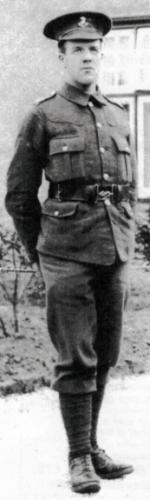
From: Grassendale, Liverpool
K.I.A (110 Years this day)
Wednesday 18th October 1916.
26 years old
Thomas Leonard (Len) Cromwell was born on the 01st June 1890 in Grassendale, Liverpool and was baptised on the 29th June, 1890 at St Mary’s Church of England Church, Grassendale. He was the son of Benjamin Cromwell and his wife Ann (nee Turton) of The Hollies, Willaston, near Chester who were married in 1871 at All Saints Church, Childwall, Liverpool.
On the 1891 Census the family are living at Green Bank, 1 Long Lane, Garston. His father, Benjamin, is aged 40, a gardener and domestic servant, born in Shropshire, mother Ann is aged 40, born in Lancashire, children Agnes A. 18 b.Allerton, William O. 15, a clerk b.Mossley Hill, born Aigburth are Benjamin 13 a scholar, Christine 12 a scholar, James P. 10 a scholar, Sydney 8 a scholar, Reginald 5 a scholar, and Thomas L. 10 months.
On the 1901 Census the family have moved to Dale Villa, 4 Whitehedge Rd, Garston. Father Benjamin is aged 50, a gardener domestic, born in Shifnal, mother Ann is aged 50, born in Halewood, children Benjamin 23 a clerk, Percival 20 a joiner, Sydney 18 a railway clerk, Reginald 15 a railway clerk, and Leonard 10.
The 1911 Census shows the family living at Greenbank, Higher Road, Halewood, Liverpool. His father Benjamin is aged 62, born 1849 and is a Horticulturist and was born in Shifnal, Shropshire. His wife Ann is aged 60, born 1851 in Halewood, Liverpool. They have three children all being born in Liverpool. Sydney Dawson who is a widower aged 28, born 1883 and occupation shipping clerk, John Reginald aged 25, born 1886 a Joiner and Thomas aged 20, occupation banking clerk. They also have a grandson Leslie aged 4, born 1907 at the address.
Len was working as a bank clerk at Parrs Bank in Chester prior to his enlistment.
He enlisted on the 03rd September, 1914 at St George's Hall in Liverpool joining the 18th Battalion of The King’s Liverpool Regiment, He was aged 24 years and sixty days, and he gave his occupation as a Clerk. He was described as being 5 foot 5 and quarter inches tall, weighed 122lbs, 35" chest of fresh complexion, with grey eyes and brown hair. He stated his religion as Church of England and his father as next of kin at Greenbank, Hunts Cross.
From the 23rd September 1914 he was billeted at Hooton Park Race Course and remained there until 03rd December 1914 when they moved into the hutted accommodation at Lord Derby’s estate at Knowsley Hall. On 30th April 1915 the 18th Battalion alongside the other three Pals battalions left Liverpool via Prescot Station for further training at Belton Park, Grantham. They remained here until September 1915 when they reached Larkhill Camp on Salisbury Plain.
18.09.15: Appointed unpaid Lance Corporal.
06.11.15: Appointed paid Lance Corporal.
07.11.15: Embarked for France.
21.08.16: Appointed Corporal.
03.09.16: Granted Class 1 Proficiency Pay.
He was serving in the 18th Battalion (3rd Company, 9th Platoon), of The King’s Liverpool Regiment as Corporal 16706 when he was killed in action on the 18th October 1916, aged 26, during the Battle of the Transloy Ridges which was part of the ongoing Somme Offensive.
18th Bn Diary
18th October 1916
Attacked German trenches commencing 3.40 am. Relieved by 19th Manchester Regt. Took up position in support Bn trenches W. of Goose Alley.
Graham Maddocks in his book Liverpool Pals gives an overview of the events of the day:
“At 3.40 am the whistles blew, and the Battalion left its assembly trenches, in three waves, approximately fifty yards apart, and began to cross No Man’s Land. Almost immediately, the German Barrage fell on the first wave and halted its advance, so that the second wave soon caught up with it. This was not a great problem at first, and the two combined waves were able to advance together for about 300 yards, whereupon they encountered the German Grid Trench system. On the right of the advance, it was found that the wire was largely intact, apart from a few gaps, and the Germans bombed and machine gunned these gaps, which prevented any further progress. Elsewhere along the trench, however, the wire was cut and there did not seem to be any serious opposition. Nevertheless, the men hesitated to jump down into the German trenches, and instead, began to filter back across to the safety of their own lines.
By this time the third wave had caught up, as had a fourth wave, which had been detailed to mop up any opposition once the trenches had fallen, and all four waves became intermingled which added to the confusion. No less than three attempts were made to try to get the men to go forward again, but each attempt became markedly less successful than its predecessor, and eventually the attack came to a standstill. Although the British assembly trenches had received the attention of the German guns, the attackers in No Mans Land had not come under any great intensity of fire up until this point.
However, once it became obvious to the Germans that the attack was disorganised and faltering, they began to fire into the massed men from the flanks. It was probably this that finally settled the issue and convinced the Pals that they could no longer gain the enemy trenches, and all four waves, now merged into one, began to retreat to their own lines. The whole attack had been an abysmal failure, and no ground had been gained at all”.
Len's body was not recovered or was subsequently lost as he has no known grave and is commemorated on the Thiepval Memorial in France.
The Thiepval Memorial, the Memorial to the Missing of the Somme, bears the names of more than 72,000 officers and men of the United Kingdom and South African forces who died in the Somme sector before 20 March 1918 and have no known grave. Over 90% of those commemorated died between July and November 1916.
On 01st August 1932 the Prince of Wales and the President of France inaugurated the Thiepval Memorial in Picardy. The inscription reads: “Here are recorded the names of officers and men of the British Armies who fell on the Somme battlefields between July 1915 and March 1918 but to whom the fortune of war denied the known and honoured burial given to their comrades in death.”
He was remembered on his birthday by his family in the Liverpool Echo on Friday 01 June 1917:
CROMWELL —In loving birthday remembrance of our dear Len, (Corporal T. L. Cromwell) K.L.R, missing since October 18, 1916.—From his loving Mother, Father, Sisters, and Brothers, " Weston," Willaston, near Chester.
He was also remembered in the Liverpool Echo on Friday 18 October 1918:
CROMWELL—In loving remembrance of our dear LEN, Corporal T. L. CROMWELL, K.L.R., (late of Parr's Bank, Chester), missing since October 18, 1916, officially presumed to have died on that date.— From his loving Mother, Father, Sisters and Brothers, “ Weston,” Willaston, near Chester.
His brother, Sydney Danson Cromwell, served as C.S.M. G/107270 Royal Fusiliers and was discharged on the 21st February 1919. (pension card).
Soldiers Effects and Pension to father Benjamin, address Weston, Willaston
Probate 1917:-
CROMWELL Thomas Leonard of Weston, Willaston near Chester corporal 18th Battalion Liverpool regiment died on or since 18 October 1916 in France Administration Chester 12 November to Benjamin Cromwell horticulturist. Effects £124 6s 7d.
His mother died on 22nd May 1938, aged 88, his father died on 04th January 1942, aged 93.
Thomas is also commemorated on the following Memorials:
Halewood Civic Memorial
Willaston Civic Memorial
Willaston Royal British Legion
St Hilda’s C. of E. Church, Hunts Cross
St Nicholas’ C. of E. Church, Halewood
St Peter’s C. of E. Church, Woolton
Victoria Schools, Grassendale
National Westminster Bank, Eastgate, Chester
Grateful thanks are extended to Jean King and her daughter Bridget Bryson of Alpharetta, GA, USA, and the Willaston Residents and Countryside Society for permission to use the photograph of Len now shown on the website.
We currently have no further information on Thomas Leonard Cromwell, If you have or know someone who may be able to add to the history of this soldier, please contact us.

From: Liverpool
K.I.A (110 Years this day)
Wednesday 18th October 1916.
22 years old
Frederick Fitzroy was born on the 05th November, 1894 in Liverpool, the son of Thomas Fitzroy and his wife Mary (nee Williams). They were married on the 22nd June 1890 at Christ Church, Liverpool. Thomas was a 27 year old auctioneer of 28 Kirby Street, father Thomas deceased, whilst Mary was aged 19 of 74 Field Street, father Samuel.
The 1901 Census shows the family living at 46 Lennox Street, Liverpool. His father Thomas is aged 37, and is a furniture remover, born in Liverpool. His wife Mary is aged 30, born in Liverpool. The children, all born Liverpool, are Emily 9, Harold L. aged 8, Frederick aged 6, William aged 4, Harry aged 3, Thomas 9 months.
Frederick was educated at Newsham School, Liverpool.
The 1911 Census shows the family living at 47 Lennox Street, Liverpool. His father Frederick is aged 48, and is a furniture removers assistant, born in Liverpool. His wife Mary is aged 39, born in Manchester and they have been married for 21 years. The children are Harold Lancelot aged 18, butcher's assistant, Frederick aged 16, cycle makers assistant, William aged 14, butcher boy, Harry aged 13, Thomas and Winifred aged 8, Albert aged 7 and Ivy aged 5. All the children were born in Liverpool.
He enlisted in Liverpool and was serving in the 18th Battalion, The King’s Liverpool Regiment as Private No 32741 when he was killed in action on the 18th October 1916 aged 22 during the Battle of the Transloy Ridges which was part of the ongoing Somme Offensive.
18th Bn Diary
18th October 1916
Attacked German trenches commencing 3.40 am. Relieved by 19th Manchester Regt. Took up position in support Bn trenches W. of Goose Alley.
Graham Maddocks in his book Liverpool Pals gives an overview of the events of the day:
“At 3.40 am the whistles blew, and the Battalion left its assembly trenches, in three waves, approximately fifty yards apart, and began to cross No Man’s Land. Almost immediately, the German Barrage fell on the first wave and halted its advance, so that the second wave soon caught up with it. This was not a great problem at first, and the two combined waves were able to advance together for about 300 yards, whereupon they encountered the German Grid Trench system. On the right of the advance, it was found that the wire was largely intact, apart from a few gaps, and the Germans bombed and machine gunned these gaps, which prevented any further progress. Elsewhere along the trench, however, the wire was cut and there did not seem to be any serious opposition. Nevertheless, the men hesitated to jump down into the German trenches, and instead, began to filter back across to the safety of their own lines.
By this time the third wave had caught up, as had a fourth wave, which had been detailed to mop up any opposition once the trenches had fallen, and all four waves became intermingled which added to the confusion. No less than three attempts were made to try to get the men to go forward again, but each attempt became markedly less successful than its predecessor, and eventually the attack came to a standstill. Although the British assembly trenches had received the attention of the German guns, the attackers in No Mans Land had not come under any great intensity of fire up until this point.
However, once it became obvious to the Germans that the attack was disorganised and faltering, they began to fire into the massed men from the flanks. It was probably this that finally settled the issue and convinced the Pals that they could no longer gain the enemy trenches, and all four waves, now merged into one, began to retreat to their own lines. The whole attack had been an abysmal failure, and no ground had been gained at all”.
He was posted as amogst the Missing in the Liverpool Daily Post on Wednesday 29 November 1916:
Missing.
King’s Liverpool Regiment - Broady, 17046, W. T. (Egremont); Cadwell, 29492 J. J. (Southport); Cromwell, 16706, Corpl. T. L.; Fitzroy, 32741, F; Golothan, 32690, Corpl. W. P. (Chester); Griffiths, 32795, J. W.; Hilditch, 17057, A. J.; Leadsom, 39054, S.; Leighton, 16975, H. N. (Seaforth); Narracott, 17080, F. V.; Orrett, 16984, Sergt. J. S. (Prescot); Poole, 33265, F. (Shrewsbury); Powell, 23167, J.; Rench, 16992, T. F.; Ronson, 16054, G. R.; Speed, 26587, R.; Taylor, 23841, A.
Frederick's body was not recovered or was subsequently lost as he has no known grave and is commemorated on the Thiepval Memorial.
The Thiepval Memorial, the Memorial to the Missing of the Somme, bears the names of more than 72,000 officers and men of the United Kingdom and South African forces who died in the Somme sector before 20 March 1918 and have no known grave. Over 90% of those commemorated died between July and November 1916.
On 01st August 1932 the Prince of Wales and the President of France inaugurated the Thiepval Memorial in Picardy. The inscription reads: “Here are recorded the names of officers and men of the British Armies who fell on the Somme battlefields between July 1915 and March 1918 but to whom the fortune of war denied the known and honoured burial given to their comrades in death.”
He is also commemorated on St Anne’s C. of E. Church, Stanley.
The family suffered another grievous loss when his brother Harry who enlisted in Liverpool and was serving as Lance Corporal 203080, Lancashire Fusiliers, 3rd/5th Battalion was killed on 09th October 1917, aged 19.
He too had been originally posted as Missing in the Liverpool Echo on 17th October 1917:
LANCE-CORPL. HARRY FITZROY 3/5th Lancashire Fusiliers, Reported Missing October 9, any information will be gladly received by his parents, 73 Green Lane, Stoneycroft.
Harry now rests at XXVIII.A10 in Tyne Cot Cemetery, Belgium where his headstone bears the following inscription, paying tribute to his brother:
"ALSO IN MEMORY OF 32741 PTE F. FITZROY 18TH BN KING'S LIVERPOOL RGT. 18TH OCTOBER 1916"
Soldiers Effects to mother Mary, the Pensions of both Frederick and Harry to Mary.
His father died in 1938, aged 75.
His death was reported in the Liverpool Daily Post on Wednesday 06 April 1938:
FITZROY— April 4 at Belmont Road Hospital, THOMAS FREDERICK FITZROY, aged 75 years, husband of Mary Fitzroy (late of Green Lane, Stoneycroft), 583 Queen's Drive. (No flowers, by request.)
His mother, Mary, date of birth shown as 24th September 1870, appears on the 1939 register at 583 Queens Drive, she died in 1965, aged 94, in Barton, Lancs.
Both brothers are commemorated on St Anne’s C. of E. Church, Stanley.
We currently have no further information on Frederick Fitzroy, If you have or know someone who may be able to add to the history of this soldier, please contact us.

From: Chester
K.I.A (110 Years this day)
Wednesday 18th October 1916.
26 years old
William Percy Golothan was born on the 11th May, 1890 in Chester. He was the son of James Golothan and his wife Sarah Jane (nee Baker). His parents married at City Road, Presbyterian Church in 1887.
The 1891 Census shows William P. aged 10 months, living with his parents and elder brother James, aged 3 at 19 Wellington Street, Chester. His father, James, is 25 years of age and is a porter, who was born in Chester, his mother, Sarah J. is 22 years old and was also born in Chester.
The 1901 Census shows the family are still living at 19 Wellington Street, Chester. His father James is aged 35 and is a general dealer. His mother Sarah Jane is now shown as aged 33. They have four children declared in the household; James T. aged 13, born 1888, William aged 10, Sarah L. is aged 8, born 1893 and Cecil E. aged 2, born 1899.
Percy was educated at Chester College School and entered the school on 04th October 1901. He is also listed at Chester Grammar School for Boys in 1902.
His father's occupation is shown as green grocer and Percy's occupation upon leaving the school is recorded as a Post Office clerk.
William Percy Golothan featured in the London Gazette on both 24th May 1906 and 01st June 1906 under the header:
In pursuance of the provisions of Her late Majesty's Order in Council of the 29th November, 1898, the Civil Service Commissioners hereby announce the undermentioned Appointments, Promotions, etc. (including Assignments and Transfers of Second Division Clerks), for the month of May, 1906
The purpose was for his Registration as a Temporary Boy Clerk.
His name also featured in the Edinburgh Gazette on 05th June for the same purpose.
He again featured in the London Gazette on 02nd September 1910 under the header:
In pursuance of the provisions of His late Majesty's Order in Council of the 10th January, 1910, the Civil Service Commissioners hereby announce the undermentioned Appointments, Promotions, etc. (including Assignments and Transfers of Second Division Clerks and Transfers of Assistant Clerks of the Abstractor Class), for the month of August, 1910.
The purpose for this notification was that he had achieved the position of male sorting clerk and telegraphist post.
Again this appointment featured in the Edinburgh Gazette, a few days later, on 06th September 1910
William Golothan is found on the 1911 Census as a visitor to 45 Christ Church Street, Chelsea, London. He is described as 20 year old sorting clerk, born in Chester. He is visiting the house of the Crisp family.
His brother James T. married Lottie Cooper in the second quarter of 1915.
He was serving in the 18th Battalion, The King’s Liverpool Regiment as Acting Sergeant No 32690 when he was killed in action on the 18th October 1916 aged 26 during the Battle of the Transloy Ridges which was part of the ongoing Somme Offensive.
18th Bn Diary
18th October 1916
Attacked German trenches commencing 3.40 am. Relieved by 19th Manchester Regt. Took up position in support Bn trenches W. of Goose Alley.
Graham Maddocks in his book Liverpool Pals gives an overview of the events of the day:
“At 3.40 am the whistles blew, and the Battalion left its assembly trenches, in three waves, approximately fifty yards apart, and began to cross No Man’s Land. Almost immediately, the German Barrage fell on the first wave and halted its advance, so that the second wave soon caught up with it. This was not a great problem at first, and the two combined waves were able to advance together for about 300 yards, whereupon they encountered the German Grid Trench system. On the right of the advance, it was found that the wire was largely intact, apart from a few gaps, and the Germans bombed and machine gunned these gaps, which prevented any further progress. Elsewhere along the trench, however, the wire was cut and there did not seem to be any serious opposition. Nevertheless, the men hesitated to jump down into the German trenches, and instead, began to filter back across to the safety of their own lines.
By this time the third wave had caught up, as had a fourth wave, which had been detailed to mop up any opposition once the trenches had fallen, and all four waves became intermingled which added to the confusion. No less than three attempts were made to try to get the men to go forward again, but each attempt became markedly less successful than its predecessor, and eventually the attack came to a standstill. Although the British assembly trenches had received the attention of the German guns, the attackers in No Mans Land had not come under any great intensity of fire up until this point.
However, once it became obvious to the Germans that the attack was disorganised and faltering, they began to fire into the massed men from the flanks. It was probably this that finally settled the issue and convinced the Pals that they could no longer gain the enemy trenches, and all four waves, now merged into one, began to retreat to their own lines. The whole attack had been an abysmal failure, and no ground had been gained at all”.
Percy was initially declared as Missing in the Liverpool Daily Post on Wednesday 29th November 1916:
Missing.
King’s Liverpool Regiment - Broady, 17046, W. T. (Egremont); Cadwell, 29492 J. J. (Southport); Cromwell, 16706, Corpl. T. L.; Fitzroy, 32741, F; Golothan, 32690, Corpl. W. P. (Chester); Griffiths, 32795, J. W.; Hilditch, 17057, A. J.; Leadsom, 39054, S.; Leighton, 16975, H. N. (Seaforth); Narracott, 17080, F. V.; Orrett, 16984, Sergt. J. S. (Prescot); Poole, 33265, F. (Shrewsbury); Powell, 23167, J.; Rench, 16992, T. F.; Ronson, 16054, G. R.; Speed, 26587, R.; Taylor, 23841, A.
Upon receipt of confirmation of his death his family placed the following notice in the local press:
IN MEMORIAM
GOLOTHAN - In loving and sacred memory Corporal Percy Golothan, King's Liverpool Regt (Pals), dearly loved son of Mr and Mrs Golothan, Whipcord Lane, who was reported missing on October 18th 1916 and is now officially presumed killed.
Sleep on beloved, sleep and take thy rest,
Lay down thy head upon thy Saviour's breast,
We love thee well, but Jesus loves thee best,
Good night! Good night! Good night!
Until made beautiful by Lord divine,
Thou in the likeness of thy Lord will shine,
And he shall bring that golden crown of thine,
Good Night!
Only "Good night" beloved - not farewell
"Till the day breaks and the shadows flee away"
Percy's body was not recovered or was subsequently lost as he has no known grave and is commemorated on the Thiepval Memorial, France. The Thiepval Memorial, the Memorial to the Missing of the Somme, bears the names of more than 72,000 officers and men of the United Kingdom and South African forces who died in the Somme sector before 20 March 1918 and have no known grave. Over 90% of those commemorated died between July and November 1916.
On 01st August 1932 the Prince of Wales and the President of France inaugurated the Thiepval Memorial in Picardy. The inscription reads: “Here are recorded the names of officers and men of the British Armies who fell on the Somme battlefields between July 1915 and March 1918 but to whom the fortune of war denied the known and honoured burial given to their comrades in death.”
Percy earned two medals, the Victory Medal and the British War Medal which suggests that he did not serve overseas until 1916.
His will was made as follows:
This is the last Will and Testament of me William Percy Golothan of number 9 Whipcord Lane, Chester in the County of Cheshire made on this 27th day of December in the year of our lord one thousand nine hundred and fifteen. I hereby revoke all Wills made by me any time. Heretofore , I appoint my mother, Mrs S.J. Golothan 9 Whipcord Lane, Chester to be my Executive and direct that all my debts and funeral expenses shall be paid as soon as conveniently may be after my decease. I give and bequeath all my estate and effects whatsoever and wheresoever both real and personal to which I may be entitled or which I may have power to dispose of at my decease unto and to the use of my mother Mrs S.J. Golothan, 9 Whipcord Lane, Chester
William Percy Golothan
Signed by the Testator William Percy Golothan in the presence of us at the same time who at his request in his presence and in the presence of each then have subscribed our names as witnesses.
Jas Golothan Deynebout, Vicar's Cross, Chester, Post Office Official, Chester
Cedric Hunt The Croft, Sneyd Green, Stoke on Trent, Private in RAMC
Probate was granted to his mother, as sole executive, on 10th June 1925.
Probate 1925
Golothan William Percy of 9 Whipcord Lane, Chester, died on or since 18 October 1916 in France. Probate Chester 10 June to Sarah Jane Golothan (wife of James Golothan). Effects £112 13s 10d.
Percy was remembered by his family in the Chester Chronicle on 24th October 1931:
GOLOTHAN— In loving and sacred memory of Acting-Sergt Percy Golothan, King’s Liverpool (Pals), dearly loved second son of Mr and Mrs Golothan, 37 Halkyn-road, who was reported missing October 18, 1916, and presumed killed on that day.
And there shall be no night there.
For the Lord God giveth them light,
and they shall reign for ever and ever.
He is commemorated on the family headstone at Overleigh New Cemetery, Chester where the inscription reads:
“Also W. PERCY,
Dearly Loved Son Of The Above
Killed On The Somme Oct. 18th 1916,
(18th Kings Liverpool Regt.) Aged 26 Years. "I Thank My God, Upon Every Remembrance Of You."
He is also commemorated on the following Memorials:
Royal Mail War Memorial at Chester Delivery Office
Post Office, St John Street, Chester
Chester Citizens Memorial situated in Chester Town Hall
His father died on the 15th March 1935, aged 70.
His mother died in 1959, aged 90.
In an obituary for his mother in the Chester Chronicle on 17th January 1959, details of Percy's surviving brothers and sisters are recorded as: James T. a former Head Postmaster, Cecil E. sub editor on the Chester Chronicle, Lilian Golothan a former secretary to the general manager of the Co-operative Society and Ivy Golothan of the GPO Telephone Department in Chester.
We currently have no further information on William Percy Golothan, If you have or know someone who may be able to add to the history of this soldier, please contact us.
From: Liverpool
K.I.A (110 Years this day)
Wednesday 18th October 1916.
19 years old
John Walter (Jack) Griffiths was born in Liverpool on 01st May 1897, the son of James Henry Griffiths and his wife Mary Emma (née Doyle), who married in 1888 at St Ambrose's Church, Everton. Jack was the eldest surviving son, and the fifth of 12 children, two of whom died young. He had older sisters Annie, Emma, Margaret, and Ellen, and younger siblings Thomas, Katie, James, Nora, and Albert. He was baptised in St. Peter's Church, Liverpool, on 17th May 1897, his parents’ abode Cornwall Street, his mother’s name given as Emma, and his father’s occupation listed as labourer.
In 1891 the family are living at 67 Opie Street, Everton, father James is aged 21, a labourer in a sugar refinery born in Liverpool, mother Emma, aged 21, born in Newcastle, Durham, children Ann 1, and Emma 1 month, both born Liverpool. After this census his mother’s birthplace is then shown as Liverpool.
In 1901 the family are living at 84 Opie Street, Everton, his father is not present and his mother, aged 31, is head of household, with six children: Annie 11, Emma 10, Margaret A. 8, and Ellen 6, John W. is 3, and James 1. They have a boarder Henry Carr 45 from Liverpool.
He enlisted in Liverpool and was serving in the 18th Battalion, The King’s Liverpool Regiment as Private No 32795 when he was killed in action on the 18th October 1916 during the Battle of the Transloy Ridges which was part of the ongoing Somme Offensive.
18th Battalion Diary
18th October 1916
Attacked German trenches commencing 3.40 am. Relieved by 19th Manchester Regt. Took up position in support Bn trenches W. of Goose Alley.
Graham Maddocks in his book Liverpool Pals gives an overview of the events of the day:
“At 3.40 am the whistles blew, and the Battalion left its assembly trenches, in three waves, approximately fifty yards apart, and began to cross No Man’s Land. Almost immediately, the German Barrage fell on the first wave and halted its advance, so that the second wave soon caught up with it. This was not a great problem at first, and the two combined waves were able to advance together for about 300 yards, whereupon they encountered the German Grid Trench system. On the right of the advance, it was found that the wire was largely intact, apart from a few gaps, and the Germans bombed and machine gunned these gaps, which prevented any further progress. Elsewhere along the trench, however, the wire was cut and there did not seem to be any serious opposition. Nevertheless, the men hesitated to jump down into the German trenches, and instead, began to filter back across to the safety of their own lines.
By this time the third wave had caught up, as had a fourth wave, which had been detailed to mop up any opposition once the trenches had fallen, and all four waves became intermingled which added to the confusion. No less than three attempts were made to try to get the men to go forward again, but each attempt became markedly less successful than its predecessor, and eventually the attack came to a standstill. Although the British assembly trenches had received the attention of the German guns, the attackers in No Mans Land had not come under any great intensity of fire up until this point.
However, once it became obvious to the Germans that the attack was disorganised and faltering, they began to fire into the massed men from the flanks. It was probably this that finally settled the issue and convinced the Pals that they could no longer gain the enemy trenches, and all four waves, now merged into one, began to retreat to their own lines. The whole attack had been an abysmal failure, and no ground had been gained at all”.
He was listed amongst the Missing in the Liverpool Weekly Courier on Saturday 25 December 1916:
Missing Soldiers.
Information concerning the following soldiers who are reported missing at the front will be welcomed at the addresses given:-
Pte John Walter Griffiths, K.L.R. is reported missing. Information regarding him will be welcomed by Mrs Griffiths, of 7 Leycester Street, off Wilbraham Street, Liverpool.
Jack earned his two medals.
He now rests at Warlencourt British Cemetery, France.
Warlencourt Cemetery is entirely a concentration cemetery, begun late in 1919 when graves were brought in from small cemeteries and the battlefields of Warlencourt and Le Sars. The Graves Registration form shows graves from “Le Sars 6/1, 6/2, Hexham Road, Seven Elms”.
Graves were brought in from the original cemeteries at Hexham Road (Le Sars), and Seven Elms (Flers), as well as over 3,000 British graves due to the fighting which took place around the Butte de Warlencourt from the autumn of 1916 to the spring of 1917, and again in the German advance and retreat of 1918. The cemetery now contains 3,505 Commonwealth burials and commemorations of the First World War, 1,823 of which are unidentified.
We currently have no further information on John Walter Griffiths, If you have or know someone who may be able to add to the history of this soldier, please contact us.
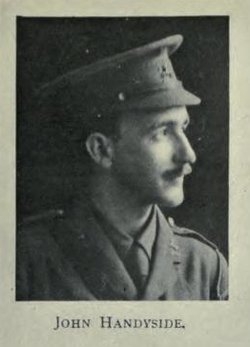
From: Leith, Edinburgh
(110 Years this day)
Wednesday 18th October 1916.
33 years old
John Handyside was born on the 31st January, 1883 in Leith, Edinburgh, Scotland, the son of Adam Handyside and his wife Agnes (nee Spalding) who were married in 1869 in Leith.
The 1891 Census finds the family living at Montgomery Street, Edinburgh. His father Adam is shown as a Railway Clerk born in Midlothian in 1855, whilst his mother Agnes was born at Kirriemuir, Forfarshire in 1853. John is 8 years of age and a scholar, born at Leith as were his two siblings Annie b.1881 and Adam b.1886.
The 1901 Census finds the family living at 10 Queens Park Avenue, South Leith, Edinburgh. His father Adam is aged 46, a Railway Clerk, whilst his mother Agnes is aged 48. John is aged 18 years of age and an art student, Annie aged 20 is a student, Adam is 15 and Agnes 7.
He was educated at Royal High School of which he was Dux in 1899 and at the University of Edinburgh where he graduated with an M.A. in 1903. From there he went to Balliol College Oxford, where he achieved a First Class Honours B.A. in 1907 and was elected to a prize fellowship at St John's College, Oxford. He returned to the University of Edinburgh in 1907 and his teaching duties included advanced logic and Spinoza for the Honours class.
In 1911 he was appointed to a lectureship in Philosophy at Liverpool University, where he turned his attention to ethics and political philosophy.
In 1915 he enlisted and was commissioned Second Lieutenant and Gazetted to the 16th Battalion The King’s Liverpool Regiment. He was subsequently attached to the 18th Battalion, perhaps after its heavy losses of July 1916, but there is no mention of his arrival at the Battalion Headquarters in the War Diary at all. It is probable, however, this happened just before he was fatally wounded in action during fighting around Flers 18th October 1918.
The Battalion had been ordered to make an attack on the German position known as Gird Trench, near Flers, which had been unsuccessfully attacked five days earlier by the 89th Brigade.
The objectives of the 18th Battalion were in the centre of the 21st Brigade attack and included the capture and holding of a German strong point.
18th Bn Diary
18th October 1916
Attacked German trenches commencing 3.40 am. Relieved by 19th Manchester Regt. Took up position in support Bn trenches W. of Goose Alley.
Graham Maddocks in his book Liverpool Pals gives an overview of the events of the day:
“At 3.40 am the whistles blew, and the Battalion left its assembly trenches, in three waves, approximately fifty yards apart, and began to cross No Man’s Land. Almost immediately, the German Barrage fell on the first wave and halted its advance, so that the second wave soon caught up with it. This was not a great problem at first, and the two combined waves were able to advance together for about 300 yards, whereupon they encountered the German Grid Trench system. On the right of the advance, it was found that the wire was largely intact, apart from a few gaps, and the Germans bombed and machine gunned these gaps, which prevented any further progress. Elsewhere along the trench, however, the wire was cut and there did not seem to be any serious opposition. Nevertheless, the men hesitated to jump down into the German trenches, and instead, began to filter back across to the safety of their own lines.
By this time the third wave had caught up, as had a fourth wave, which had been detailed to mop up any opposition once the trenches had fallen, and all four waves became intermingled which added to the confusion. No less than three attempts were made to try to get the men to go forward again, but each attempt became markedly less successful than its predecessor, and eventually the attack came to a standstill. Although the British assembly trenches had received the attention of the German guns, the attackers in No Mans Land had not come under any great intensity of fire up until this point.
However, once it became obvious to the Germans that the attack was disorganised and faltering, they began to fire into the massed men from the flanks. It was probably this that finally settled the issue and convinced the Pals that they could no longer gain the enemy trenches, and all four waves, now merged into one, began to retreat to their own lines. The whole attack had been an abysmal failure, and no ground had been gained at all”.
During the course of the attack Second-Lieutenant Handyside was fatally wounded and died the same day at 15th Corps Dressing Station. He was aged thirty three at the time.
He now rests at Thistle Dump Cemetery, High Wood, near Longueval on the Somme. Perhaps because he was never officially on the strength of the 18th Battalion his headstone does not bear the Eagle and Child of the Pals Battalions, but the White Horse of Hanover worn by the Regular and some Territorial Battalions. His headstone bears the epitaph:
"THEY SHALL NOT GROW OLD AS WE THAT ARE LEFT GROW OLD"
Thistle Dump Cemetery was begun in August 1916 and used as a front line cemetery until February 1917. It was later increased after the Armistice by the concentration of 56 graves from the Somme battlefields. There are now 196 Commonwealth servicemen of the First World War buried or commemorated in the cemetery. 59 of the burials are unidentified but there are special memorials to four casualties known to be buried among them. The cemetery also contains seven German war graves. High Wood was fiercely fought over during the Battle of the Somme until cleared by 47th (London) Division on 15 September 1916. It was lost during the German advance of April 1918, but retaken the following August.
His death was reported in the Dundee Courier on Monday 23 October 1916 as follows:
SCOTTISH OFFICER DIES OF WOUNDS
LECTURER IN LIVERPOOL UNIVERSITY
Lieutenant John Handyside of the King's Liverpool Regiment, has died of wounds. Lieutenant Handyside was a graduate of Edinburgh and Oxford Universities. As a student he gained many academic honours including the Ferguson Scholarship and the Baxter Scholarship in Mental Philosophy. After acting as assistant to Professor Pringle Paterson, Edinburgh University, he was appointed lecturer in Philosophy in Liverpool University. His only brother Lieutenant Adam Handyside left for the front with a draught of the Black Watch in June 1915, and he is still there being attached to the munitions department of the Army Ordnance. The deceased officer was a nephew of Mr H. T. Templeton, "Courier" Office, Dundee.
Second Lieutenant John Handyside, King's Liverpool Regiment, who is announced to have died from wounds was formally Lecturer in Philosophy at the Liverpool University. Age 33 years, he was the elder son of the late Adam Handyside and Mrs Handyside, 5 Hamilton Place, Edinburgh. He had a distinguished University career. At Edinburgh he gained besides further distinctions, the Hamilton Fellowship and the Ferguson scholarship in Philosophy, open to graduates of the four Scottish Universities. At Oxford he gained the Jenkyns Exhibition and took a first class in Literae Humaniores. He was elected a Fellow of St. John's College, Oxford, in 1908.
On the same day his death was announced in the Liverpool Daily Post on Monday 23 October 1916
LIVERPOOL UNIVERSITY LECTURER
Second Lieutenant John Handyside, King's Liverpool Regiment, who is announced to have died from wounds was formally Lecturer in Philosophy at the Liverpool University. Age 33 years, he was the elder son of the late Adam Handyside and Mrs Handyside, 5 Hamilton Place, Edinburgh. He had a distinguished University career. At Edinburgh he gained besides further distinctions, the Hamilton Fellowship and the Ferguson scholarship in Philosophy, open to graduates of the four Scottish Universities. At Oxford he gained the Jenkyns Exhibition and took a first class in Literae Humaniores. He was elected a Fellow of St. John's College, Oxford, in 1908.
Probate was awarded at Edinburgh on 20th December 1916 to his mother:
HANDYSIDE John, of 5 Hatton Place, Edinburgh, and of 50 Canning Street, Liverpool, Temporary 2nd Lieut. 18th (Service) Battalion, Liverpool Regiment, died 18 October, at 15th Corps Dressing Station, France, testate. Confirmation granted at Edinburgh, 20 December to Agnes Spalding or Handyside, 5 Hatton Place, aforesaid widow, his mother, Universal Legatory, and as such Executrix nominate under Will or Deed, dated 6 July 1916 and recorded in Court books of Commissariot of Edinburgh 19 December 1916. Value of estate £1,321 4s 3d.
His father, predeceased John as he died on 22nd April 1916.
His mother, Agnes, died on 03rd February 1944 aged 92
John is commemorated on the following Memorials:
Hall of Remembrance, Liverpool Town Hall, Panel 51 Left
Royal High School, Edinburgh
Liverpool University
We currently have no further information on John Handyside, if you have or know someone who may be able to add to the history of this soldier, please contact us.
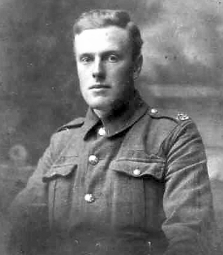
From: Hunts Cross, Liverpool
K.I.A (110 Years this day)
Wednesday 18th October 1916.
24 years old
Arthur Jackson Hilditch was born on the 14th November, 1891 in Hunts Cross, Liverpool and was baptised on the 27th January, 1892 at St Thomas' C.of E. Church, Liverpool. He was the youngest son of Henry Hilditch and his wife Jane (nee Jackson) of Hunts Cross Hotel, Liverpool, who married on the 25th April 1878 at St Mary's Church, Bootle. Henry was a victualler of Childwall, father George, whilst Jane was of Bootle, father Richard.
The 1901 Census shows the family are living at the Hunts Cross Hotel, Liverpool. His father, Henry, is a 47 year old hotel proprietor born in Haslington, Cheshire. His mother, Jane, is a 53 year old born in Jedburgh, Yorkshire. They have six children in the household; Phoebe a 22 year old domestic waitress, Gertrude a 20 year old domestic cook, George is an 18 year old grocer's apprentice, Henry E. is a 17 year old grocer's apprentice, Ethel is 11 and Arthur is 9. The family also employ a general domestic servant, Elizabeth Cummings who is 28 years old
His father died on 13th October 1905, aged 51 years, he was buried at St Peter's Church, Woolton on the 17th October.
The 1911 Census shows the family are still at the Hunts Cross Hotel. His mother is now shown as a widow, aged 66, and is now a hotel proprietress. She has four of her children with her in the household; Gertrude aged 30, George is aged 29 and a hotel manager, Henry Ernest is 27 and also a hotel manager, Arthur Jackson is a junior clerk aged 19. The family employ a servant; Mary Corris aged 34.
Arthur enlisted on the 01st September 1914 at St George's Hall in Liverpool aged 22 years and 240 days, and gave his occupation as a clerk. He was described as being five foot ten inches tall, weighed 133lbs, 36" chest, with a fresh complexion, blue eyes and brown hair. He stated his religion as Church of England and stated his next of kin as his mother Jane, at the Hunts Cross Hotel. .
From the 23rd September 1914 he was billeted at Hooton Park Race Course and remained there until 03rd December 1914 when they moved into the hutted accommodation at Lord Derby’s estate at Knowsley Hall. On 30th April 1915 the 18th Battalion alongside the other three Pals battalions left Liverpool via Prescot Station for further training at Belton Park, Grantham. They remained here until September 1915 when they reached Larkhill Camp on Salisbury Plain.
07.11.15: Embarked for France with his Battalion.
16.03.16: Attached to 30th Division Grenade School.
16.02.16: Entitled to Class 1, Proficiency Pay.
He was serving in the 18th Battalion, The King’s Liverpool Regiment as Private No 17057 when he was killed in action on the 18th October 1916, aged 24, during the Battle of the Transloy Ridges which was part of the ongoing Somme Offensive.
18th Bn Diary
18th October 1916
Attacked German trenches commencing 3.40 am. Relieved by 19th Manchester Regt. Took up position in support Bn trenches W. of Goose Alley.
Graham Maddocks in his book Liverpool Pals gives an overview of the events of the day:
“At 3.40 am the whistles blew, and the Battalion left its assembly trenches, in three waves, approximately fifty yards apart, and began to cross No Man’s Land. Almost immediately, the German Barrage fell on the first wave and halted its advance, so that the second wave soon caught up with it. This was not a great problem at first, and the two combined waves were able to advance together for about 300 yards, whereupon they encountered the German Grid Trench system. On the right of the advance, it was found that the wire was largely intact, apart from a few gaps, and the Germans bombed and machine gunned these gaps, which prevented any further progress. Elsewhere along the trench, however, the wire was cut and there did not seem to be any serious opposition. Nevertheless, the men hesitated to jump down into the German trenches, and instead, began to filter back across to the safety of their own lines.
By this time the third wave had caught up, as had a fourth wave, which had been detailed to mop up any opposition once the trenches had fallen, and all four waves became intermingled which added to the confusion. No less than three attempts were made to try to get the men to go forward again, but each attempt became markedly less successful than its predecessor, and eventually the attack came to a standstill. Although the British assembly trenches had received the attention of the German guns, the attackers in No Mans Land had not come under any great intensity of fire up until this point.
However, once it became obvious to the Germans that the attack was disorganised and faltering, they began to fire into the massed men from the flanks. It was probably this that finally settled the issue and convinced the Pals that they could no longer gain the enemy trenches, and all four waves, now merged into one, began to retreat to their own lines. The whole attack had been an abysmal failure, and no ground had been gained at all”.
He was listed as Missing in the Liverpool Daily Post on Wednesday 29 November 1916:
Missing.
King’s Liverpool Regiment - Broady, 17046, W. T. (Egremont); Cadwell, 29492 J. J. (Southport); Cromwell, 16706, Corpl. T. L.; Fitzroy, 32741, F; Golothan, 32690, Corpl. W. P. (Chester); Griffiths, 32795, J. W.; Hilditch, 17057, A. J.; Leadsom, 39054, S.; Leighton, 16975, H. N. (Seaforth); Narracott, 17080, F. V.; Orrett, 16984, Sergt. J. S. (Prescot); Poole, 33265, F. (Shrewsbury); Powell, 23167, J.; Rench, 16992, T. F.; Ronson, 16054, G. R.; Speed, 26587, R.; Taylor, 23841, A.
Soldiers Effects to mother Jane, no Pension record found.
He now rests at Warlencourt British Cemetery where his headstone bears the epitaph:
“IN THE MIDST OF LIFE WE ARE IN DEATH”
Warlencourt Cemetery is entirely a concentration cemetery, begun late in 1919 when graves were brought in from small cemeteries and the battlefields of Warlencourt and Le Sars. The Graves Registration form shows graves from “Le Sars 6/1, 6/2, Hexham Road, Seven Elms”.
Graves were brought in from the original cemeteries at Hexham Road (Le Sars), and Seven Elms (Flers), as well as over 3,000 British graves due to the fighting which took place around the Butte de Warlencourt from the autumn of 1916 to the spring of 1917, and again in the German advance and retreat of 1918. The cemetery now contains 3,505 Commonwealth burials and commemorations of the First World War, 1,823 of which are unidentified.
Probate of his estate was obtained at Liverpool on the 17th November 1917 by his widowed mother of Highfield Farm, Halewood. His effects were valued at £128 9s 9d.
His identity disc was also sent to his mother.
Arthur is commemorated on the family headstone in St Peter’s C. of E. Church, Woolton:
ALSO ARTHUR JACKSON
YOUNGEST SON OF ABOVE
PRIVATE 18TH BATT K.L.R. PALS
KILLED IN ACTION FRANCE
OCT 18TH 1916 AGED 24
This is final resting place of his parents, his mother Jane died on 27th April 1924 aged 78. Also his brother Henry Ernest who died on 21st August 1962, aged 78.
He is also commemorated on the Memorials at:
St.Hilda’s C. of E. Church, Hunts Cross
Liscard High School
Liverpool Institute School
We currently have no further information on Arthur Jackson Hilditch, If you have or know someone who may be able to add to the history of this soldier, please contact us.
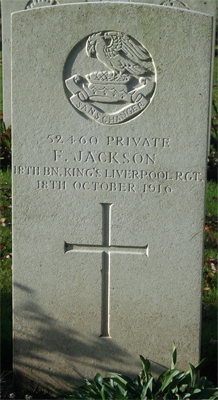
From: Pendleton, Manchester
K.I.A (110 Years this day)
Wednesday 18th October 1916.
38 years old
Francis Matthews Jackson was born in the September Qtr of 1879 in Pendleton, Manchester and was the son of Thomas and Mary (nee Jackson) Jackson who married in 1876 in Chorlton-in-Medlock.
The 1881 Census shows the family living at 1 Barker St, Salford.
Father Thomas is aged 28, a paperhanger born in Stockport, mother Mary is aged 30, born Warrington, Henry 5 born Hulme, Joseph 4 born Salford, and Francis Matthews aged 1 born Salford.
The mother Mary died aged 41 in 1890.
The 1891 Census shows the greater family living at 20 Cross St, Salford.
The head of the family is widow Ann Jackson, aged 61 born in Ireland, her children Margaret 30, Elizabeth 28, Francis 21 and widowed Thomas aged 38, a paperhanger, the grandchildren are Henry 15, Joseph 13, Francis is aged 10, a scholar, and Elizabeth 7 a scholar.
The 1901 Census shows the family living at 5 Cooper St, Salford.
Widowed father Thomas is aged 49, a paperhanger, Francis is aged 21, a house painter, and Elizabeth aged 17.
He married Jane Hampton on the 8th April 1901 at St Paul, Pendleton. Francis was a 22 year old house decorator of 63 Bury St, Salford, father Thomas, whilst Jane was aged 22, same address, father Isaac a miner. Jane Rebecca was born in Sedgley, Staffordshire in 1877, the daughter of Isaac and Margaret Hampton.
The 1911 Census shows Francis and his family living at 18 Strawberry Hill Terrace, Pendleton, Salford.
Francis is aged 32, occupation house painter, born in Salford. His wife Jane is aged 34, born 1877 no occupation listed, she was born in Staffordshire. They have been married for ten years and have had five children of which one had died. Those listed on the Census are shown as: Margaret aged 9, born 1902, William aged 8, born 1903, Thomas aged 6, born 1905 and Joseph aged 2, born 1909. The children were all born in Salford. The pension record reveals Jane was born on the 19th Dec 1876 and 2 more children were born after the census, Ellen in 1913, and Francis 1916.
Francis enlisted in Manchester and was formerly 17978, Border Regiment and was serving in the 18th Battalion, The King’s Liverpool Regiment as Private No 52460 when he was killed in action on the 18th October 1916 aged 38 during the Battle of the Transloy Ridges which was part of the ongoing Somme Offensive.
18th Battalion Diary
18th October 1916
Attacked German trenches commencing 3.40 am. Relieved by 19th Manchester Regt. Took up position in support Bn trenches W. of Goose Alley.
Graham Maddocks in his book Liverpool Pals gives an overview of the events of the day:
“At 3.40 am the whistles blew, and the Battalion left its assembly trenches, in three waves, approximately fifty yards apart, and began to cross No Man’s Land. Almost immediately, the German Barrage fell on the first wave and halted its advance, so that the second wave soon caught up with it. This was not a great problem at first, and the two combined waves were able to advance together for about 300 yards, whereupon they encountered the German Grid Trench system. On the right of the advance, it was found that the wire was largely intact, apart from a few gaps, and the Germans bombed and machine gunned these gaps, which prevented any further progress. Elsewhere along the trench, however, the wire was cut and there did not seem to be any serious opposition. Nevertheless, the men hesitated to jump down into the German trenches, and instead, began to filter back across to the safety of their own lines.
By this time the third wave had caught up, as had a fourth wave, which had been detailed to mop up any opposition once the trenches had fallen, and all four waves became intermingled which added to the confusion. No less than three attempts were made to try to get the men to go forward again, but each attempt became markedly less successful than its predecessor, and eventually the attack came to a standstill. Although the British assembly trenches had received the attention of the German guns, the attackers in No Mans Land had not come under any great intensity of fire up until this point.
However, once it became obvious to the Germans that the attack was disorganised and faltering, they began to fire into the massed men from the flanks. It was probably this that finally settled the issue and convinced the Pals that they could no longer gain the enemy trenches, and all four waves, now merged into one, began to retreat to their own lines. The whole attack had been an abysmal failure, and no ground had been gained at all”.
He now rests at Warlencourt British Cemetery, France.
Warlencourt Cemetery is entirely a concentration cemetery, begun late in 1919 when graves were brought in from small cemeteries and the battlefields of Warlencourt and Le Sars. The Graves Registration form shows graves from “Le Sars 6/1, 6/2, Hexham Road, Seven Elms”.
Graves were brought in from the original cemeteries at Hexham Road (Le Sars), and Seven Elms (Flers), as well as over 3,000 British graves due to the fighting which took place around the Butte de Warlencourt from the autumn of 1916 to the spring of 1917, and again in the German advance and retreat of 1918. The cemetery now contains 3,505 Commonwealth burials and commemorations of the First World War, 1,823 of which are unidentified.
Manchester Evening News Friday 18th October 1918
Jackson - In loving memory of Private FRANK JACKSON, killed in action, October 18, 1916 in France.
Time changes many things.
But loving memories ever cling.
Always remembered by his loving WIFE and six CHILDREN - 18 Strawberry Hill Terrace, Pendleton.
Soldiers Effects and pension to widow Jane, 18 Strawberry Hill Terrace, Pendleton.
Father Thomas appears on the 1921 Census living with daughter Elizabeth. He may have died aged 77 in 1929 or aged 87 in 1939.
Thomas, Jackson, 1852, Stockport, Cheshire, England, Salford
Widow Jane R. appears on the 1939 Register at 27 Plymouth St, Salford with children William and Francis. She died aged 96 in 1973 Rochdale.
We currently have no further information on Francis Matthews Jackson, If you have or know someone who may be able to add to the history of this soldier, please contact us.
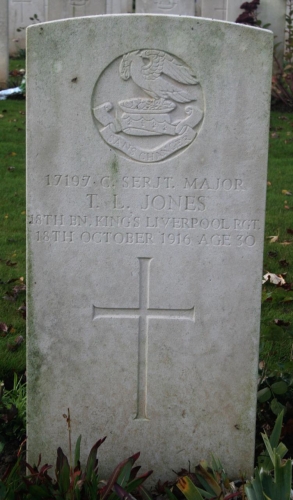
From: Liverpool
K.I.A (110 Years this day)
Wednesday 18th October 1916.
30 years old
Thomas Lloyd Jones was born on the 16th February, 1886 in Liverpool, and was baptised on the 27th January, 1892 at St Thomas Church of England Church, Liverpool. He was the son of John S. and Alice Jones, (nee Lloyd) who were married in 1881 at West Derby Register Office. He was educated at Granby Street Council School.
On the 1881 census father John was lodging with a Lloyd family at 27 Fernhill St, he was aged 38, a house joiner, born in Llannon, Carmarthenshire. Mother Alice was a servant living with a Jones family at 31 Pembroke St, Bootle, she was aged 29, born in Cerrigydruidion, Denbighshire.
The 1891 Census shows the family living at 33 Fernhill Street, Toxteth, Liverpool.
Father John aged 48 a joiner b.Wales, mother Alice 39 b.Wales, children all born Liverpool: William L. 8, David L. 7, John L. 6, Thomas L. 5, Catherine A. 2, Robert L 2mths, and servant Georgia Wilcox 14.
His father died in 1898 aged 56.
The 1901 Census shows the family still living at 33 Fernhill Street, Toxteth, Liverpool.
Widowed Mother Alice 49 b.Cerrigydruidion, Denbighshire, children William 18 a sorting clerk/telegraphist, David 17 a joiner, John 16 an insurance clerk, Thomas 15 an engineer, Catherine 12, and Robert 10.
The 1911 Census shows the family living at 33 Fernhill Street, Toxteth, Liverpool.
His widowed mother Alice is aged 59, born 1852 in Cerrigydruidion, Denbighshire. She had six children all born in Liverpool. William aged 28, born 1883 and occupation Sorting Clerk and Telegraphist, John aged 26, born 1885 Insurance Clerk, Thomas aged 25, born 1886 occupation Invoice Clerk (African merchants), Catherine Alice aged 22, born 1889 no occupation listed and Robert aged 20, born 1891 a Joiner.
Thomas enlisted on the 01st September, 1914 at St George's Hall in Liverpool joining the 18th Battalion of the King's Liverpool Regiment. He was aged 28 years and 180 days and gave his occupation as a Clerk. He was 5 foot five inches tall, weighed 122lbs, 36” chest, had a fresh complexion, steel grey coloured eyes, brown hair and gave his religion as Welsh Presbyterian. His NOK was mother Ailce, 33 Fernhill Street.
From the 23rd September 1914 he was billeted at Hooton Park Race Course and remained there until 03rd December 1914 when they moved into the hutted accommodation at Lord Derby’s estate at Knowsley Hall. On 30th April 1915 the 18th Battalion alongside the other three Pals battalions left Liverpool via Prescot Station for further training at Belton Park, Grantham. They remained here until September 1915 when they reached Larkhill Camp on Salisbury Plain. He arrived in France on 7th November 1915.
01.09.14: Attested and posted as a Private.
02.10.14: Appointed Lance Corporal.
15:12:14: Promoted to Corporal.
07.04.15: Appointed Unpaid Lance Sergeant.
27.05.15: Appointed paid Lance Sergeant.
28.06.15: Promoted Sergeant.
07.11.15: Embarked for France.
09.07.16: Promoted and appointed Warrant Officer Class II Colour Sergeant Major.
He was serving in the 18th Battalion, The King’s Liverpool Regiment as Colour Sergeant Major No 17197 when he was killed in action on the 18th October 1916 aged 30 during the Battle of the Transloy Ridges which was part of the ongoing Somme Offensive.
18th Bn Diary
18th October 1916
Attacked German trenches commencing 3.40 am. Relieved by 19th Manchester Regt. Took up position in support Bn trenches W. of Goose Alley.
Graham Maddocks in his book Liverpool Pals gives an overview of the events of the day:
“At 3.40 am the whistles blew, and the Battalion left its assembly trenches, in three waves, approximately fifty yards apart, and began to cross No Man’s Land. Almost immediately, the German Barrage fell on the first wave and halted its advance, so that the second wave soon caught up with it. This was not a great problem at first, and the two combined waves were able to advance together for about 300 yards, whereupon they encountered the German Grid Trench system. On the right of the advance, it was found that the wire was largely intact, apart from a few gaps, and the Germans bombed and machine gunned these gaps, which prevented any further progress. Elsewhere along the trench, however, the wire was cut and there did not seem to be any serious opposition. Nevertheless, the men hesitated to jump down into the German trenches, and instead, began to filter back across to the safety of their own lines.
By this time the third wave had caught up, as had a fourth wave, which had been detailed to mop up any opposition once the trenches had fallen, and all four waves became intermingled which added to the confusion. No less than three attempts were made to try to get the men to go forward again, but each attempt became markedly less successful than its predecessor, and eventually the attack came to a standstill. Although the British assembly trenches had received the attention of the German guns, the attackers in No Mans Land had not come under any great intensity of fire up until this point.
However, once it became obvious to the Germans that the attack was disorganised and faltering, they began to fire into the massed men from the flanks. It was probably this that finally settled the issue and convinced the Pals that they could no longer gain the enemy trenches, and all four waves, now merged into one, began to retreat to their own lines. The whole attack had been an abysmal failure, and no ground had been gained at all”.
Thomas now rests at Warlencourt British Cemetery, France.
Warlencourt Cemetery is entirely a concentration cemetery, begun late in 1919 when graves were brought in from small cemeteries and the battlefields of Warlencourt and Le Sars. The Graves Registration form shows graves from “Le Sars 6/1, 6/2, Hexham Road, Seven Elms”.
Graves were brought in from the original cemeteries at Hexham Road (Le Sars), and Seven Elms (Flers), as well as over 3,000 British graves due to the fighting which took place around the Butte de Warlencourt from the autumn of 1916 to the spring of 1917, and again in the German advance and retreat of 1918. The cemetery now contains 3,505 Commonwealth burials and commemorations of the First World War, 1,823 of which are unidentified.
Liverpool Echo 15th Nov 1916
Killed in Action.
JONES - October 18, killed in action, aged 30, Company Sergeant Major Thomas Lloyd Jones (K.L.R.), the dearly beloved fourth son of Mrs and the late John S. Jones - 33 Fernhill Street, Liverpool.
Liverpool Echo 18th Oct 1917
JONES - In loving memory of C.S.M. Thomas Lloyd Jones (K.L.R.), killed in action October 18, 1916. (Ever remembered by his Mother, Sister and Brothers.) - 33 Fernhill Street, Liverpool.
He is also commemorated on the following Memorials:
David Street Welsh Presbyterian Church, Toxteth
Granby Street Council School, also in Toxteth.
His mother died aged 67 in 1919 (before the Family Declaration dated 5th May).
Soldiers Effects executor was brother David, no Pension record found.
We currently have no further information on Thomas Lloyd Jones, If you have or know someone who may be able to add to the history of this soldier, please contact us.
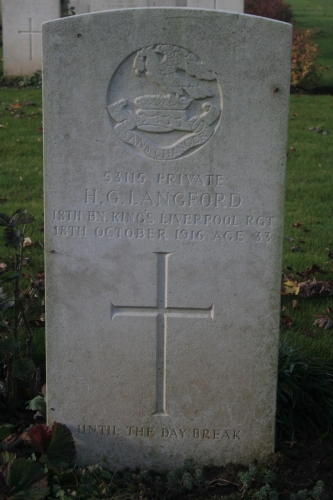
From: Marylebone London
D.O.W (110 Years this day)
Wednesday 18th October 1916.
33 years old
Henry George Langford was born on the 28th May 1883 in Marylebone, London. He was the son of Thomas Holland and Martha (nee Wossencraft) Langford,. His parents married on the 25th March 1877 at St Mary, Islington, Holland was a draper of 16 Packington St, father William Frederick a farmer, whilst Martha was of 9 Prebend St, father Daniel a shoemaker. Henry was baptised on 8th July 1883 at St Marylebone.
On the 1891 Census the family are living at 13 Beaumont Mews, St Marylebone.
Father Holland is aged 39, a police constable born in Church Stretton, Salop, mother Martha is aged 37 born Dolfor, Montgomeryshire, children born in Marylebone are William aged 13 , a scholar, Albert aged 11, a scholar, Thomas aged 10, a scholar, Charles aged 7, a scholar, Walter aged 4, and Henry aged 3.
His father died 1895 aged 42.
On the 1901 Census the family are living at 47 Wharncliffe Gardens, St Marylebone.
His mother Martha is a widow aged 47, children born in Marylebone are William F. aged 23, a clerk in the Civil Service(Admiralty), Thomas H. aged 20, a clerk in the Civil Service(War Office), Henry G. is aged 17, a boy copyist in the Civil Service , Charles F. aged 14, a telegraph messenger, and Alfred W. aged 12.
The 1911 Census shows the family living at Harlesden Road, Willesden, London.
His mother Martha is a widow aged 57, born 1854 in Montgomeryshire and living on none private means. She has five children living with her, all born in Marylebone, London. William Frederick aged 33, born 1878 and Thomas aged 30, born 1881 are both Civil Servants, Henry George is aged 27, occupation Clerk, Charles Francis aged 24, born 1887 is a Postman and Alfred Walter aged 22, born 1889 is an Engraver on Metals.
He enlisted in London and served originally as Private 20497 in the Surrey Regiment. Following a transfer he was serving in the 18th Battalion, The King’s Liverpool Regiment as Private No 53115 when he died of wounds on the 18th October 1916, aged 33, during the Battle of the Transloy Ridges which was part of the ongoing Somme Offensive.
18th Bn Diary
18th October 1916
Attacked German trenches commencing 3.40 am. Relieved by 19th Manchester Regt. Took up position in support Bn trenches W. of Goose Alley.
Graham Maddocks in his book Liverpool Pals gives an overview of the events of the day:
“At 3.40 am the whistles blew, and the Battalion left its assembly trenches, in three waves, approximately fifty yards apart, and began to cross No Man’s Land. Almost immediately, the German Barrage fell on the first wave and halted its advance, so that the second wave soon caught up with it. This was not a great problem at first, and the two combined waves were able to advance together for about 300 yards, whereupon they encountered the German Grid Trench system. On the right of the advance, it was found that the wire was largely intact, apart from a few gaps, and the Germans bombed and machine gunned these gaps, which prevented any further progress. Elsewhere along the trench, however, the wire was cut and there did not seem to be any serious opposition. Nevertheless, the men hesitated to jump down into the German trenches, and instead, began to filter back across to the safety of their own lines.
By this time the third wave had caught up, as had a fourth wave, which had been detailed to mop up any opposition once the trenches had fallen, and all four waves became intermingled which added to the confusion. No less than three attempts were made to try to get the men to go forward again, but each attempt became markedly less successful than its predecessor, and eventually the attack came to a standstill. Although the British assembly trenches had received the attention of the German guns, the attackers in No Mans Land had not come under any great intensity of fire up until this point.
However, once it became obvious to the Germans that the attack was disorganised and faltering, they began to fire into the massed men from the flanks. It was probably this that finally settled the issue and convinced the Pals that they could no longer gain the enemy trenches, and all four waves, now merged into one, began to retreat to their own lines. The whole attack had been an abysmal failure, and no ground had been gained at all”.
He now rests at Warlencourt British Cemetery, France, where his headstone bears the epitaph:
“UNTIL THE DAY BREAK”
Warlencourt Cemetery is entirely a concentration cemetery, begun late in 1919 when graves were brought in from small cemeteries and the battlefields of Warlencourt and Le Sars. The Graves Registration form shows graves from “Le Sars 6/1, 6/2, Hexham Road, Seven Elms”.
Graves were brought in from the original cemeteries at Hexham Road (Le Sars), and Seven Elms (Flers), as well as over 3,000 British graves due to the fighting which took place around the Butte de Warlencourt from the autumn of 1916 to the spring of 1917, and again in the German advance and retreat of 1918. The cemetery now contains 3,505 Commonwealth burials and commemorations of the First World War, 1,823 of which are unidentified.
Soldiers Effects and Pension to mother Martha, 107 Harlesden Road, Willesden Green, London.
We currently have no further information on Henry George Langford, If you have or know someone who may be able to add to the history of this soldier, please contact us.
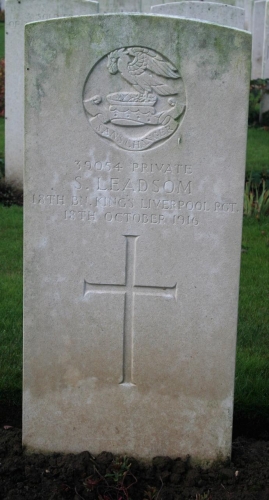
From: Liverpool
K.I.A (110 Years this day)
Wednesday 18th October 1916.
27 years old
Stanley Leadsom was born on the 03rd July, in 1889 in Liverpool and was the son of Archibald Wolley and Jessie(nee Gilmour) Leadsom who were married on the 12th Nov 1873 at St. Michael, Toxteth Park. Archibald was a 23 year old publican of Park Rd, father John a publican, whilst Jess was aged 18 also of Park Rd, father William, a shipwright. Stanley was baptised on the 19th October, 1889 at Stanhope Street Wesleyan Methodist Church, Liverpool,was a year
The 1891 Census shows the family living at 32 Letitia St, Toxteth.
Father Archibald aged 40, a publican born Liverpool, mother Jessie is 36 born Liverpool, children all born Liverpool, Archibald 16 a boy in boot shop, George 9 a scholar, and Stanley 1.
The 1901 Census shows the family have moved to 384 Kell St, Toxteth.
Father Archibald W. aged 50, a barman in a public house, mother Jessie 43, children Archibald 26 a general labourer, George 19 a baker, Stanley 12, Douglas 10 and Harold 6.
The 1911 Census shows the family living at 17 Drysdale St, Liverpool.
His father Archibald is aged 61, born in Liverpool in 1850 and occupation carpet and window cleaner. His wife Jessie is aged 52, born 1859. They have four children living at the address having had ten children but six having subsequently died and all born in Liverpool. Archibald Jnr aged 37, born 1874 has no occupation, Stanley aged 21, Douglas aged 19, born 1892 and Harold aged 16, born 1895 all are employed as Carpet and Window Cleaners.
His father died 1913 aged 64.
He enlisted in Seaforth, Liverpool and was serving in the 18th Battalion, The King’s Liverpool Regiment as Private No 39054 when he was killed in action on the 18th October 1916 aged 27 during the Battle of the Transloy Ridges which was part of the ongoing Somme Offensive.
18th Bn Diary
18th October 1916
Attacked German trenches commencing 3.40 am. Relieved by 19th Manchester Regt. Took up position in support Bn trenches W. of Goose Alley.
Graham Maddocks in his book Liverpool Pals gives an overview of the events of the day:
“At 3.40 am the whistles blew, and the Battalion left its assembly trenches, in three waves, approximately fifty yards apart, and began to cross No Man’s Land. Almost immediately, the German Barrage fell on the first wave and halted its advance, so that the second wave soon caught up with it. This was not a great problem at first, and the two combined waves were able to advance together for about 300 yards, whereupon they encountered the German Grid Trench system. On the right of the advance, it was found that the wire was largely intact, apart from a few gaps, and the Germans bombed and machine gunned these gaps, which prevented any further progress. Elsewhere along the trench, however, the wire was cut and there did not seem to be any serious opposition. Nevertheless, the men hesitated to jump down into the German trenches, and instead, began to filter back across to the safety of their own lines.
By this time the third wave had caught up, as had a fourth wave, which had been detailed to mop up any opposition once the trenches had fallen, and all four waves became intermingled which added to the confusion. No less than three attempts were made to try to get the men to go forward again, but each attempt became markedly less successful than its predecessor, and eventually the attack came to a standstill. Although the British assembly trenches had received the attention of the German guns, the attackers in No Mans Land had not come under any great intensity of fire up until this point.
However, once it became obvious to the Germans that the attack was disorganised and faltering, they began to fire into the massed men from the flanks. It was probably this that finally settled the issue and convinced the Pals that they could no longer gain the enemy trenches, and all four waves, now merged into one, began to retreat to their own lines. The whole attack had been an abysmal failure, and no ground had been gained at all”.
He now rests at Warlencourt British Cemetery, France.
Warlencourt Cemetery is entirely a concentration cemetery, begun late in 1919 when graves were brought in from small cemeteries and the battlefields of Warlencourt and Le Sars. The Graves Registration form shows graves from “Le Sars 6/1, 6/2, Hexham Road, Seven Elms”.
Graves were brought in from the original cemeteries at Hexham Road (Le Sars), and Seven Elms (Flers), as well as over 3,000 British graves due to the fighting which took place around the Butte de Warlencourt from the autumn of 1916 to the spring of 1917, and again in the German advance and retreat of 1918. The cemetery now contains 3,505 Commonwealth burials and commemorations of the First World War, 1,823 of which are unidentified.
Liverpool Daily Post - Wednesday 29 November 1916
Missing.
King’s Liverpool Regiment - Broady, 17046, W. T. (Egremont); Cadwell, 29492 J. J. (Southport); Cromwell, 16706, Corpl. T. L.; Fitzroy, 32741, F; Golothan, 32690, Corpl. W. P. (Chester); Griffiths, 32795, J. W.; Hilditch, 17057, A. J.; Leadsom, 39054, S.; Leighton, 16975, H. N. (Seaforth); Narracott, 17080, F. V.; Orrett, 16984, Sergt. J. S. (Prescot); Poole, 33265, F. (Shrewsbury); Powell, 23167, J.; Rench, 16992, T. F.; Ronson, 16054, G. R.; Speed, 26587, R.; Taylor, 23841, A.
Liverpool Daily Post 19th July 1917
LEADSOM - Reported missing since October 28, 1916, now reported killed in action, aged 27 years, Private Stanley Leadsom K.L.R. (Deeply regretted by his Mother and Brothers, 1 Gilpin Street, Dingle.)
He is also commemorated on the St John the Baptist’s C. of E. Church, Toxteth.
Soldiers Effects to mother Jessie, no Pension record found.
Mother died in 1920 aged 64.
We currently have no further information on Stanley Leadsom, If you have or know someone who may be able to add to the history of this soldier, please contact us.
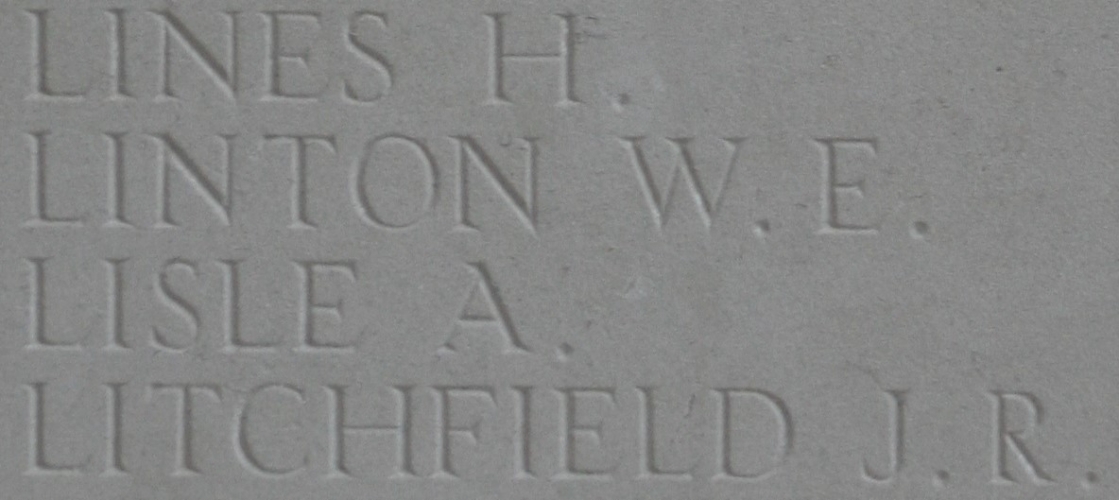
From: Liverpool
K.I.A (110 Years this day)
Wednesday 18th October 1916.
19 years old
Walter Edward Linton was born on the 01st March, 1897 in Liverpool, the son of Henry and Harriet(nee Woods) Linton who were married at Holy Trinity, Parr Mount, St Helens in 1889. Walter was baptised on the 03rd May, 1897 at St Peter’s C. of E. Church, Liverpool.
He was educated at Breckfield School, Liverpool and Bluecoat School in Wavertree.
The 1901 Census shows the family living at Walter living at 76 Thirlmere Road, Anfield Liverpool.
His father, Henry, is aged 31, born in the USA in 1870 and occupation General Labourer. His wife, Harriet, is aged 31, born 1870 in Liverpool. They have six children living at the address and all born in Liverpool. William aged 8, born 1893, George aged 7, born 1894, Harriet aged 5, born 1896, Edward aged 4, born 1897, Harry aged 2, born 1899 and Margaret born in 1901.
His father died aged just 38 in 1908.
The 1911 Census shows Walter living at Church Road, Wavertree, Liverpool as a Scholar. The rest of the family have moved to 6 Boycott St, Everton. Widowed mother Harriet 41 is a char woman, children William Henry aged 18 a shipping clerk, George aged 17 a general labourer, Harriet aged 15, Alfred 7 at school, and Gladys 3.
He enlisted in Prescot, Knowsley and was serving in the 18th Battalion, The King’s Liverpool Regiment as Private No 26640 when he was killed in action on the 18th October 1916 aged 19 during the Battle of the Transloy Ridges which was part of the ongoing Somme Offensive.
18th Bn Diary
18th October 1916
Attacked German trenches commencing 3.40 am. Relieved by 19th Manchester Regt. Took up position in support Bn trenches W. of Goose Alley.
Graham Maddocks in his book Liverpool Pals gives an overview of the events of the day:
“At 3.40 am the whistles blew, and the Battalion left its assembly trenches, in three waves, approximately fifty yards apart, and began to cross No Man’s Land. Almost immediately, the German Barrage fell on the first wave and halted its advance, so that the second wave soon caught up with it. This was not a great problem at first, and the two combined waves were able to advance together for about 300 yards, whereupon they encountered the German Grid Trench system. On the right of the advance, it was found that the wire was largely intact, apart from a few gaps, and the Germans bombed and machine gunned these gaps, which prevented any further progress. Elsewhere along the trench, however, the wire was cut and there did not seem to be any serious opposition. Nevertheless, the men hesitated to jump down into the German trenches, and instead, began to filter back across to the safety of their own lines.
By this time the third wave had caught up, as had a fourth wave, which had been detailed to mop up any opposition once the trenches had fallen, and all four waves became intermingled which added to the confusion. No less than three attempts were made to try to get the men to go forward again, but each attempt became markedly less successful than its predecessor, and eventually the attack came to a standstill. Although the British assembly trenches had received the attention of the German guns, the attackers in No Mans Land had not come under any great intensity of fire up until this point.
However, once it became obvious to the Germans that the attack was disorganised and faltering, they began to fire into the massed men from the flanks. It was probably this that finally settled the issue and convinced the Pals that they could no longer gain the enemy trenches, and all four waves, now merged into one, began to retreat to their own lines. The whole attack had been an abysmal failure, and no ground had been gained at all”.
He has no known grave and is commemorated on the Thiepval Memorial to the Missing fo the Somme, France.
The Thiepval Memorial, the Memorial to the Missing of the Somme, bears the names of more than 72,000 officers and men of the United Kingdom and South African forces who died in the Somme sector before 20 March 1918 and have no known grave. Over 90% of those commemorated died between July and November 1916.
On 01st August 1932 the Prince of Wales and the President of France inaugurated the Thiepval Memorial in Picardy. The inscription reads: “Here are recorded the names of officers and men of the British Armies who fell on the Somme battlefields between July 1915 and March 1918 but to whom the fortune of war denied the known and honoured burial given to their comrades in death.”
Liverpool Daily Post - Wednesday 29 November 1916
Wounded.
King’s (Liverpool Regt.) - Linton, 26640, W.E. ;
He is commemorated on the Blue Coat School War Memorial.
Soldiers Effects and Pension to mother Harriet, 6 Boycott St, Everton
Mother died aged 89 in 1959.
We currently have no further information on Walter Edward Linton, If you have or know someone who may be able to add to the history of this soldier, please contact us.

From: Moston, Manchester
K.I.A (110 Years this day)
Wednesday 18th October 1916.
22 years old
Alan Strutt Morrell was born on the 8th Dec 1893 in New Moston, Manchester(from family tree), the son of Arthur and Martha(nee Slater) Morrell, of 3 Moorfield, Moston Lane, Moston, Manchester, who were married on 26th Dec 1892 at the Christian Church, Mossley. Prior to the outbreak of the war he had been employed by the Cooperative Wholesale Society.
The 1901 Census shows the family living in Vine Fold, Parkfield Rd, Moston Lane, Moston, Manchester.
His father, Arthur, is aged 34, born in Mossley and is a Commercial Clerk. His wife Martha is aged 32, born in Clayton, West Yorkshire, son Alan aged 7, born Moston.
The 1911 Census shows the family living at 3 Moorfield, Moston Lane, Moston, Manchester.
His father, Arthur, is aged 44, born in Mossley in 1867 and is a Commercial Clerk. His wife Martha is aged 42, was born 1869 in Clayton, West Yorkshire. They have been married for 18 years and have had three children of which one had died. Their two children were both born in Moston. Alan aged 17, born 1894 is an Insurance Clerk and Norah aged 7, born 1904 at school.
He enlisted in Manchester and was formerly 2759, 7th Battalion, Manchester Regiment and was serving in the 19th Battalion, The King’s Liverpool Regiment as Private No 52136 when he was killed in action on the 18th October 1916 aged 22 during the Battle of the Transloy Ridges which was part of the ongoing Somme Offensive.
19th Bn Diary
18th October 1916
Zero hour for attack 3.40am. The 21st Brigade attacked on our left, the Battalion immediately on our left being the 2nd Battn. Yorkshire Regiment, to whom 2nd Lieut Rendell was sent as Liaison Officer. The 12th Division attacked on the right, the Battalion immediately on our right being the 5th Battalion Royal Berks Regiment, from whom Lieut Debono was sent to us as Liaison Officer . Advances were made on the far right and far left of the attack, but the Brigades immediately on our left and right were held up. The Battalion was not called upon to advance, merely to hold its position. Two tanks went into action, one got into the German trenches, remaining there for about 25 minutes, killing many Germans and causing many others to run away. Casualties 4 O.R. killed and 4 O.R. wounded. Late in the evening orders were received for the Battalion to take over a portion of the line held by the 21st Infantry Brigade, and No.1 Company, under Captain Dodd, was brought up to effect this, his Company being relieved at Factory Corner by 2 Companies of the 20th Battn K.L.R.
Alan has no known grave and is commemorated on the Thiepval Memorial to the Missing fo the Somme, France.
The Thiepval Memorial, the Memorial to the Missing of the Somme, bears the names of more than 72,000 officers and men of the United Kingdom and South African forces who died in the Somme sector before 20 March 1918 and have no known grave. Over 90% of those commemorated died between July and November 1916.
On 01st August 1932 the Prince of Wales and the President of France inaugurated the Thiepval Memorial in Picardy. The inscription reads: “Here are recorded the names of officers and men of the British Armies who fell on the Somme battlefields between July 1915 and March 1918 but to whom the fortune of war denied the known and honoured burial given to their comrades in death.”
Manchester Evening News 13th Nov 1916
FROM THE DISTRICTS.
OLDHAM.
Lance Corporal ALAN S. MORRELL, Manchester Regiment (attached King's Liverpool Regiment), 3 Moorfield, Moston Lane, New Moston. Well known in Failsworth, killed on October 18, worked in an insurance office in Manchester.
Mossley Reporter 11th November 1916
Died in Action.
Loss to well-known Mossley Family.
Mr. and Mrs. Arthur Morrell of Moston Lane, Failsworth, have this week received official news of the death of their son Lance Corporal Alan Morrell, who was killed in action on October 18th. The only particulars to hand are that he was struck by a shell and killed instantly. Lance Corporal Morrell joined the 7th Manchester Regiment in November 1914 and went to France three months ago. On arrival there he was transferred to the King's Liverpool Regiment and it was whilst fighting with this regiment that he met his death. He was 22 years of age, belonged to a well-known and highly respected family. His grandfather, the late Mr Abraham Morrell, was for a great number of years Secretary of the Mossley Co-operative Society. He himself was in the office of the Co-operative Wholesale Society until he enlisted. The family have a long and honourable connection with the Christian church and Sunday school and the news of Lance Corporal Morrell’s untimely death will be received with general regrets.
He is also commemorated on the Cooperative Wholesale Society Ltd Roll of Honour.
Soldiers Effects to father Arthur, and pension to mother Martha, 3 Moorfield, Moston Lane.
Father died on the 1st May 1929, probate 28th May to Martha widow and Nora Nuttall. Effects £2433 23s 2d.
Mother died on the 4th Dec 1933 and is buried at Failsworth Cemetery.
We currently have no further information on Alan Strutt Morrrell, If you have or know someone who may be able to add to the history of this soldier, please contact us.

From: Hoylake, Cheshire
K.I.A (110 Years this day)
Wednesday 18th October 1916.
29 years old
John Peattie Morris was born in the September Qtr 1887 at Hoylake and was and baptised on the 28th Sept 1887 at Holy Trinity Church. He was the son of John Morris and his wife Margaret Jane (née Smith). His parents married on the 17th Sep 1877 at the Parish Church, Llangollen, Denbigh. John was a 30 year old golf club maker of Hoylake, father George, whilst Margaret was aged 23 of Llangollen, father William a flour merchant. They had ten children, John had older siblings Agnes, Thomas, Esther, Margaret, and Jane, and younger siblings George, Marion, Dorothy, and James. He was educated at Calday Grange Grammar School before becoming a shipping clerk.
On the 1891 census the family are living at 218 Valentine Rd, Hoylake.
Father John is aged 43, a golf club manufacturer b.St Andrews, Fife, mother Margaret J. is 36 b.Hoylake, children all born Hoylake, Agnes 12 a scholar, Thomas 10 a scholar, Esther 8 a scholar, Margaret S. 6 a scholar, Jane B. 5 a scholar, John P. 3, George 2, Marion 5mths, and 2 servants.
The 1901 Census shows the family living at 20 Cable Road, Hoylake, Cheshire.
His father John is aged 53, born in Scotland in 1848 and is a Golf Club Manufacturer. His wife Martha (Margaret) is aged 47, born 1854 in Hoylake, Cheshire. They have eight children all born in Hoylake. Agnes aged 22, born 1879, Margaret aged 17, born 1884 both have no occupation listed. Jane aged 15, born 1886, John aged 13, George aged 12, born 1889, Marion aged 10, born 1891 Dorothy aged 8, born 1893 and James aged 6, born 1895 are all still in school.
The 1911 Census shows the family still living at 20 Cable Road.
His father, 63, is now a golf professional at the Royal Liverpool Golf Club. His mother is not in the household. Six of the children are living at home: Agnes, 32, Jane, 25, and Dorothy, 18, have no occupation, while Marion, is a typist in the shipping trade. John, 23, and James, 16, are clerks, John in shipping and James in the corn trade.
His brothers Thomas and George both emigrated to the United States and became golf professionals.
John enlisted on the 31st August, 1914 at St George's Hall in Liverpool, joining the 18th Battalion of The King's Liverpool Regiment as Private 16981. He was aged 26 years and 330 days and gave his occupation as Shipping Clerk. He was five foot, ten inches tall, weighed 154lbs, 38” chest, of fair complexion, had brown eyes, brown hair and gave his religion as Church of England. He gave his father as next of kin at 37 Church Road, Hoylake.
From the 23rd September 1914 he was billeted at Hooton Park Race Course and remained there until 03rd December 1914 when they moved into the hutted accommodation at Lord Derby’s estate at Knowsley Hall. On 30th April 1915 the 18th Battalion alongside the other three Pals battalions left Liverpool via Prescot Station for further training at Belton Park, Grantham. They remained here until September 1915 when they reached Larkhill Camp on Salisbury Plain.
His service records show:
19.02.15: Appointed unpaid Lance Corporal.
06.03.15: Appointed Lance Corporal.
01.11.15: Promoted to Corporal.
07.11.15: Embarked for France with his Battalion.
28.12.15: To 97th Field Ambulance for skin trouble and muscular strain.
29.12.15: 96th Field Ambulance for strain.
07.01.16: Return to Duty.
11.01.16: To F.A. for Rash.
19.01.16: Return to Duty.
02.08.16: C.C.S. Bronchitis and Right Foot.
31.08.16: Granted Class 1 Proficiency of Pay.
He was killed in action on the 18th October 1916, aged 29, during the Battle of the Transloy Ridges which was part of the ongoing Somme Offensive.
18th Bn Diary
18th October 1916
Attacked German trenches commencing 3.40 am. Relieved by 19th Manchester Regt. Took up position in support Bn trenches W. of Goose Alley.
Graham Maddocks in his book Liverpool Pals gives an overview of the events of the day:
“At 3.40 am the whistles blew, and the Battalion left its assembly trenches, in three waves, approximately fifty yards apart, and began to cross No Man’s Land. Almost immediately, the German Barrage fell on the first wave and halted its advance, so that the second wave soon caught up with it. This was not a great problem at first, and the two combined waves were able to advance together for about 300 yards, whereupon they encountered the German Grid Trench system. On the right of the advance, it was found that the wire was largely intact, apart from a few gaps, and the Germans bombed and machine gunned these gaps, which prevented any further progress. Elsewhere along the trench, however, the wire was cut and there did not seem to be any serious opposition. Nevertheless, the men hesitated to jump down into the German trenches, and instead, began to filter back across to the safety of their own lines.
By this time the third wave had caught up, as had a fourth wave, which had been detailed to mop up any opposition once the trenches had fallen, and all four waves became intermingled which added to the confusion. No less than three attempts were made to try to get the men to go forward again, but each attempt became markedly less successful than its predecessor, and eventually the attack came to a standstill. Although the British assembly trenches had received the attention of the German guns, the attackers in No Mans Land had not come under any great intensity of fire up until this point.
However, once it became obvious to the Germans that the attack was disorganised and faltering, they began to fire into the massed men from the flanks. It was probably this that finally settled the issue and convinced the Pals that they could no longer gain the enemy trenches, and all four waves, now merged into one, began to retreat to their own lines. The whole attack had been an abysmal failure, and no ground had been gained at all”.
John now rests at Warlencourt British Cemetery, France.
Warlencourt Cemetery is entirely a concentration cemetery, begun late in 1919 when graves were brought in from small cemeteries and the battlefields of Warlencourt and Le Sars. The Graves Registration form shows graves from “Le Sars 6/1, 6/2, Hexham Road, Seven Elms”.
Graves were brought in from the original cemeteries at Hexham Road (Le Sars), and Seven Elms (Flers), as well as over 3,000 British graves due to the fighting which took place around the Butte de Warlencourt from the autumn of 1916 to the spring of 1917, and again in the German advance and retreat of 1918. The cemetery now contains 3,505 Commonwealth burials and commemorations of the First World War, 1,823 of which are unidentified.
His Casualty Form shows Wounded in Action dated 18th October 1916, then later Wounded and Missing. His family was notified accordingly, as enquiries were made with the International Red Cross in Geneva in hopes that John, Cpl. 16981, 4th Company, wounded and missing on 18/10/1916, had been taken prisoner.
Mr. A. (sic, possibly his sister Agnes), from 37 Church Road, Hoylake, was informed on 24th January 1917 that they held no information on John.
A Miss May Davies (relationship unknown), of Lyndale, 31 Avenue Road, Southall, Middlesex, received a negative reply on the same date, and also to a subsequent enquiry on 26th April 1917.
On 11th March 1917 a report was received from the O/C 2nd Hants (?), stating that this soldier had been killed in action and buried, giving a map reference near Guillemont.
John earned his three medals.
His Army pay and a War Gratuity of £10 went to his sister Agnes.
Probate 1917:-
MORRIS John Pettie of 37 Church Road, Hoylake Cheshire corporal died 18 October 1916 in France Administration (with Will) London 4 July to Agnes Morris spinster. Effects £377 16s 7d.
His youngest brother James served in the 2/6th K.L.R. (attached L.T.M.B.). He was killed in action on 15th July 1917 (per CWGC record, although his parents were apparently told a different date). James was 22. He now rests at Cité Bonjean Military Cemetery, Armentières.
The Scotsman 24th July 1917
MORRIS - Killed in action, 18th July 1917, JAMES HUNTER MORRIS, King's Liverpool, aged 22, and on 18th October 1916, JOHN PEATTIE MORRIS, King's Liverpool Regiment, age 29, beloved sons of John Morris, The Haven, Hoylake, Cheshire.
No pension card has been found for either son, suggesting that his parents made no application.
On the second anniversary of his death in 1918 his father placed a notice in the Liverpool Post:
“In loving memory of John Peattie Morris, killed in action October 18, 1916; also James Hunter Morris, killed in action July 16, 1917, the beloved sons of John Morris, Church Road, Hoylake.”
His father died in 1929, aged 82, and his mother in 1934 aged 80.
Permission was granted in 1919 to erect three stained glass windows in Holy Trinity Church, Hoylake, one of which was dedicated to the memory of John and James Morris. It is not known what became of the memorial windows when the church was demolished in the 1970s.
John is also commemorated on the following Memorials:
Grange Hill War Memorial, West Kirby
Holy Trinity Churchyard, Hoylake
Holy Trinity Church (now in St Hildeburgh's Church)
And on the family gravestone in Holy Trinity graveyard, Hoylake -
In Ever Loving Memory of...
ALSO HIS SONS
JOHN PEATTIE MORRIS
18TH KINGS L’POOL REGT
FELL IN FRANCE 18TH OCT. 1916
AGED 29 YEARS
JAMES HUNTER MORRIS
2/6TH KINGS L’POOL REGT
FELL IN FRANCE 16TH JULY 1917
AGED 22 YEARS
GREATER LOVE HATH NO MAN THAN THIS
Father died aged 82 on the 28th Nov 1929.
Probate 1930:-
MORRIS John of 18 Cable Road, Hoylake Cheshire died 28 November Administration Liverpool 30 February to George Morris, publisher, Leonard Mickle, cotton salesman, Agnes Morris spinster. Effects £15,617.
Mother died 8th Aug 1934 aged 79.
Probate 1934:-
MORRIS Margaret Jane widow of 18 Cable Road, Hoylake Cheshire died 8 August Administration Liverpool 31 December to Agnes Morris spinster. Effects £2616 17s 8d.
We currently have no further information on John Peattie Morris, If you have or know someone who may be able to add to the history of this soldier, please contact us.
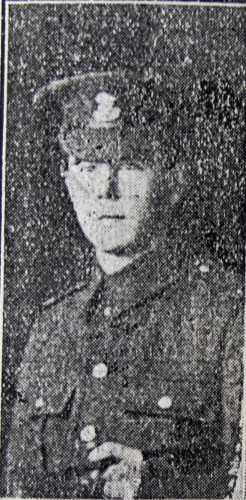
From: Liverpool
K.I.A (110 Years this day)
Wednesday 18th October 1916.
23 years old
Frank Valentine Narracott was born in 1893 in Liverpool and was the son of Matthew Henry Narracott and his wife Isabella Charlotte (nee Stewart) who were married in 1888 in the Liverpool Registration district. Prior to the outbreak of war he had been employed on the Clerical Staff of Cunard Steam Co at Derby Road, Bootle. Frank was a cotton clerk in 1911.
The 1901 Census shows the family living at 7 Recreation Street, Bootle cum Linacre.
Father Matthew H. 39 a joiner, b.Leicester, mother Isabella 37 b.Liverpool, children all born Liverpool, Matthew 12, Henry 9, Frank 7, Ronald 6 and Nellie 3.
The 1911 Census shows the family now living at 58 Boswell Street, Bootle.
Father Matthew H. 49 a joiner, mother Isabella 47, children Matthew 22 a bricklayer, Henry 19 sugar clerk, Frank 17 cotton clerk, Ronald 16 apprentice plumber, and Nellie 13 at school. The parents had been married 24 years with 8 children born and 5 still alive.
Frank enlisted on the 31st August 1914 at St George's Hall in Liverpool, joining the 18th Battalion of The King's Liverpool Regiment. he was aged 20 years and 300 days and gave his occupation as a Clerk. He was 5ft 7 inches tall, weighed 140lbs, 34” chest, had a fair complexion, blue eyes, brown hair and gave his religion as Baptist. His NOK was father Matthew, 58 Boswell St.
From the 23rd September 1914 he was billeted at Hooton Park Race Course and remained there until 03rd December 1914 when they moved into the hutted accommodation at Lord Derby’s estate at Knowsley Hall. On 30th April 1915 the 18th Battalion alongside the other three Pals battalions left Liverpool via Prescot Station for further training at Belton Park, Grantham. They remained here until September 1915 when they reached Larkhill Camp on Salisbury Plain.
His service records have survived and show :
29.08.15: At Knowsley he was absent without leave between 12 midday on 29.08.15 to 01:00am on the 30.08.15. Awarded forfeiture of Indulgences for three days.
26.09.15: At Knowsley he was absent without leave between 12 midday on 26.09.15 to 10:15am on the 27.09.15. Punishment of three days confined to Barracks awarded 28.09.15.
29.12.15: Embarked for France.
30.12.15: Arrived at Etaples.
07.01.16: Attached to No2 Entrenching Battalion.
17.05.16: whilst on duty attached to 120(railway Company) Royal Engineers at Borre Siding he lacerated his Right Index Finger.
18.05.16: Admitted to 3rd Canadian General Hospital, Boulogne.
23.05.16: To Depot.
02.06.16. Discharge to Base.
08.06.16: Etaples.
08.06.16: Boulogne Classified “A”
He was serving in the 18th Battalion, The King’s Liverpool Regiment as Private No 17080 when he was killed in action on the 18th October 1916, aged 23, during the Battle of the Transloy Ridges which was part of the ongoing Somme Offensive.
18th Bn Diary
18th October 1916
Attacked German trenches commencing 3.40 am. Relieved by 19th Manchester Regt. Took up position in support Bn trenches W. of Goose Alley.
Graham Maddocks in his book Liverpool Pals gives an overview of the events of the day:
“At 3.40 am the whistles blew, and the Battalion left its assembly trenches, in three waves, approximately fifty yards apart, and began to cross No Man’s Land. Almost immediately, the German Barrage fell on the first wave and halted its advance, so that the second wave soon caught up with it. This was not a great problem at first, and the two combined waves were able to advance together for about 300 yards, whereupon they encountered the German Grid Trench system. On the right of the advance, it was found that the wire was largely intact, apart from a few gaps, and the Germans bombed and machine gunned these gaps, which prevented any further progress. Elsewhere along the trench, however, the wire was cut and there did not seem to be any serious opposition. Nevertheless, the men hesitated to jump down into the German trenches, and instead, began to filter back across to the safety of their own lines.
By this time the third wave had caught up, as had a fourth wave, which had been detailed to mop up any opposition once the trenches had fallen, and all four waves became intermingled which added to the confusion. No less than three attempts were made to try to get the men to go forward again, but each attempt became markedly less successful than its predecessor, and eventually the attack came to a standstill. Although the British assembly trenches had received the attention of the German guns, the attackers in No Mans Land had not come under any great intensity of fire up until this point.
However, once it became obvious to the Germans that the attack was disorganised and faltering, they began to fire into the massed men from the flanks. It was probably this that finally settled the issue and convinced the Pals that they could no longer gain the enemy trenches, and all four waves, now merged into one, began to retreat to their own lines. The whole attack had been an abysmal failure, and no ground had been gained at all”.
He was originally posted as Missing and was reported as such in the Bootle Times 24th November 1916
Information is sought concerning Private Frank V. Narracott, K.L.R., who previous to joining the colours resided with his parents at 58, Boswell-Street, Bootle. Before joining the Army he was a member of the clerical staff of the Cunard Company at Derby-Road.
Liverpool Daily Post - Wednesday 29 November 1916
Missing.
King’s Liverpool Regiment - Broady, 17046, W. T. (Egremont); Cadwell, 29492 J. J. (Southport); Cromwell, 16706, Corpl. T. L.; Fitzroy, 32741, F; Golothan, 32690, Corpl. W. P. (Chester); Griffiths, 32795, J. W.; Hilditch, 17057, A. J.; Leadsom, 39054, S.; Leighton, 16975, H. N. (Seaforth); Narracott, 17080, F. V.; Orrett, 16984, Sergt. J. S. (Prescot); Poole, 33265, F. (Shrewsbury); Powell, 23167, J.; Rench, 16992, T. F.; Ronson, 16054, G. R.; Speed, 26587, R.; Taylor, 23841, A.
Liverpool Echo 22nd Aug 1917
NARRACOTT - Reported missing, now officially presumed killed, October 18,1916, aged 23 years, Frank Valentine (K.L.R.), the third beloved son of Mr and Mrs Narracott, 58 Boswell Street, Bootle.
Frank has no known grave and is commemorated on the Thiepval Memorial to the Missing for the Somme, France.
The Thiepval Memorial, the Memorial to the Missing of the Somme, bears the names of more than 72,000 officers and men of the United Kingdom and South African forces who died in the Somme sector before 20 March 1918 and have no known grave. Over 90% of those commemorated died between July and November 1916.
On 01st August 1932 the Prince of Wales and the President of France inaugurated the Thiepval Memorial in Picardy. The inscription reads: “Here are recorded the names of officers and men of the British Armies who fell on the Somme battlefields between July 1915 and March 1918 but to whom the fortune of war denied the known and honoured burial given to their comrades in death.”
He is also commemorated on the following Memorials:
Bootle Civic Memorial
Christ Church C. of E. Church, Bootle
Ash Street Baptist Mission, Bootle
Christ Church C. of E. School, Bootle
Cunard Steam Co Plaques and Roll of Honour now situated in Our Lady and St Nicholas Church, Liverpool
St Leonard’s C. of E. Church, Bootle.
Soldiers Effects to father Matthew H., Pension to father and sister Nellie M.
Mother Isabella died aged 55 in 1919.
Brother Henry served as L/Cpl 22187 KLR.
Liverpool Daily Post 25th July 1916
FALLEN AND WOUNDED "PALS"
Corporal H.S. Narracott has been seriously wounded and is in hospital at Stockport with his left leg amputated. He was employed by the Sicilian Marble Company Ltd, Vauxhall Road, and resided with his parents at 58 Boswell Street, Bootle. He has three brothers in France.
He was Gazetted for the Military Medal on the 14th Dec 1916.
He was discharged on 17th Feb 1917 and received a Pension.
Brother Ronald served as Pte 1274 KLR, and Pte 325148 Lancashire Fusiliers.
His brother, Matthew Fleming Narracott served with the Labour Corps (No 36409) and was discharged from the army on the 11th October 1919
Father died in hospital on the 4th June 1938 aged 77.
Liverpool Daily Post - Tuesday 07 June 1938
NARRACOTT - June 4 in hospital, aged 77, MATTHEW HENRY, husband of the late Isabella Narracott, 58 Boswell Street, Bootle. Interment at Bootle Cemetery to-morrow (Wednesday) at 4pm. (No mourning.)
We currently have no further information on Frank Valentine Narracott, If you have or know someone who may be able to add to the history of this soldier, please contact us.

From: Hulme, Manchester
K.I.A (110 Years this day)
Wednesday 18th October 1916.
21 years old
Harry Owen was born in Hulme, Manchester on 30th May 1895, the youngest son of Thomas Owen and his wife Martha (nee Owen) who married on the 15th July 1883 at Holy Trinity Church, Hulme. Thomas, born in Chester, was aged 25, a tin case maker of 25 Upper Duke St, father Samuel, whilst Martha, born in Manchester, was aged 28, same address, father William. They had six children, all boys, and his brothers were Thomas, George (who died age 6), James (died age 2), William, and Arthur. Harry was baptised also at Holy Trinity on the 10th July 1895.
The family lived at 64 Warde Street in Hulme from at least 1891.
In 1901 his father is 42, a packing case maker, his mother is 45, children born Manchester: Thomas is 17, a saddler, William is 10, Arthur 8, and Harry 5. They also have a boarder Percy Lewis aged 16.
His father died on the 11th Sept 1910, aged 52.
The 1911 Census shows the family are still living at 64 Warde Street, Manchester.
His mother Martha is a widow, aged 55, born 1856 and advises that she had been married for 28 years, had six children of which two died (entry crossed out). All the children being born in Manchester. Listed in the household are; Thomas aged 27, born 1884 occupation saddler, William aged 22, born 1891 is a tin packing case maker, Arthur aged 18, born 1893 is a grey cloth manufacturers clerk and Harry aged 15, occupation pawnbroker's assistant.
Prior to the outbreak of the war, Harry was employed by a Mr Jones of Tamworth Street, Hulme.
He enlisted in Manchester and served initially as Private 2994 with the Manchester Regiment. His regimental number suggests that he enlisted in August/September 1914 (length of service supported by the amount of the War Gratuity). This number was assigned to men of the 11th/12th/13th battalions of the Manchester Regiment. No 1914-1915 Star has been found, indicating that he arrived overseas some time in 1916. His Medal Roll shows only service overseas with the 19th K.L.R.
Following a transfer he was serving in the 19th Battalion, The King’s Liverpool Regiment as Private No 52163 when he was killed in action on the 18th October 1916, aged 21, during the Battle of the Transloy Ridges which was part of the ongoing Somme Offensive.
18th Bn Diary
18th October 1916
Attacked German trenches commencing 3.40 am. Relieved by 19th Manchester Regt. Took up position in support Bn trenches W. of Goose Alley.
Graham Maddocks in his book Liverpool Pals gives an overview of the events of the day:
“At 3.40 am the whistles blew, and the Battalion left its assembly trenches, in three waves, approximately fifty yards apart, and began to cross No Man’s Land. Almost immediately, the German Barrage fell on the first wave and halted its advance, so that the second wave soon caught up with it. This was not a great problem at first, and the two combined waves were able to advance together for about 300 yards, whereupon they encountered the German Grid Trench system. On the right of the advance, it was found that the wire was largely intact, apart from a few gaps, and the Germans bombed and machine gunned these gaps, which prevented any further progress. Elsewhere along the trench, however, the wire was cut and there did not seem to be any serious opposition. Nevertheless, the men hesitated to jump down into the German trenches, and instead, began to filter back across to the safety of their own lines.
By this time the third wave had caught up, as had a fourth wave, which had been detailed to mop up any opposition once the trenches had fallen, and all four waves became intermingled which added to the confusion. No less than three attempts were made to try to get the men to go forward again, but each attempt became markedly less successful than its predecessor, and eventually the attack came to a standstill. Although the British assembly trenches had received the attention of the German guns, the attackers in No Mans Land had not come under any great intensity of fire up until this point.
However, once it became obvious to the Germans that the attack was disorganised and faltering, they began to fire into the massed men from the flanks. It was probably this that finally settled the issue and convinced the Pals that they could no longer gain the enemy trenches, and all four waves, now merged into one, began to retreat to their own lines. The whole attack had been an abysmal failure, and no ground had been gained at all”.
Harry has no known grave and is commemorated on the Thiepval Memorial to the Missing of the Somme, France.
The Thiepval Memorial, the Memorial to the Missing of the Somme, bears the names of more than 72,000 officers and men of the United Kingdom and South African forces who died in the Somme sector before 20 March 1918 and have no known grave. Over 90% of those commemorated died between July and November 1916.
On 01st August 1932 the Prince of Wales and the President of France inaugurated the Thiepval Memorial in Picardy. The inscription reads: “Here are recorded the names of officers and men of the British Armies who fell on the Somme battlefields between July 1915 and March 1918 but to whom the fortune of war denied the known and honoured burial given to their comrades in death.”
His loved ones paid tribute in the Manchester Evening News on 09th November 1916:
“Owen - Private Harry, 52163 Manchester Regiment, attached King’s Liverpool Regiment, killed in action October 18, 1916. - From his sorrowing Mother and Brothers, 64 Warde Street, Hulme.
No one knows how much we miss him,
No, not one on earth can tell;
Only dear ones left behind him,
Only those who loved him well.”
“Owen - Private Harry, 52163 Manchester Regiment, attached King’s Liverpool Regiment, killed in action October 18, 1916.
Sleep on, dear Harry, in a far-off grave,
In a grave I shall never see;
As long as life and memory lasts
I shall always think of thee.
From his sorrowing sweetheart, Elsie.”
On the first anniversary of his death, his loved ones placed In Memoriam notices:
“In loving memory of my dear son and brother, Private Harry Owen, killed in action in France October 18, 1916, age 21.
His tender words and smiling face
Are pleasant to recall;
He had a loving word for all
And died beloved by all.
Sadly missed by his sorrowing Mother, Brothers, and Elsie. - 64 Warde Street, Hulme.”
“In loving memory of Private H. Owen, 52163, killed in action October 18, 1916. Some day we will meet again. - Deeply mourned by his sweetheart Elsie.”
Manchester Evening News - Tuesday 11 September 1917
OWEN—ln loving memory of my dear husband and father, THOMAS OWEN, who died September 11, 1910.
There is a link death cannot sever;
Love and remembrance last for ever.
WIFE and SONS, 64, Warde-street, Hulme.
On the first anniversary of his death, his loved ones placed In Memoriam notices in the Manchester Evening News - Thursday 18 October 1917:
And in the Manchester Evening News - Friday 18 October 1918:
“In loving memory of our dear brother, Private Harry Owen, 19th King’s Liverpools, killed in action at Flers, France, October 18, 1916.
When the great day breaks we shall meet together once more. From his loving brother and sister Tom and Gertie.
"I think of you dear brother, no eyes can see me weep, many a silent tear I shed while others are asleep". From his loving brother Will.
"His smiling face and cheerful ways bring back memories of such happy days" From his loving brother and sister Arthur and Alice, 64 Warde Street., Hulme.”
“In loving memory of Private H. Owen, 52163, killed in action October 18, 1916.
God takes the loved ones from our homes but never from our hearts. Aunt, Uncle, and Cousin Elsie, 83 Pollard St.
His Army pay went to his mother and brother Arthur, and the War Gratuity of £9 was shared between his brothers Thomas, William, and Arthur.
Arthur attested in December 1915, and was mobilised in June 1916. He was sent to France in December 1916, but returned home less than three months later, in March 1917 with valvular disease of the heart. He was discharged in August 1917 with a Silver War Badge and a partial pension.
The pension card in the name of his mother Martha, at 64 Warde Street, does not indicate whether a pension was awarded. She died in April 1918, aged 62.
Harry is commemorated on the family headstone in Southern Cemetery, Manchester -
ALSO PTE. HARRY OWEN
SON OF THE ABOVE
19TH KINGS LIVERPOOL REGT.
KILLED IN FRANCE OCT. 18TH 1916
IN HIS 22ND YEAR
THE SUPREME SACRIFICE - HIS LIFE
We currently have no further information on Harry Owen, If you have or know someone who may be able to add to the history of this soldier, please contact us.
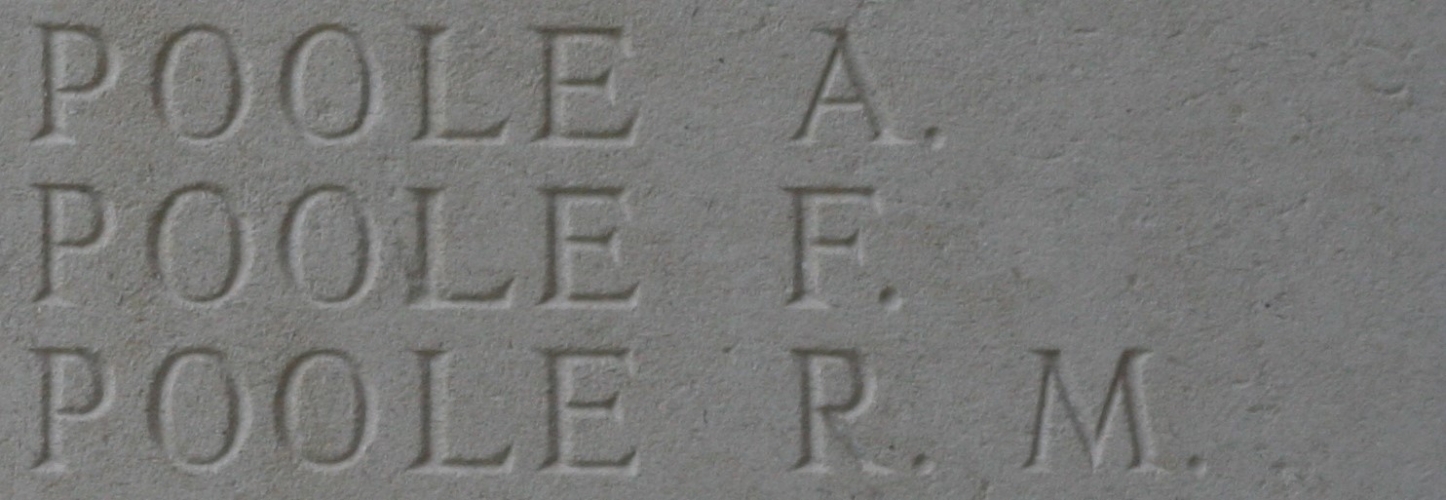
From: Shrewsbury, Salop
K.I.A (110 Years this day)
Wednesday 18th October 1916.
37 years old
SDGW gives this soldier’s place of birth as Shrewsbury, Shropshire, and an online site, St. Michael’s Church War Memorial, gives Frank Poole’s age as 36. There were two Frank Pooles born in the Shrewsbury area in 1880 +/- 4 years. One died in 1912, so it appears this soldier was born in the June quarter of 1879, the son of Edward Poole and Eliza (née Woodall). Both born in Shrewsbury, they married in 1868. Six births have been found; Frank had older siblings Edward, Emily, William (who died at age 2), and Richard (who died in infancy), and a younger sister Eleanor or Helena.
The 1881 census finds the family in School Lane, Shrewsbury. His father, 37, is a lead grinder, his mother is 36, Edward is 11, Emily 10, and Frank 2. In the household are his grandmother Emma Woodall, 61, and aunt Emma, 25.
His father died in 1887 aged 43, when Frank was 7 or 8 years old.
By 1891 they are living at 14 York Place, Shrewsbury. His mother Eliza (age listed as 44) is head of household, Edward 21, is an iron moulder, Frank is 11, and Eleanor 6.
It is not known when his mother died, but by 1901 Frank is living with married sister Emily Griffiths, 30, and her three young children in Sheinton, 12 miles southeast of Shrewsbury. Frank is 21, occupation illegible (cement business?), worker.
In 1911 Frank is lodging at 34A New Park Road, Castle Fields, Shrewsbury with a work colleague, Edward Farmer and family. Frank, 31, like Edward, is a farm implement maker in an ironworks.
The Perseverance Iron Works in Castle Forgate produced a wide range of agricultural machinery and equipment, including “World Famed Ploughs” and was one of the largest employers in the town.
Frank married Mary Jane Kite in early 1912 and their son William James was born on 12th April 1914.
The amount of the War Gratuity suggests that he enlisted in about April 1915.
Frank enlisted in Shrewsbury and was formerly 18313, Shropshire Light Infantry. The amount of the War Gratuity suggests that he enlisted in about April 1915. He was transferred to the 2nd (Garrison) Bn, King’s Liverpool Regiment with regimental number 33265. The medal roll shows only K.L.R., indicating that Frank transferred out of the S.L.I. before being posted overseas. The 2nd (Garrison) Battalion, K.L.R. was formed at Pembroke Dock in November 1915 and moved to Egypt in March 1916 then to Salonika.
Following a transfer he was serving in the 18th Battalion, The King’s Liverpool Regiment as Private No 33265 when he was killed in action on the 18th October 1916 during the Battle of the Transloy Ridges which was part of the ongoing Somme Offensive.
18th Bn Diary
18th October 1916
Attacked German trenches commencing 3.40 am. Relieved by 19th Manchester Regt. Took up position in support Bn trenches W. of Goose Alley.
Graham Maddocks in his book Liverpool Pals gives an overview of the events of the day:
“At 3.40 am the whistles blew, and the Battalion left its assembly trenches, in three waves, approximately fifty yards apart, and began to cross No Man’s Land. Almost immediately, the German Barrage fell on the first wave and halted its advance, so that the second wave soon caught up with it. This was not a great problem at first, and the two combined waves were able to advance together for about 300 yards, whereupon they encountered the German Grid Trench system. On the right of the advance, it was found that the wire was largely intact, apart from a few gaps, and the Germans bombed and machine gunned these gaps, which prevented any further progress. Elsewhere along the trench, however, the wire was cut and there did not seem to be any serious opposition. Nevertheless, the men hesitated to jump down into the German trenches, and instead, began to filter back across to the safety of their own lines.
By this time the third wave had caught up, as had a fourth wave, which had been detailed to mop up any opposition once the trenches had fallen, and all four waves became intermingled which added to the confusion. No less than three attempts were made to try to get the men to go forward again, but each attempt became markedly less successful than its predecessor, and eventually the attack came to a standstill. Although the British assembly trenches had received the attention of the German guns, the attackers in No Mans Land had not come under any great intensity of fire up until this point.
However, once it became obvious to the Germans that the attack was disorganised and faltering, they began to fire into the massed men from the flanks. It was probably this that finally settled the issue and convinced the Pals that they could no longer gain the enemy trenches, and all four waves, now merged into one, began to retreat to their own lines. The whole attack had been an abysmal failure, and no ground had been gained at all”.
He has no known grave and is commemorated on the Thiepval Memorial to the Missing of the Somme, France.
Frank was initially declared Missing in Action. Over four months later, on 24th February 1917, his wife requested information in the Wellington Journal and Shrewsbury News:
“Pte. Frank Poole, 33265, Liverpool Regt, has been missing since October 18 last year. Any comrades who can give news are asked to write to his wife at 3, Britannia Place, Castleforgate, Shrewsbury.”
His death was later presumed for official purposes as having occurred on or since 18th October 1916. Based on his birth registration, Frank would have been 37 years old when he died.
His son was just two years old when Frank was killed. His widow Mary Jane, at 96 New Park Road, Castle Forgate, Shrewsbury, received his Army effects, including a War Gratuity of £5-10s. She was awarded a pension of 18/9d a week for herself and child from June 1917.
Frank’s medals, the British War Medal and Victory Medal, were returned, reason unknown.
His widow never remarried. In 1939 Mary Jane, 64, is living at 19 Cross Hill, Shrewsbury with son William, 25, a Coop shop assistant.
Mary Jane lived through the Second World War and died in 1949, aged 74. His son William lived to the age of 88, and died in 2002.
Frank is also commemorated on the following Memorials:
Castle Fields, Shropshire War Memorial
St. Michael’s Church, Shrewsbury
We currently have no further information on Frank Poole, If you have or know someone who may be able to add to the history of this soldier, please contact us.
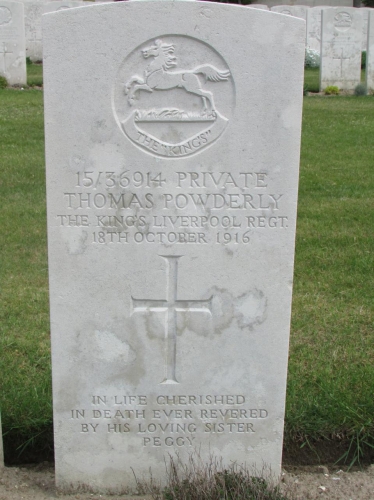
From: Kirkdale, Liverpool
D.O.W (110 Years this day)
Wednesday 18th October 1916.
33 years old
Thomas Powderly was born in 1883 in Kirkdale and was the son of Thomas Powderly and his wife Margaret (nee Rafferty) who were married around 1865 in Kingscourt, County Cavan. His parents and older sisters - Ellen, Ann, Bridget and Margaret - were all born in Kingscourt, County Cavan. Ireland. The Powderly family had moved to Liverpool by 1880 when Thomas' brother, Philip, was born.
The 1881 Census shows the family living at 6 Back Lodwick Street, Kirkdale. His father, Thomas, is aged 39, a coal labourer, mother Margaret is aged 40, children Ellen 14, a confectionary cook’s assistant, Ann 12 a scholar, Bridget 9 a scholar, Margaret 6 a scholar, and Philip is aged 7 months.
His father died, aged 48, shortly before the next census was taken and was buried on the 16th March 1891 at Ford Cemetery.
The 1891 Census shows the family living at 5 Boston Street, Bootle cum Linacre. His widowed mother, Margaret, is aged 49 born in Ireland. She declares five children in the household; Annie aged 22, a domestic servant born in Ireland, Margaret aged 16, a book folder also born in Ireland, Philip aged 10, a scholar born in Liverpool and Thomas 8, a scholar also born in Liverpool. They also have a boarder Patrick Martin 37 a dock porter born in Ireland.
The family in the 1901 Census are still at 5 Boston Street, Bootle cum Linacre. His mother, Margaret, is now said to be aged 56, There are three children in the household; Margaret said to be aged 24, a book binder, Philip 20, a dock labourer, and Thomas aged 18 who is a Grocers Assistant.
The 1911 Census has the family living with the widowed sister of Thomas, Ellen Harrison at 60 Wordsworth Street, Bootle. The head of the household is Ellen Harrison 43 born in Kingscourt, County Cavan, her children born in Bootle are; Ellen 9, John 7, Thomas James 5. His mother, Margaret is now said to be aged 73, with her children Margaret 34 a book folder and Thomas 28 a warehouseman and shop assistant for a grocer.
His mother died in 1914, aged 75 and was buried on the 07th March 1914 at Ford Cemetery.
Thomas enlisted in Liverpool and was serving in the 20th Battalion of The King’s Liverpool Regiment as Private No 36914.
Cwgc have his service no. 15/36914, similar service numbers enlisted in Seaforth around March-April 1916 as 15/369xx in the 15th(Reserve) Bn.
https://www.cwgc.org/find-records/find-war-dead/casualty-details/504935/thomas-powderly/
He died of wounds with 1 Coy on the 18th October 1916, aged 33, during the Battle of the Transloy Ridges which was part of the ongoing Somme Offensive.
20th Battalion War Diary
FLERS SUPPORT TRENCH
17.10.16 - Artillery active on both sides during the day. Battalion H.Q. at ABBEY ROAD heavily shelled during the afternoon.
18.10.16 - The attack was continued at 3.20 a.m.(89th Inf. Bde 0.0.No.61) by the 21st Inf. Bde. The objective was the line drawn from the EAUCOURT L’ABBAYE ROAD to BAYONET TRENCH. The Battalion held themselves in readiness to provide carrying and working parties.
5.25 a.m. The Btn was ordered to hold itself in readiness to support the 21st Inf. Bde but was not called upon. According to information obtained the 21st Inf. Bde appear to have been held up, and later to have consolidated enemy front line. Two tanks two part in this operation. Many enemy bombing attacks took place. FLERS SUPPORT shelled during the day.
8.30p.m. In accordance with 89th Inf. Bde were B.M.132 Nos 3 + 4 Coys made up to 60 O.R. each echoed? 2 Coys 19th Bn. K.L.R. in FACTORY TRENCH at 8.30 p.m. and came into support to 19th Bn. K.L.R.
2 Officers 100 O.R. acted as bearers to 21st Inf. Bde from 12 noon to about 12 midnight. They were held in readiness from 8.30 a.m.
His death was reported in the Liverpool Echo on Thursday 26 October 1916:
POWDERLY - October 18, at a hospital of wounds received in action, October 18, Thomas Powderly, K.L.R., lately residing with his sisters at 60 Wordsworth Street, Bootle. (Sadly missed by his devoted sister Maggie.)
Also in the Liverpool Echo on Friday 18 October 1918:
POWDERLY - In sad remembrance of my beloved brother, THOMAS POWDERLY, 20th K.L.R., who died from wounds at Le Toquay, October 18, 1916.
(Le Toquay – probably means the Duchess of Westminster's (No.1 Red Cross) Hospital at Le Touquet, this coastal town is very close to Etaples)
His death was also reported in the Nottingham and Midland Catholic News on Saturday 28 October 1916:
Pte. Thomas Powderly, of the King's Liverpool Regiment, died in a hospital at the front from wounds received in action, on October 12th(sic). Deceased was well known in Bootle and district. He previously resided with his sisters at 60, Wordsworth Street, Bootle, and a member of St. James's congregation.
He now rests at Etaples Military Cemetery, France, where his headstone bears the epitaph:
“IN LIFE CHERISHED IN DEATH EVER REVERED BY HIS LOVING SISTER PEGGY”
During the First World War, the area around Etaples was the scene of immense concentrations of Commonwealth reinforcement camps and hospitals. It was remote from attack, except from aircraft, and accessible by railway from both the northern or the southern battlefields. In 1917, 100,000 troops were camped among the sand dunes and the hospitals, which included eleven general, one stationary, four Red Cross hospitals and a convalescent depot, could deal with 22,000 wounded or sick. In September 1919, ten months after the Armistice, three hospitals and the Q.M.A.A.C. convalescent depot remained.
The cemetery contains 10,771 Commonwealth burials of the First World War, the earliest dating from May 1915. 35 of these burials are unidentified. It is the largest CWGC cemetery in France, was designed by Sir Edwin Lutyens.
Soldiers Effects to sister Mrs Margaret Green, a pension of 5/- pw was awarded to sister Miss Margaret Powderly, 60, Wordsworth Street, Bootle.
He was remembered by his sister in the Liverpool Echo - Wednesday 18 October 1922:
POWDERLY - In sad remembrance of my devoted brother, THOMAS POWDERLY, 20th K.L.R., who died from wounds in France, October 18, 1916. - Maggie.
Thomas is also commemorated on the following Memorials:
Bootle Civic Memorial
St James R. C. Church, Bootle
We currently have no further information on Thomas Powderly, If you have or know someone who may be able to add to the history of this soldier, please contact us.
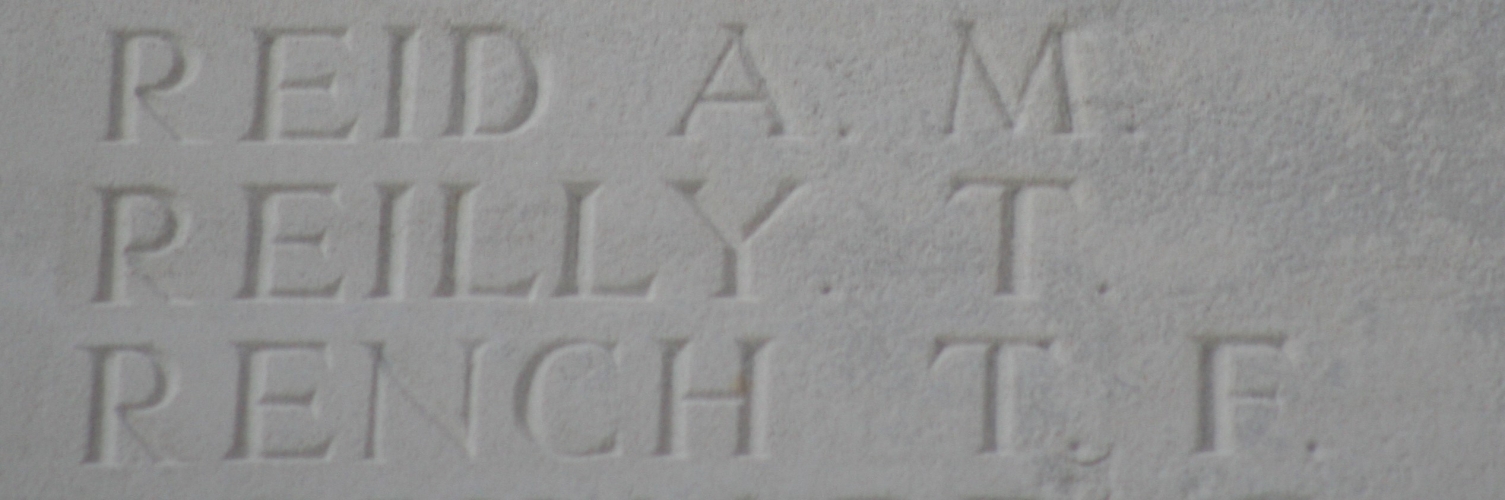
From: Manchester
K.I.A (110 Years this day)
Wednesday 18th October 1916.
19 years old
Thomas Reilly was born on the 17th April 1897 in Manchester and was the son of James Joseph and Ann (nee Verner) Reilly, of 39 Lower Chatham St, Chorlton-on-Medlock, Manchester, who married in 1889 at St Michael, Manchester. He was baptised on the 26th April 1897 at St Augustine RC Church, Chorlton.
The 1901 Census shows the family living at 2 Cook St, Chorlton-on-Medlock, Manchester.
Father James Joseph is aged 46, a gas mains labourer, mother Ann is aged 32, children John E. aged 10, Ann aged 8, James William aged 7, Mary Ellen aged 5, Thomas aged 3 (everybody born Manchester).
Father died aged 51 in 1908.
The 1911 Census shows the family living at 39 Lower Chatham St, Chorlton-on-Medlock, Manchester.
His mother Ann is aged 43, born in Manchester in 1868 and is a widow. She stated that she had twelve children of which seven were still living, and six were living with her. All her children were born in Manchester. Those listed in the household are: Ann aged 18, born 1893 occupation Handkerchief Folder, James William aged 17, born 1894 a Wood Case Maker, Mary Ellen aged 15, born 1896 an Errand Girl, Thomas aged 13, and Catherine aged 6, born 1905 are at school and the youngest Fredrick aged 4, born 1907. She also had three boarders living at the property William Verner aged 67, born 1844 occupation Bricklayer, David Verner aged 46, born 1865 a Wooden Case Maker and William Farrell aged 40, born 1871 a Carman.
He enlisted in Manchester and was formerly Private 2015, Manchester Regiment and following a transfer was serving in the 19th Battalion, The King’s Liverpool Regiment as Private No 52102 when he was killed in action on the 18th October 1916 aged 19 during the Battle of the Transloy Ridges which was part of the ongoing Somme Offensive.
19th Bn Diary
18th October 1916
Zero hour for attack 3.40am. The 21st Brigade attacked on our left, the Battalion immediately on our left being the 2nd Battn. Yorkshire Regiment, to whom 2nd Lieut Rendell was sent as Liaison Officer. The 12th Division attacked on the right, the Battalion immediately on our right being the 5th Battalion Royal Berks Regiment, from whom Lieut Debono was sent to us as Liaison Officer . Advances were made on the far right and far left of the attack, but the Brigades immediately on our left and right were held up. The Battalion was not called upon to advance, merely to hold its position. Two tanks went into action, one got into the German trenches, remaining there for about 25 minutes, killing many Germans and causing many others to run away. Casualties 4 O.R. killed and 4 O.R. wounded. Late in the evening orders were received for the Battalion to take over a portion of the line held by the 21st Infantry Brigade, and No.1 Company, under Captain Dodd, was brought up to effect this, his Company being relieved at Factory Corner by 2 Companies of the 20th Battn K.L.R.
Thomas has no known grave and is commemorated on the Thiepval Memorial to the Missing of the Somme, France.
The Thiepval Memorial, the Memorial to the Missing of the Somme, bears the names of more than 72,000 officers and men of the United Kingdom and South African forces who died in the Somme sector before 20 March 1918 and have no known grave. Over 90% of those commemorated died between July and November 1916.
On 01st August 1932 the Prince of Wales and the President of France inaugurated the Thiepval Memorial in Picardy. The inscription reads: “Here are recorded the names of officers and men of the British Armies who fell on the Somme battlefields between July 1915 and March 1918 but to whom the fortune of war denied the known and honoured burial given to their comrades in death.”
Manchester Evening News 17th Nov 1916
REILLY - Private T. REILLY, killed in action October 18, 1916, Manchesters, attached to King's Liverpool, second son of Anne Reilly, age 19.
The shock was great, the blow severe,
We little thought that death was near;
Only those who have lost them are able to tell
The grief for one we loved so well.
- sadly missed by his sorrowing MOTHER, SISTERS and BROTHERS.
39 Lower Chatham Street, C on M.
Manchester Evening News 18th Oct 1917
REILLY - In loving memory of my dear sons, Private THOMAS REILLY, killed in action October 18, 1916, age 19, also his brother Private JOHN EDWARD, killed in action August 21, 1915, age 25.
I cannot forget them, I love them too early
For their memory to fade from my mind like a dream;
My lips need not speak, for my heart mourns sincerely,
And thoughts often dwell where they seldom are seen.
- Sadly missed by his MOTHER, SISTERS, BROTHER and BROTHER in France.
39 Lower Chatham Street, C on M, Manchester.
Soldiers Effects and Pension to mother Ann, 39 Lower Chatham St.
Brother John Edward died on 21st Aug 1915 at Gallipoli whilst serving as Pte 9294, 9th Battalion Lancashire Fusiliers
https://www.cwgc.org/find-records/find-war-dead/casualty-details/687505/john-edward-reilly/
We currently have no further information on Thomas Reilly, If you have or know someone who may be able to add to the history of this soldier, please contact us.
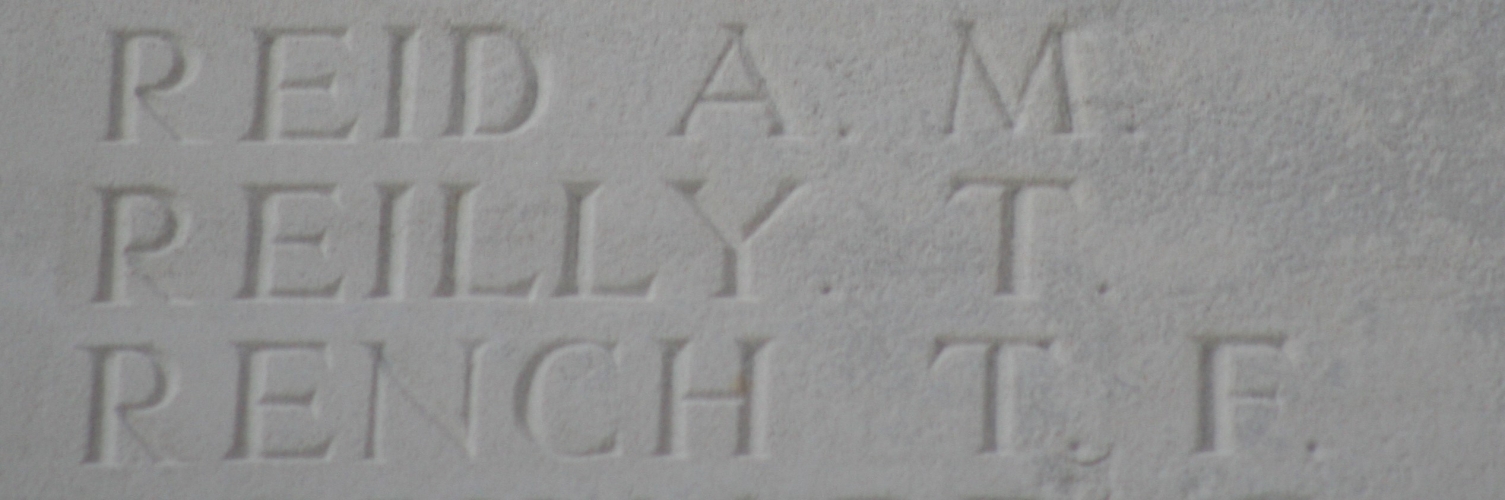
From: Aigburth
K.I.A (110 Years this day)
Wednesday 18th October 1916.
28 years old
Thomas Frederick (Fred) Rench was born on the 31st August, 1888 in Aigburth, Liverpool, the son of Richard Rench (a Policeman) and his wife Mary Ann (nee Stevens) who married in 1877 at St Anne's Church, Stanley. He was baptised on the 5th October, 1888 at St Peter's, Church Of England Church, Liverpool.
The 1891 Census shows the family living at George Terrace, Garston, Liverpool.His father Richard is aged 41, born 1850 and is a Policeman and his wife Mary Ann is aged 39, born 1852 and has no occupation listed. They have five children living at the address, William aged 11, born 1880, Richard aged 9 and Sarah Ann aged 7 are all scholars, Thomas Frederick aged 3 and Alice born 1891.
The 1901 Census shows the family living at 19, Scott Street, Bootle cum Linacre, Liverpool. His father, Richard is shown as aged 53, born 1848 and is a hall porter, his mother, Mary Ann, is aged 48, (showing born in 1853) and has no occupation listed. They have five children living at the address, Richard aged 19 , is a railway porter, Sarah Ann aged 16, Thomas Frederick aged 13, Alice aged 9 and George aged 6, born 1895.
His mother died in 1908, aged 55.
The 1911 Census shows the family living at 19 Chantrey Street, Edge Hill, Liverpool. His father, Richard is now showing as a widower, aged 64, born 1847 and is a retired Policeman who was born in Leamington, Warwickshire. He has four children living at the address and the eldest son also called Richard born 1883, who is a serving Police Constable no longer living at the family home, all the children being born in Liverpool. Sarah Ann aged 24, born 1887 occupation Housekeeper, Thomas Frederick aged 22, born 1889 occupation Messenger as his younger brother George Alexander aged 16, born 1895 and Alice aged 20, born 1891 is a Dressmaker.
Fred married Catherine Gelanos on the 13th July 1912 at St Joseph’s, Grosvenor Street. Both giving their address as 92 Victoria Square, Scotland Road. Catherine was born in Birkenhead in 1879, the daughter of Greek seafarer John, and Anne (nee Murphy) Gelanos who married in 1875.
Fred and Catherine had one child Mary Catherine born 24th June, 1912.
He enlisted on the 01st September, 1914 at St George's Hall in Liverpool joining the 18th Battalion of The King's Liverpool Regiment. He was aged 26 years and 32 days. He was described as being five foot nine inches tall, weighed 121lbs, with a 37" chest and was of sallow complexion, with hazel eyes and dark brown hair. He stated his religion as Church of England and his next of kin was his wife Catherine, of 40 Webster Road, Edge Hill. .
From the 23rd September 1914 he was billeted at Hooton Park Race Course and remained there until 03rd December 1914 when they moved into the hutted accommodation at Lord Derby’s estate at Knowsley Hall. On 30th April 1915 the 18th Battalion alongside the other three Pals battalions left Liverpool via Prescot Station for further training at Belton Park, Grantham. They remained here until September 1915 when they reached Larkhill Camp on Salisbury Plain.
07.11.15: Embarked for France with his Battalion.
29.05.16: Attached Army Infantry School.
He was serving in the 18th Battalion, The King’s Liverpool Regiment as Private No 16992 in No.4 Coy, when he was killed in action on the 18th October 1916, aged 28, during the Battle of the Transloy Ridges which was part of the ongoing Somme Offensive.
18th Bn Diary
18th October 1916
Attacked German trenches commencing 3.40 am. Relieved by 19th Manchester Regt. Took up position in support Bn trenches W. of Goose Alley.
Graham Maddocks in his book Liverpool Pals gives an overview of the events of the day:
“At 3.40 am the whistles blew, and the Battalion left its assembly trenches, in three waves, approximately fifty yards apart, and began to cross No Man’s Land. Almost immediately, the German Barrage fell on the first wave and halted its advance, so that the second wave soon caught up with it. This was not a great problem at first, and the two combined waves were able to advance together for about 300 yards, whereupon they encountered the German Grid Trench system. On the right of the advance, it was found that the wire was largely intact, apart from a few gaps, and the Germans bombed and machine gunned these gaps, which prevented any further progress. Elsewhere along the trench, however, the wire was cut and there did not seem to be any serious opposition. Nevertheless, the men hesitated to jump down into the German trenches, and instead, began to filter back across to the safety of their own lines.
By this time the third wave had caught up, as had a fourth wave, which had been detailed to mop up any opposition once the trenches had fallen, and all four waves became intermingled which added to the confusion. No less than three attempts were made to try to get the men to go forward again, but each attempt became markedly less successful than its predecessor, and eventually the attack came to a standstill. Although the British assembly trenches had received the attention of the German guns, the attackers in No Mans Land had not come under any great intensity of fire up until this point.
However, once it became obvious to the Germans that the attack was disorganised and faltering, they began to fire into the massed men from the flanks. It was probably this that finally settled the issue and convinced the Pals that they could no longer gain the enemy trenches, and all four waves, now merged into one, began to retreat to their own lines. The whole attack had been an abysmal failure, and no ground had been gained at all”.
Fred was originally reported as Missing in the Liverpool Echo on 22nd November 1916:
MISSING MEN - NEWS WANTED
RENCH - Private T. F. Rench K.L.R. His wife and child reside at 40 Webster Road, Edge Hill.
He was also listed amongst the Missing in the Liverpool Daily Post on Wednesday 29 November 1916:
Missing.
King’s Liverpool Regiment - Broady, 17046, W. T. (Egremont); Cadwell, 29492 J. J. (Southport); Cromwell, 16706, Corpl. T. L.; Fitzroy, 32741, F; Golothan, 32690, Corpl. W. P. (Chester); Griffiths, 32795, J. W.; Hilditch, 17057, A. J.; Leadsom, 39054, S.; Leighton, 16975, H. N. (Seaforth); Narracott, 17080, F. V.; Orrett, 16984, Sergt. J. S. (Prescot); Poole, 33265, F. (Shrewsbury); Powell, 23167, J.; Rench, 16992, T. F.; Ronson, 16054, G. R.; Speed, 26587, R.; Taylor, 23841, A.
It was until January 1917 that he was reported as killed in the Liverpool Echo on 11th January 1917:
Killed in Action.
Private Thomas Frederick French (29), the King's (Liverpool Regiment), previously reported missing, now reported killed. He enlisted in September 1914, and had been twelve months at the front. His wife and child reside at 40 Webster Road, Edge Hill.
The Liverpool Echo on 12th January 1917, also reported Fred's death:
RENCH - October 18, killed in action, Thomas Frederick (Fred) Rench (29), King's (Liverpool Regiment), the dearly beloved husband of Catherine Rench, 40 Webster Road, Edge Hill.
Could I have raised his dying head
Or heard his last farewell
The blow would not have been so great
To one who loved him well.
Sleep on, dear husband, in a foreign grave,
Your life for your country you nobly gave.
From his sorrowing Wife and Child.
His wife received his effects which were one letter and two photos. She also received a pension of 18/9 for herself and daughter payable from 18th June 1917.
Fred's body was not recovered or was subsequently lost as he has no known grave and is commemorated on the Thiepval Memorial to the Missing of the Somme, France.
The Thiepval Memorial, the Memorial to the Missing of the Somme, bears the names of more than 72,000 officers and men of the United Kingdom and South African forces who died in the Somme sector before 20 March 1918 and have no known grave. Over 90% of those commemorated died between July and November 1916.
On 01st August 1932 the Prince of Wales and the President of France inaugurated the Thiepval Memorial in Picardy. The inscription reads: “Here are recorded the names of officers and men of the British Armies who fell on the Somme battlefields between July 1915 and March 1918 but to whom the fortune of war denied the known and honoured burial given to their comrades in death.”
Fred was remembered in the Liverpool Daily Post close to the first anniversary of his death on 19 October 1917:
RENCH - In loving memory of my dear husband, Thomas Frederick (Fred) Rench, King's (Liverpool Regiment), who was killed in action October 18 1916.
I cannot forget you, I loved you too dearly
For your memory to fade from my life like a dream;
Lips need not speak when the heart mourns sincerely,
And thoughts often dwell where seldom they are seen.
His loving wife and child, 45 Rydal Street.
RENCH - In affectionate remembrance of Thomas Frederick (Fred) Rench King's (Liverpool Regiment), who was killed in action October 18 1916. (Ever remembered by all at 45 Rydal Street.)
RENCH - In loving memory of Private Thomas Frederick Rench, K.L.R., who was killed in action October 18 1916. (Ever remembered by Lizzy, Jenny, and Will.)
He was remembered by his wife on his birthday in the Liverpool Echo on 31st July 1918:
RENCH - In sad but loving birthday remembrance of my dear husband, Thomas Frederick (Fred) Rench, 2nd Pals, who was killed in action October 18 1916. (One of the best.)
Nobly he answered the country's call, he gave his life, his best, his all. - Ever remembered by his loving wife and child, 45 Rydal Street, Everton.
He was remembered by his wife and family on the second anniversary of his death in the Liverpool Echo on 18th October 1918:
In Memoriam.
RENCH - In affectionate remembrance of Thomas Frederick (Fred) Rench King's (Liverpool Regiment), who was killed in action October 18 1916. (Ever remembered by all at 45 Rydal Street.)
RENCH - In loving memory of my dear husband, Thomas Frederick (Fred) Rench, King's (Liverpool Regiment), who was killed in action October 18 1916.
Torn from my heart, oh, how I miss you,
My husband kind and true;
In all my pain and suffering
God alone can help me through.
- Ever remembered by his devoted Wife and darling child, Maisie. - 45 Rydal Street.
RENCH - In loving memory of Private Thomas Frederick Rench, K.L.R., who was killed in action October 18 1916. (Ever remembered by Lizzy, Jenny, and Will.)
On the 1919 Relative Declaration his brother George was in Australia, and William in New Zealand.
On the 1921 census his father is living at 19 Chantrey St, Edge Hill with daughter Sarah Ann, and married daughter Alice Barrett.
His father died in 1922, aged 75.
His widow, Catherine, (date of birth 31/12/1879) and daughter Mary C. Sayle (dob 24/06/1912) appear on the 1939 register at 39 Rydal Street, Everton.
Catherine, never remarried and died, aged 79, in 1960. She was buried at Anfield Cemetery on 07th May 1960.
Thomas Frederick Rench is also commemorated on the following Memorials:
St Cyprian’s C. of E. Church, Edge-Hill
Hall of Remembrance, Liverpool Town Hall, Panel 45
We currently have no further information on Thomas Frederick Rench, If you have or know someone who may be able to add to the history of this soldier, please contact us.
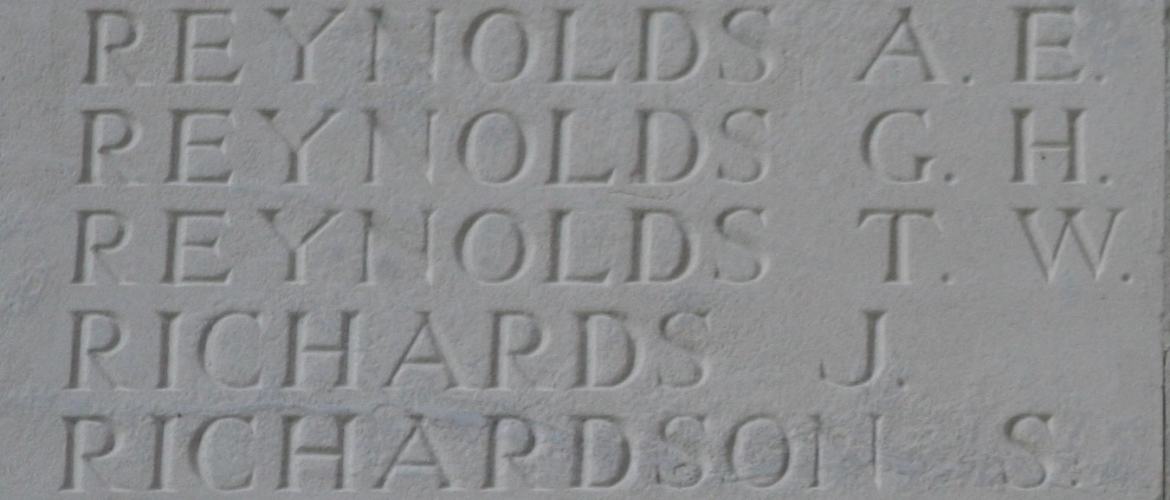
From: Craven Arms, Salop
K.I.A (110 Years this day)
Wednesday 18th October 1916.
20 years old
George Howard Reynolds was born on 17th July 1896 in Craven Arms, Salop and was baptised on the 17th August 1896 at Shropshire South Circuit, Methodist Church. He was the son of George and Eliza (nee Downes) Reynolds who were married on the 11th Feb 1892 in Diddlebury.
The 1901 Census shows the family living at Upper Westhope, Craven Arms, Salop. His father George is 32, born in St Owen, Hereford and is a under Gamekeeper. His wife Eliza is aged 32, born in Eaton-under-Heywood, Salop. They have three children, Willie aged 8 born Munslow, Nellie aged 6 born Diddlebury, and George H. aged 4, born Diddlebury.
The 1911 Census shows the family living at Westhope, Craven Arms, Salop. His father George is 42, born in Hereford in 1869 and is a Gamekeeper. His wife Eliza is aged 42, born 1869 in Salop. They have been married for 19 years at the time of the Census. They have three children all being born in Salop. Willie aged 18, born 1883 but no longer at the address. Nellie aged 16, born 1895 no occupation and George Howard aged 14, born 1897 occupation Gardener/ Labourer.
He enlisted in Shrewsbury and was formerly Private 11125, Shropshire Light Infantry and following a transfer he was serving in the 18th Battalion, The King’s Liverpool Regiment as Private No 33698 when he was killed in action on the 18th October 1916 aged 21 during the Battle of the Transloy Ridges which was part of the ongoing Somme Offensive.
18th Bn Diary
18th October 1916
Attacked German trenches commencing 3.40 am. Relieved by 19th Manchester Regt. Took up position in support Bn trenches W. of Goose Alley.
Graham Maddocks in his book Liverpool Pals gives an overview of the events of the day:
“At 3.40 am the whistles blew, and the Battalion left its assembly trenches, in three waves, approximately fifty yards apart, and began to cross No Man’s Land. Almost immediately, the German Barrage fell on the first wave and halted its advance, so that the second wave soon caught up with it. This was not a great problem at first, and the two combined waves were able to advance together for about 300 yards, whereupon they encountered the German Grid Trench system. On the right of the advance, it was found that the wire was largely intact, apart from a few gaps, and the Germans bombed and machine gunned these gaps, which prevented any further progress. Elsewhere along the trench, however, the wire was cut and there did not seem to be any serious opposition. Nevertheless, the men hesitated to jump down into the German trenches, and instead, began to filter back across to the safety of their own lines.
By this time the third wave had caught up, as had a fourth wave, which had been detailed to mop up any opposition once the trenches had fallen, and all four waves became intermingled which added to the confusion. No less than three attempts were made to try to get the men to go forward again, but each attempt became markedly less successful than its predecessor, and eventually the attack came to a standstill. Although the British assembly trenches had received the attention of the German guns, the attackers in No Mans Land had not come under any great intensity of fire up until this point.
However, once it became obvious to the Germans that the attack was disorganised and faltering, they began to fire into the massed men from the flanks. It was probably this that finally settled the issue and convinced the Pals that they could no longer gain the enemy trenches, and all four waves, now merged into one, began to retreat to their own lines. The whole attack had been an abysmal failure, and no ground had been gained at all”.
He was originally reported as Missing in the Evening Despatch (Warks) on Wednesday 29 November 1916:
Missing.
King’s Liverpools - Reynolds, 33698, G. H. (Salop); Poole, 33265, F. (Shrewsbury);
George's body was not recovered or was subsequently lost as he has no known grave and is commemorated on the Thiepval Memorial to the Missing of the Somme, France.
The Thiepval Memorial, the Memorial to the Missing of the Somme, bears the names of more than 72,000 officers and men of the United Kingdom and South African forces who died in the Somme sector before 20 March 1918 and have no known grave. Over 90% of those commemorated died between July and November 1916.
On 01st August 1932 the Prince of Wales and the President of France inaugurated the Thiepval Memorial in Picardy. The inscription reads: “Here are recorded the names of officers and men of the British Armies who fell on the Somme battlefields between July 1915 and March 1918 but to whom the fortune of war denied the known and honoured burial given to their comrades in death.”
Soldiers Effects and Pension to father George, address Westhope, Craven Arms.
His father died in 1935 aged 66, and his mother died 1937, aged 68.
George is also commemorated on the Diddlebury War Memorial.
We currently have no further information on George Howard Reynolds, If you have or know someone who may be able to add to the history of this soldier, please contact us.
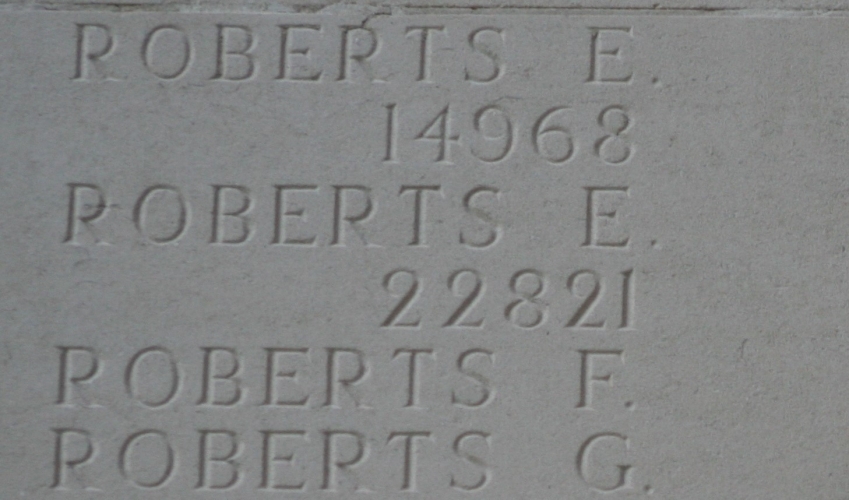
From: Egremont, Cheshire
K.I.A (110 Years this day)
Wednesday 18th October 1916.
22 years old
Edward (Ted) Ernest was born in Birkenhead in the first quarter of 1894, the son of Richard Tucker Roberts and his wife Mary Louisa (nee Jones) who were married on the 06th July 1885 at St John's Church, Liverpool. Richard was a 23 year old pawnbroker of 25 Cockspur Street, father John a general foreman, whilst Mary was aged 20 of 231 County Road, father Robert a master mariner.
The 1901 Census shows the family are living at 122 Lawrence Road, Wavertree. Edward is 7 years of age. His father is shown as a manager in a Pawnbroker's born in Liverpool in 1862, whilst his mother was born in Liverpool in 1865. He has four siblings: Louise 12, Eveline 10, Winifred 5 and Francis 2. His grandfather Robert Jones is also in the household, a retired master mariner now 74 years of age.
The 1911 Census finds the family living at 27 St Paul's Road, Seacombe. Edward is aged 17, single and a Dentistry Apprentice. Both parents are living at the property, his father is now shown as a collector of accounts. Edward has four siblings living at home; Louise born in Liverpool in 1889 is a clerk, Eveline born in Liverpool in 1891 is shown as an attendant, Winifred born in Wallasey is a student at a technical school and Francis born in 1899 in Liverpool. His grandfather now aged 84 is also still with the family.
The 1914 Gores directory shows his father Richard, a collector living at St. Paul's Road, Seacombe.
Edward enlisted in Liverpool in November 1914 and served in the 20th Battalion of The King’s Liverpool Regiment as Private No 22821.
Formed in November 1914 the 20th Battalion were originally billeted at Tournament Hall, Knotty Ash before on 29th January 1915 they moved to the hutted accommodation purposely built at Lord Derby’s estate at Knowsley Hall. On 30th April 1915 the 20th Battalion alongside the other three Pals battalions left Liverpool via Prescot Station for further training at Belton Park, Grantham. They remained here until September 1915 when they reached Larkhill Camp on Salisbury Plain. He arrived in France on 07th November 1915.
He was killed in action on the 18th October 1916, aged 22, during the Battle of the Transloy Ridges which was part of the ongoing Somme Offensive.
Ted's death was reported in the Wallasey News:
Killed By A Shell
Seacombe Soldier’s Fate
Mr and Mrs R.T. Roberts, of 27, St. Paul’s Road, Seacombe, have received official notification that their eldest son, Private Edward Ernest (Ted) Roberts, of the King’s Liverpool Regiment, was killed in action by a heavy shell on October 18th.
Writing to deceased’s sister, a comrade says:- “It is with deep regret that I write these few lines regarding the death of your beloved brother, Ted. It is a safe thing to say that death was instantaneous, being killed by the explosion of a heavy shell. Probably it may interest you to know that previous to going in the trenches Ted went to church. He was well liked by everybody who knew him.”
Twenty-two years of age, Private Roberts enlisted in November, 1914, and went out a year later to France, where he had been up to the day he was killed. A former St. Francis Xaviers’ boy, he regularly attended St. Joseph’s Church, Seacombe. He was connected with the dental profession.
His death was also reported in the Birkenhead News on 15th November 1916:
KILLED BY A SHELL
The sad intelligence has been received by Mr and Mrs R. T. Roberts of 27 St Paul's Road, Seacombe, of the death of their eldest son Private Edward E. Roberts (Ted) of the K.L.R., who was killed in action on October 19th(sic). He was educated at St Francis Xavier College, Liverpool and was just completing his apprenticeship with Mr Schultz, dentist, Norton Street, Liverpool. He joined the colours on November 10, 1914, and went out to France November 15, 1915. He attended St Joseph's Church, Seacombe.
His body was not recovered or was subsequently lost as he has no known grave and is commemorated on the Thiepval Memorial, to the Missing of the Somme, France.
The Thiepval Memorial, the Memorial to the Missing of the Somme, bears the names of more than 72,000 officers and men of the United Kingdom and South African forces who died in the Somme sector before 20 March 1918 and have no known grave. Over 90% of those commemorated died between July and November 1916.
On 01st August 1932 the Prince of Wales and the President of France inaugurated the Thiepval Memorial in Picardy. The inscription reads: “Here are recorded the names of officers and men of the British Armies who fell on the Somme battlefields between July 1915 and March 1918 but to whom the fortune of war denied the known and honoured burial given to their comrades in death.”
Soldiers Effects were sent to his father Richard, no Pension record found.
His parents appear on the 1939 register at 11 Stourcliffe Road, Wallasey. Richard T, date of birth shown as 08th February 1862, Mary L., date of birth shown as 27th November 1864, and daughter Winifred.
His father died in the December quarter of 1941, aged 79.
His mother died in 1943, aged 78.
We currently have no further information on Edward Ernest Roberts, If you have or know someone who may be able to add to the history of this soldier, please contact us.
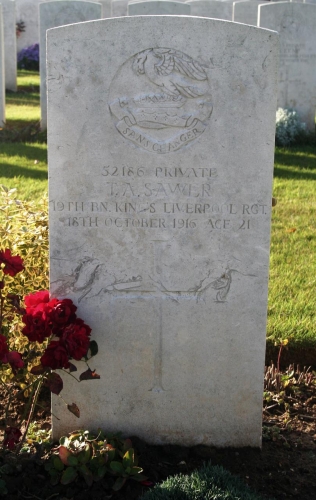
From: Lower Broughton,Manchester
K.I.A (110 Years this day)
Wednesday 18th October 1916.
21 years old
Thomas Alexander Sawer was born in 1896 in Lower Broughton, Manchester and resided in Salford and was the son of Joseph Buxton Sawer and his wife Elizabeth (née Astley). Although his headstone shows his age as 21, Thomas’ birth was registered in the December quarter of 1896, making him 19 or just turned 20 years old when he was killed. His father was from Penrith, Cumberland, and his mother from Salford. They married in 1889 at Salford Ascension Church and had five children. Thomas had older siblings Thomas Slinger, born in 1890 (who died at age 1), and John Astley, 1894. He had younger sisters Elizabeth Gertrude, 1899, and Mary, born in 1901.
At the time of the 1901 census the family is found at 46 & 48 Tintern Street, Salford. This seems to be the address of his father’s business as well as the the family’s home, as his father is a grocer/shopkeeper working on his own account at home. They have four children; John aged 6, Elizabeth aged 5, Thomas is 4 years old, and Mary just 1 month old.
In 1911 they are living at the same premises. His father is 44, a grocer working on his own account, his mother is 40, they advised that they had been married for 21 years, and had 5 children, 4 of whom have survived; John, 16, is a plumber’s apprentice, and Thomas, 14, Elizabeth, 12, and Mary, 10, are at school.
His father died on the 22nd November 1916, at the age of 50.
His death was reported in the Manchester Evening News on Thursday 23 November 1916:
SAWER—On the 22nd inst., JOSEPH BUXTON, the beloved husband of Elizabeth SAWER, aged 50 years, at 32, Taylorson-street, Salford. Inter St Paul’s, Kersal, Monday, Nov. 27, at 3 o'clock.
Thomas enlisted in Manchester and originally served as Private 3280, in the Manchester Regiment. Based on the amount of the War Gratuity, Thomas served for about 34 months, enlisting not long after war was declared. He would have been 17 or 18 years old. SDGW gives his Manchester Regiment number as 3280, which was one of a series issued in August or September 1914 to men joining Depot, 11th, 12th and 13th Bns. However, a 1914-1915 Star medal roll has not been found, suggesting that he did not arrive in France until 1916. (Perhaps his true age was revealed and he was not sent overseas until he turned 19.) The Medal Roll shows service overseas with the K.L.R. only.
Following a transfer he was serving in the 19th Battalion of The King’s Liverpool Regiment as Private No 52186 when he was killed in action on the 18th October 1916 aged 21 during the Battle of the Transloy Ridges which was part of the ongoing Somme Offensive.
19th Bn Diary
18th October 1916
Zero hour for attack 3.40am. The 21st Brigade attacked on our left, the Battalion immediately on our left being the 2nd Battn. Yorkshire Regiment, to whom 2nd Lieut Rendell was sent as Liaison Officer. The 12th Division attacked on the right, the Battalion immediately on our right being the 5th Battalion Royal Berks Regiment, from whom Lieut Debono was sent to us as Liaison Officer . Advances were made on the far right and far left of the attack, but the Brigades immediately on our left and right were held up. The Battalion was not called upon to advance, merely to hold its position. Two tanks went into action, one got into the German trenches, remaining there for about 25 minutes, killing many Germans and causing many others to run away. Casualties 4 O.R. killed and 4 O.R. wounded. Late in the evening orders were received for the Battalion to take over a portion of the line held by the 21st Infantry Brigade, and No.1 Company, under Captain Dodd, was brought up to effect this, his Company being relieved at Factory Corner by 2 Companies of the 20th Battn K.L.R.
Thomas was buried close to where he fell and his grave marked with a cross. The CWGC Graves Registration form shows F. A. Sawyer date of death 11th October 1916. After the war when graves were concentrated, he was correctly identified, and his initial, surname, and date of death amended.
He now rests at Caterpillar Valley, Cemetery, Longueval, France.
Caterpillar Valley was the name given by the army to the long valley which ran west to east, past "Caterpillar Wood", to the high ground at Guillemont. Caterpillar Valley was captured during a successful night assault on 14th July 1916. It was lost in the German advance of March 1918 and recovered on 28th August 1918, when a little cemetery was made (now Plot 1 of the cemetery) containing 25 graves. After the Armistice, this cemetery was hugely increased when the graves of more than 5,500 officers and men were brought in from other small cemeteries, and the battlefields of the Somme. The great majority of these soldiers died in the autumn of 1916.
His death was not officially recorded until September 1917:
Weekly Casualty List Tuesday 11th Sept 1917
Previously reported wounded and missing, now reported
KILLED.
King’s(Liverpool Regiment) - Sawer, 52186, T. A. (Salford);
His mother Elizabeth received his Army pay and a War Gratuity of £8. The pension card, giving her address as 32 Taylorson Street, Salford, shows that she was awarded a pension of 4/- a week from August 1917, increased to 5/- in November 1918. An entry on the card notes, “increase refused”; however, the pension was increased to 10/- in March 1923 for one year.
His mother appears to have emigrated to Canada in June 1923 (possibly to join one of her daughters), her address on the pension card c/o Mrs. Taylor, 15 Southgate Street, London, Ontario.
His elder brother John enlisted in the Army in January 1916 and transferred to the Royal Flying Corps in December 1917 then served with the R.A.F. until he was discharged in April 1920. He also emigrated to Canada, in 1929 with his family.
His mother died in Sarnia, Ontario, in 1929.
Thomas has not been found on any local memorial.
He is commemorated on the Fallen Men of Broughton online site.
We currently have no further information on Thomas Alexander Sawer, If you have or know someone who may be able to add to the history of this soldier, please contact us.

From: Hull
K.I.A (110 Years this day)
Wednesday 18th October 1916.
34 years old
Second Lieut. William Sinclair was one of the the "Pals" who responded to Lord Derby's call at the end of August, 1914. He was a son of Mr. William Sinclair, of Hull, and Mrs. Sinclair, and following a successful school career at Hymers' College and at Sandbach Grammar School, became associated about 1899 with the Liverpool provisions trade with Messrs: W.P. Sinclair & Co, Ltd, of North John Street. He was thirty four years of age at the time of his death.
He obtained his commission in April, 1915, and in June, 1916, went to France with the 18th Battalion K.L.R. At 4.30am on October 18th, 1916, in cold, raw weather the Battalion received orders to make an attack near Geuedecourt. The men had previously been through a hard and dis-spiriting time, and just before the attack was launched Second Lieut. Sinclair, realising his men needed encouragement, went along the line serving out rum rations at the risk of his life. Then he gallantly led his men forward in the dark, and had got up to the German wire when Lance-Corporal Roberts, who was near him, heard him gasp, and saw him put his hand to his left side and fall over. The Corporal stopped, and tried to get him to speak, but in vain. He then left him with his servant and went on. Nothing further has been seen or heard of either the officer or the man, although bearers and patrols made a search for them.
Captain Clayton writing to Second Lieut. Sinclair's sister, said, "The conditions that night were particularly hard, and the darkness made the keeping of direction difficult, and the wet and cold had greatly affected the men's spirits. These hardships evidently did not daunt your brother, who led his men in the true direction, and fell close to the first objective. . . . We are proud of him and miss him sorely."
Second Lieut. Sinclair lived at Fern Grove, Sefton Park, Liverpool and was unmarried. He played hockey for the Huyton Club and later for Bebington. He was a member of the Huyton Golf Club and of the Mersey Bowmen's Lawn Tennis Club.
The above extract was taken from Liverpool's Scroll of Fame.
William was born at Sculcoates, Hull in late 1881, the son of William Sinclair and his wife Eleanor Adeline (nee Cook) who were married on 03rd July 1879 in Hull.
On the 1891 census the family are living at 78 Beverley Rd, Sculcoates, Yorkshire. Father William 38 an American merchant b.Bebington, Cheshire, mother Eleanor C. 34 b.Hull, children born Hull, Wilda St Clair 10 a scholar, William 8 a scholar, Francis St Clair 8 a scholar, and Agatha 6 a scholar.
His father died on the 07th January 1896 in Hull.
Probate:-
SINCLAIR - William of 111 Beverley Road, Kingston upon Hull, died 7th January 1896. Administration London 12th of March to Eleanor Adeline Sinclair widow. Effects £1889.
On the 1901 Census the family have moved to 37 Fern Grove, Toxteth Park. His widowed mother ,Eleanor, is aged 44 and she has three children in the household; Wilda is aged 20, William is aged 19 and is a clerk for a provision dealer, Nora is 10 and was also born in Hull. Also present in the household is a servant; Margaret aged 20 born in Co.Down.
His mother died on the 24th April 1906 in Liverpool.
Probate:-
SINCLAIR - Eleanor Adeline of 37 Fern Grove, Sefton Park, Liverpool widow died 24th April 1906 at 19 Percy Street, Liverpool. Probate London 14th June to Samuel Gibson Sinclair ship owner and Lucy Amelia Cook spinster effects £3462 5s 11d.
On the 1911 Census William is boarding with the Bainbridge family at 34 Fern Grove, Toxteth Park. William aged 29, is single and a merchant in American produce, also his brother Harold Lumley St Clair aged 22, a bank clerk who was born in Hull.
He joined the ranks of the Pals in August 1914 as Private 15565, joining the 17th Battalion. After earning his commission he joined the 18th Battalion in France when it was stationed on the Somme. However there is no mention of him in the Battalion War Diary at all.
On the day that he was killed, 18th October 1916, the Battalion had been ordered to make an attack on the German Position known as Gird Trench near Flers, which had been unsuccessfully attacked five days earlier by the 89th Brigade. The objectives of the 18th Battalion were in the centre of the Brigade attack and included the capture and holding of a German strong point.
However, the preliminaries to the attack went badly when, on the evening of the 17th October, the enemy, who obviously sensed that another attack was coming, heavily shelled the British front and communication line trenches severely mauling No.3 Company, killing its Commander Captain G Ravenscroft. This so unsettled the company, that it had to be withdrawn from the line, and the reserve Company, only just arrived at the attack position through narrow and congested trenches, before Zero Hour, which was 03.30am,on 18th October. By this time constant rain had turned No Man’s Land to a bog.
His body and that of his servant were never found and were probably blown apart by the retaliatory barrage which the Germans soon directed simultaneously on their own front line, and the British rear. The whole attack was a total failure, and William Sinclair, who aged thirty four, was one of four officers and twenty seven other ranks killed that day.
He was reported as Missing in the Northern Whig on Monday 30 October 1916:
Wounded and Missing.
Sinclair, Sec-Lieut. W., King’s Liverpool Regiment.
Second Lieut. Sinclair's body was not recovered or was subsequently lost as he has no known grave and is commemorated on the Thiepval Memorial.
The Thiepval Memorial, the Memorial to the Missing of the Somme, bears the names of more than 72,000 officers and men of the United Kingdom and South African forces who died in the Somme sector before 20 March 1918 and have no known grave. Over 90% of those commemorated died between July and November 1916.
On 01st August 1932 the Prince of Wales and the President of France inaugurated the Thiepval Memorial in Picardy. The inscription reads: “Here are recorded the names of officers and men of the British Armies who fell on the Somme battlefields between July 1915 and March 1918 but to whom the fortune of war denied the known and honoured burial given to their comrades in death.”
Soldiers Effects to brother Frank Waldegrave (St Clair) Sinclair, no pension record found.
He is also commemorated on the following Memorials:
Hall of Remembrance, Liverpool Town Hall, Panel 40
Mersey Bowmen.
We currently have no further information on William Sinclair, If you have or know someone who may be able to add to the history of this soldier, please contact us.

From: Liverpool
K.I.A (110 Years this day)
Wednesday 18th October 1916.
22 years old
18th Bn Diary
18th October 1916
Attacked German trenches commencing 3.40 am. Relieved by 19th Manchester Regt. Took up position in support Bn trenches W. of Goose Alley.
Graham Maddocks in his book Liverpool Pals gives an overview of the events of the day:
“At 3.40 am the whistles blew, and the Battalion left its assembly trenches, in three waves, approximately fifty yards apart, and began to cross No Man’s Land. Almost immediately, the German Barrage fell on the first wave and halted its advance, so that the second wave soon caught up with it. This was not a great problem at first, and the two combined waves were able to advance together for about 300 yards, whereupon they encountered the German Grid Trench system. On the right of the advance, it was found that the wire was largely intact, apart from a few gaps, and the Germans bombed and machine gunned these gaps, which prevented any further progress. Elsewhere along the trench, however, the wire was cut and there did not seem to be any serious opposition. Nevertheless, the men hesitated to jump down into the German trenches, and instead, began to filter back across to the safety of their own lines.
By this time the third wave had caught up, as had a fourth wave, which had been detailed to mop up any opposition once the trenches had fallen, and all four waves became intermingled which added to the confusion. No less than three attempts were made to try to get the men to go forward again, but each attempt became markedly less successful than its predecessor, and eventually the attack came to a standstill. Although the British assembly trenches had received the attention of the German guns, the attackers in No Mans Land had not come under any great intensity of fire up until this point.
However, once it became obvious to the Germans that the attack was disorganised and faltering, they began to fire into the massed men from the flanks. It was probably this that finally settled the issue and convinced the Pals that they could no longer gain the enemy trenches, and all four waves, now merged into one, began to retreat to their own lines. The whole attack had been an abysmal failure, and no ground had been gained at all”.
Richard was initially declared Missing on 18th October 1916 and his death later presumed to have occurred on or since that date.
His name appeared in the list of Missing in the Liverpool Daily Post on 29th November 1916.
He has no known grave and is commemorated on the Thiepval Memorial to the Missing of the Somme, France.The Thiepval Memorial, the Memorial to the Missing of the Somme, bears the names of more than 72,000 officers and men of the United Kingdom and South African forces who died in the Somme sector before 20 March 1918 and have no known grave. Over 90% of those commemorated died between July and November 1916.
On 01st August 1932 the Prince of Wales and the President of France inaugurated the Thiepval Memorial in Picardy. The inscription reads: “Here are recorded the names of officers and men of the British Armies who fell on the Somme battlefields between July 1915 and March 1918 but to whom the fortune of war denied the known and honoured burial given to their comrades in death.”
His father died in March 1917, aged 50 and was buried on the 27th March at Everton Cemetery, his address at the time of his death was 5 Desmond Street. It is not known if he had learned of Richard’s death or died not knowing his son’s fate.
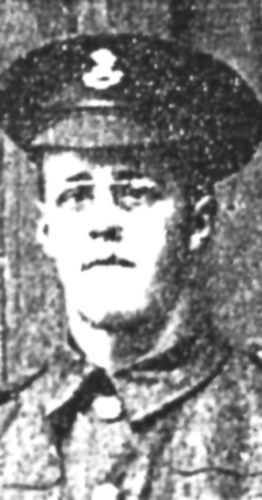
From: Liverpool
K.I.A (110 Years this day)
Wednesday 18th October 1916.
22 years old
Matthew Henry (Harry) Stead was born at Kirkdale on the 01st October 1894, the son of Matthew Henry Stead and Ellen (nee Johnson) who were married in 1892 in the Toxteth Park Registration district. Matthew Henry junior was a stores clerk in 1911. His father was a foreman mason at the Mersey Docks and Harbour Board and was born at Welshpool, Wales. His wife was a native of Liverpool. Prior to the outbreak of war he was employed in the Stores Office of the Mersey Docks and Harbour Company. He was a talented musician and was deputy organist at Christ Church, Bootle.
The 1901 Census shows the family living at 84 Antonio Street, Bootle cum Linacre. His father, Matthew Henry, is aged 37, a stone mason born in Welshpool, his mother Ellen is aged 35, born Liverpool, with children all born in Liverpool, Matthew Henry 6 and Albert 9 months.
By the time of the 1911 Census, the family have moved to 240 Gloucester Road, Bootle. His father, Matthew Henry aged 47, is a foreman mason for Mersey docks and Harbour Board, his mother Ellen is aged 45. They advised that they had been married for 19 years and had four children, two of whom have survived. Matthew Henry is aged 16,and is a stores clerk, and Albert aged10 is at school.
He enlisted on the 10th November 1914 at Liverpool joining the 19th Battalion, The King’s Liverpool Regiment as Private No 21786. He was aged 20 years and one month and was a clerk. He was described as being 5 foot seven inches tall, weighed 108lbs,with a 34" chest, a fresh complexion, grey eyes and brown hair. He stated his religion as Church of England and he gave his next of kin as his father Matthew Henry Stead, of 240 Gloucester Road. He had been previously rejected for military service, failing on "chest measurement".
Formed on 07th September 1914 the 19th Battalion trained locally at Sefton Park and remained living at home or in rented accommodation until November 1914. They then moved to the hutted accommodation at Lord Derby’s estate at Knowsley Hall. On 30th April 1915 the 19th Battalion alongside the other three Pals battalions left Liverpool via Prescot Station for further training at Belton Park, Grantham. They remained here until September 1915 when they reached Larkhill Camp on Salisbury Plain. He arrived in France on 7th November 1915.
His service record shows the following:
21.8.16 - Admitted to F.A. with defective vision.
03.9.16 - Appointed unpaid L/Cpl.
15.9.16 - To Musketry Course.
21.9.16 - Rejoined Bn.
Harry was killed in action on the 18th October 1916, aged 22, during the Battle of the Transloy Ridges which was part of the ongoing Somme Offensive.
19th Bn Diary
18th October 1916
Zero hour for attack 3.40am. The 21st Brigade attacked on our left, the Battalion immediately on our left being the 2nd Battn. Yorkshire Regiment, to whom 2nd Lieut Rendell was sent as Liaison Officer. The 12th Division attacked on the right, the Battalion immediately on our right being the 5th Battalion Royal Berks Regiment, from whom Lieut Debono was sent to us as Liaison Officer . Advances were made on the far right and far left of the attack, but the Brigades immediately on our left and right were held up. The Battalion was not called upon to advance, merely to hold its position. Two tanks went into action, one got into the German trenches, remaining there for about 25 minutes, killing many Germans and causing many others to run away. Casualties 4 O.R. killed and 4 O.R. wounded. Late in the evening orders were received for the Battalion to take over a portion of the line held by the 21st Infantry Brigade, and No.1 Company, under Captain Dodd, was brought up to effect this, his Company being relieved at Factory Corner by 2 Companies of the 20th Battn K.L.R.
His death was reported in the Liverpool Echo on 01st November 1916:
STEAD - Killed in action, Lance Corporal M. H. STEAD (Harry), K.L.R., the dearly loved eldest son of Matthew and Ellen Stead, 240 Gloucester Road, Bootle.
His death was also reported in greater detail in the Bootle Times on 03rd November 1916:
Deputy Organist of Christ Church.
Lance-Corporal Harry Stead Killed in Action.
The sympathy of a wide circle of friends in Bootle will we extended to Mr. and Mrs. M.H. Stead, of 240, Gloucester-road, in the bereavement they have suffered by the death of their eldest son, Lance-Corporal Matthew Henry Stead, K.L.R., who was killed in action.
A career full of promise was before the young soldier, when shortly after the outbreak of war he decided that it was his duty to offer himself for service. He voluntarily resigned his position in the stores office of the Mersey Docks and Harbour Board, although at that time no arrangements had been formulated as to reinstatement or salary allowances in the case of men joining the army. On the first occasion that Harry - as he was affectionately known to his friends - offered himself for enlistment, he was rejected owing to his chest measurement being half-an-inch under the required standard. He then went in for a course of physical exercises, and in November, 1914, again presented himself. This time he was successful, and a year later was drafted to France. He had gone through numerous engagements, and had seen many of his friends fall on the field of battle, but himself came through unscathed, until early this week the parents received a letter from his officer and another from a comrade conveying the sorrowful news that, a gallant soldier to the end, he had made the ultimate sacrifice.
Matthew Henry Stead was 22 years of age on October 1st. He was educated at Bedford-road school, Bootle, and at Beaumaris Grammar School, and subsequently entered the service of the Dock Board. He was an able and painstaking young man, and enjoyed the confidence and esteem of his superiors. A devoted student of music, he studied under Mr. Frank Dibb, Mus. Bac., F.R.C.O., and his exceptional ability led to his appointment as deputy-organist of Christ Church, Bootle. All who knew the late Lance-corporal Stead, and especially the congregation of Christ Church, will join in offering their sincere condolence to the parents who have lost so gallant and promising a son.
Lieut. Fox has written to Mr. Stead as follows:- "Will you please tell his mother how much I miss him. He always did his job, and was one of the coolest men in the company under fire. Please accept the sympathy of myself and the other officers of the company."
A comrade, Corporal H. Pugh, wrote:- "As one who was present, and also an old school chum of Harry's, I thought you would like to know the circumstances of his death. I can assure you it was instantaneous, and that he suffered no pain whatever. At the time the platoon was standing to under heavy shell fire, expecting a counter-attack by the Germans. Harry was struck by a piece of shell, and died doing his duty as a true British soldier. We buried him as the first opportunity in a soldier's grave on the battlefield. As a soldier and a non-commissioned officer, he always turned out smart and clean, and did his work well without hesitation or fear, liked by officers and the rank-and-file and all who knew him in the course of duty. As a man and a chum he was a true friend, and though out-spoken would never willingly give pain to anyone. I think it will please you to know that Harry was always glad of the opportunity to attend church parade, and whenever discussion arose he was never afraid to express his own opinion and belief. He very often mentioned Mr. Dibb to me, and I should like you to let Mr. Dibb know the circumstances."
Harry's grave referred to by Corporal Pugh was subsequently lost as he has no known grave and is commemorated on the Thiepval Memorial to the Missing of the Somme, France.
The Thiepval Memorial, the Memorial to the Missing of the Somme, bears the names of more than 72,000 officers and men of the United Kingdom and South African forces who died in the Somme sector before 20 March 1918 and have no known grave. Over 90% of those commemorated died between July and November 1916.
On 01st August 1932 the Prince of Wales and the President of France inaugurated the Thiepval Memorial in Picardy. The inscription reads: “Here are recorded the names of officers and men of the British Armies who fell on the Somme battlefields between July 1915 and March 1918 but to whom the fortune of war denied the known and honoured burial given to their comrades in death.”
Soldiers Effects to father Matthew, Pension to mother Ellen, 240 Gloucester Road.
Personal items returned: 2 books, postcard and letters.
On the 1919 Relative Declaration brother Albert aged 19 was with Q. Office, 10th Corps, British Army of the Rhine.
Harry is also commemorated on the following Memorials:
Bootle Civic Memorial
Christ Church C. of E. Church, Bootle
Bedford Road Council School
Also on the family grave where the headstone reads:-
IN LOVING MEMORY OF
MATTHEW STEAD
The beloved husband of ELLEN,
Who passed away 23rd March 1923, aged 53 years.
Also MATTHEW HENRY (HARRY)
L/Cpl 19th K.L.R.
Eldest son of the above,
Who was killed in France Oct 18th 1916.
Greater love hath no man than this
That he lay down his life for his friends.
Also ELLEN
The beloved wife of the above
Who died 16th May 1942, aged 76 years
We currently have no further information on Matthew Henry Stead, If you have or know someone who may be able to add to the history of this soldier, please contact us.
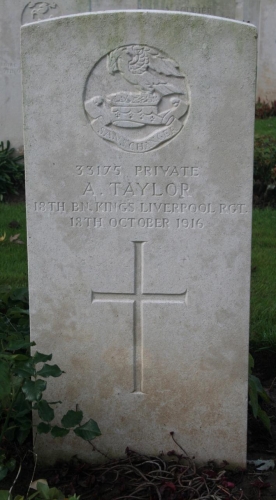
From: Liverpool
K.I.A (110 Years this day)
Wednesday 18th October 1916.
21 years old
Albert Taylor was born in Everton, Liverpool in the summer of 1895, the youngest surviving son of Robert Coombe Taylor and his wife Catherine (née Cooney) who married on the 23rd July 1882 at Holy Trinity, Walton Breck. Robert, born in Tynemouth, and Catherine in Everton. Robert was a 24 year old tobacconist of 23 Queen Anne Place, father George, whilst Catherine was aged 21 of Queen Anne St, father Patrick. They had eight children, birth records have been found for seven, all born in Everton Catherine, George, William, Florence, Isabella (who died in infancy), Albert, and John Coombe (who died at age 2).
18th Bn Diary
18th October 1916
Attacked German trenches commencing 3.40 am. Relieved by 19th Manchester Regt. Took up position in support Bn trenches W. of Goose Alley.
Graham Maddocks in his book Liverpool Pals gives an overview of the events of the day:
“At 3.40 am the whistles blew, and the Battalion left its assembly trenches, in three waves, approximately fifty yards apart, and began to cross No Man’s Land. Almost immediately, the German Barrage fell on the first wave and halted its advance, so that the second wave soon caught up with it. This was not a great problem at first, and the two combined waves were able to advance together for about 300 yards, whereupon they encountered the German Grid Trench system. On the right of the advance, it was found that the wire was largely intact, apart from a few gaps, and the Germans bombed and machine gunned these gaps, which prevented any further progress. Elsewhere along the trench, however, the wire was cut and there did not seem to be any serious opposition. Nevertheless, the men hesitated to jump down into the German trenches, and instead, began to filter back across to the safety of their own lines.
By this time the third wave had caught up, as had a fourth wave, which had been detailed to mop up any opposition once the trenches had fallen, and all four waves became intermingled which added to the confusion. No less than three attempts were made to try to get the men to go forward again, but each attempt became markedly less successful than its predecessor, and eventually the attack came to a standstill. Although the British assembly trenches had received the attention of the German guns, the attackers in No Mans Land had not come under any great intensity of fire up until this point.
However, once it became obvious to the Germans that the attack was disorganised and faltering, they began to fire into the massed men from the flanks. It was probably this that finally settled the issue and convinced the Pals that they could no longer gain the enemy trenches, and all four waves, now merged into one, began to retreat to their own lines. The whole attack had been an abysmal failure, and no ground had been gained at all”.
Warlencourt Cemetery is entirely a concentration cemetery, begun late in 1919 when graves were brought in from small cemeteries and the battlefields of Warlencourt and Le Sars. The Graves Registration form shows graves from “Le Sars 6/1, 6/2, Hexham Road, Seven Elms”.
Graves were brought in from the original cemeteries at Hexham Road (Le Sars), and Seven Elms (Flers), as well as over 3,000 British graves due to the fighting which took place around the Butte de Warlencourt from the autumn of 1916 to the spring of 1917, and again in the German advance and retreat of 1918. The cemetery now contains 3,505 Commonwealth burials and commemorations of the First World War, 1,823 of which are unidentified.
“In sad but loving memory of Private Albert Taylor, K.L.R., the dearly-beloved youngest son of Mr. and Mrs. R. Taylor, who was killed in action October 18, 1916, aged 21 years. (Duty nobly done.). Ever remembered by his sorrowing Father, Mother, Sister and Brothers (George, in France), 72, Ullswater Street.”
“In affectionate remembrance of Private Albert Taylor, K.L.R. (Pals), killed in action October 18, 1916, aged 21 years.
Liverpool Evening Express 18th October 1926
TAYLOR - In loving memory of ALBERT, the dearly-beloved youngest son of Mr and Mrs R. Taylor, 18th King’s Pals, killed in action, Oct. 18, 1916. (Always remembered by his loving father, mother, sister and brothers, 72 Ullswater Street, Everton.
We currently have no further information on Albert Taylor, If you have or know someone who may be able to add to the history of this soldier, please contact us.
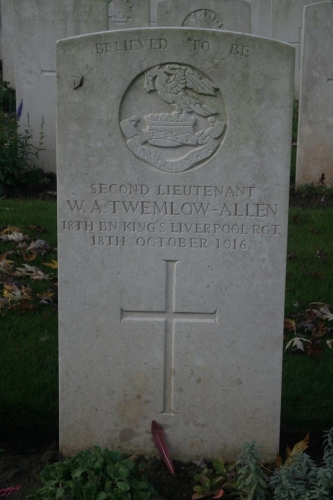
From: Seacombe, Cheshire
K.I.A (110 Years this day)
Wednesday 18th October 1916.
38 years old
William Alfred Twemlow Allen was born in Seacombe, Cheshire, on 06th September 1878 to William Frederick Allen and his wife Marianne (nee Twemlow). He was baptised in St. Peter’s Liverpool on 3rd October 1878. His father, born in London, and his mother, from Staffordshire, married in Liverpool in 1877. William was the eldest of six children. His siblings were Edith, Arthur, Florence, Charles, and Jesse.
In 1881 the family is living in Egerton Place, Liscard, Cheshire. His father is a clerk to a wine merchant. William is 2. In 1891 his father, with William and sister Florence, are lodging with John and Jane May and their family at 5 Kingsgate Street, Reading. His mother is living with his other siblings in Wallasey, and her brother William Twemlow, a 19-year old bank clerk, is in the household.
William married Charlotte Angelina Cassereau in Clapham Parish Church on 29th April 1899, giving his age as 22, he was in reality just 20. He gave his occupation as a bank clerk, and address as 73 Gauden Road. Charlotte was a naturalised British subject, born in France.
In 1901 the young couple are living at 9 St. James’, Muswell Hill, Middlesex. William is 24, a banker’s clerk. As there are no further records to be found, it is possible they went to live in France. His medal card shows next of kin as his wife, Mrs. W.A. Twemlow-Allen, c/o Mrs. Paterson, 24 Rothsay Road, Bedford.When war broke out William enlisted in the 19th Bn Royal Fusiliers, as Private 1012 W.A.T. Allen.
According to his record with the Royal Fusiliers he went to France on 14th November 1915, however his medal index card shows the date he first served in France as 24h December 1915. The medal card shows he returned to the UK on 26th January 1916. On 8th July 1916 William was discharged to a commission.
Pte 1012, Royal Fus. Theatre of war from 14/11/1915 – 26/1/1916. Discharged to commission 8/7/1916
His medal card further records that W.A.T. Allen was commissioned to the 21st Battalion of The King's Liverpool Regiment on 28th January 1916. This was a Reserve Battalion for the Liverpool Pals battalions.
His legal surname was Allen, his middle name of Twemlow he added as a double-barrelled surname when he was commissioned as reported in the Supplement to the London Gazette, 14th February 1916:
The King’s (Liverpool Regiment) - William Alfred Twemlow-Allen to be temporary Second Lieutenant (on probation). Dated 20th January 1916.
Little is known about his service as an officer, as he does not appear in the 18th Battalion War Diary at all, despite his being killed in action in the Battalion attack near Flers, on the Somme, on 18th October 1916.
On the day he was killed, the 18th,had been ordered to make a attack on the German position known as Gird Trench near Flers, which had been unsuccessfully attacked five days earlier by the 89th Brigade. The objectives of the 18th Battalion were in the centre of the 21st Brigade attack, and included the capture and holding of a German strong point.
However, the preliminaries to the attack went badly when, on the evening of the 17th October, the enemy who obviously sensed that another attack was coming, heavily shelled the British front and communication line trenches, and severely mauled No.3 Company, killing the Commander Captain G Ravenscroft. This so unsettled the company, that it had to be withdrawn from the line, and the reserve Company only just arrived at the attack position through narrow and congested trenches before Zero Hour, which was 03.30am, on 18th October.
Constant rain had turned No Man’s Land to a bog, and the Battalion was cold, wet, tired and hungry. Thus, with morale at a low ebb, the attack was made at Zero Hour in four waves. The Battalion got as far as Gird Trench, where it found the wire largely intact. Many men the hesitated to jump into the enemy trench and began to filter back to towards the British lines. Despite three attempts to stop this, the attack slowed to a standstill and all four attacking waves merged into one. With enfillading machine-gun fire from the flanks and enemy artillery firing onto Gird Trench itself, the assault inevitably failed, and the survivors returned across No Man’s Land into their own front line.
During the course of the attack Second-Lieutenant Twemlow Allen, three other officers and twenty seven other ranks were killed. He was 38 years of age and his body was not identified with total certainty after the war. His body was exhumed from its original burial place on 20th January 1921 and William now rests at Warlencourt British Cemetery, France. His headstone advises that the grave is believed to be that of William. This usually means that the Commonwealth War Graves Commission is reasonably certain about the identity of the body in the grave, it is not sure beyond all doubt.
William now rests at Warlencourt British Cemetery in France.
Warlencourt Cemetery is entirely a concentration cemetery, begun late in 1919 when graves were brought in from small cemeteries and the battlefields of Warlencourt and Le Sars. The Graves Registration form shows graves from “Le Sars 6/1, 6/2, Hexham Road, Seven Elms”.
Graves were brought in from the original cemeteries at Hexham Road (Le Sars), and Seven Elms (Flers), as well as over 3,000 British graves due to the fighting which took place around the Butte de Warlencourt from the autumn of 1916 to the spring of 1917, and again in the German advance and retreat of 1918. The cemetery now contains 3,505 Commonwealth burials and commemorations of the First World War, 1,823 of which are unidentified.
On a visit to the grave in 1985, the author of the book The Liverpool Pals, Graham Maddocks, noted that his date of death was erroneously shown to be 18th October 1918. The Commonwealth War Graves Commission was notified of this error, and within two months, had corrected the inscription on the headstone, to 18th October 1916.
The death of 2nd Lieutenant Twemlow-Allen was announced in the Army and Navy Gazette on 04th November 1916.
Probate, giving his address as The Brambles, Scarth Road, Barnes, Surrey, was issued to his widow, Charlotte Angelina.
Charlotte never remarried. She died on 6th January 1940, living at 41 Rue de la Cloche, Fontainbleu, France. Probate was issued to William Goodall Twemlow, (apparently William’s maternal uncle), retired bank manager, and John Lishman.
We currently have no further information on William Alfred Twemlow Allen, If you have or know someone who may be able to add to the history of this soldier, please contact us.
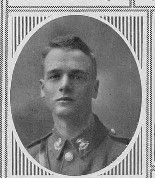
From: Lytham St. Annes, Lancs
K.I.A (110 Years this day)
Wednesday 18th October 1916.
21 years old
Hayward Wane was born in the first quarter of 1895 in Barrow in Furness and was the son of John Wane and his wife Florence (nee Gabb), of 10 Commonside, Ansdell, Lytham St Anne's, Lancs.
The 1911 Census shows the family living at Lancaster Bank, Diconson Terrace, Lytham. His mother Florence is aged 55, born 1856 in Droitwich, Worcestershire. She has been married for 31 years and has had eight children, of which sadly two have died. She has three at the home address at the time of the Census. All three were born in Barrow in Furness. Florence Adeline aged 28, born 1883 no occupation, William Harold aged 27, born 1884 who is a Bank Clerk and Hayward aged 16, born 1895 who is at school.
He was serving in the 18th Battalion, The King’s Liverpool Regiment previously as Private 17009 before he obtained his Commission to Second Lieutenant in the same Battalion in 1915. He was mentioned in the London Gazzette dated 29th May 1915 as a temporary 2nd Lieutenant with effect from 08th April 1915. He was not part of the original draft that left Larkhill for France in November 1915, but he was present at the assault south of Montauban on the opening day of the Battle of the Somme, 01st July 1916, and wounded during the course of the action. However his wounds can not have been to serious as he was back on duty with the Battalion by 18th October, the date of his death in action, during the Battalion’s attack on enemy trenches near Flers.
The Battalion had been ordered to make an attack on the German position known as Gird Trench near Flers which had been unsuccessfully attacked five days earlier by the 89th Brigade. The objectives of the 18th Battalion were in the centre of the 21st Brigade attack, and included the capture and holding of a German strong point.
However the preliminaries to the attack went badly when on the evening of the 17th October, the enemy who obviously had sensed that another attack was coming, heavily shelled the British front and communication line trenches, and severely mauled No.3 Company, killing its Commander, Captain G Ravenscroft. This so unsettled the company, that it had to be withdrawn from the line, and the reserve Company only just arrived at the attack position, through narrow and congested trenches, before Zero Hour, which was 03.30am, on 18th October.
Constant rain had turned No Man’s Land to a bog, and the Battalion was cold, wet, hungry and tired. Thus, with morale at a low ebb, the attack was made at Zero Hour, in four waves, the Battalion got as far as Gird Trench, where it found that the wire was largely intact. Many men then hesitated to jump into the enemy trench and began to filter back towards the British lines. Despite three attempts to stop this, the attack slowed to a standstill, and all four attacking waves became merged into one. With enfillading machine-gun fire from the flanks, and enemy artillery firing onto the Gird Trench itself, the assault inevitably failed, and the survivors returned across No Man’s Land into their own front line.
During the course of the attack, Second-Lieutenant Wane, three other officers and twenty seven other ranks were also killed. He was aged twenty one.
His body was not found and identified after the war and he is commemorated on the Memorial to the Missing of the Somme at Thiepval.
The Thiepval Memorial, the Memorial to the Missing of the Somme, bears the names of more than 72,000 officers and men of the United Kingdom and South African forces who died in the Somme sector before 20 March 1918 and have no known grave. Over 90% of those commemorated died between July and November 1916.
On 01st August 1932 the Prince of Wales and the President of France inaugurated the Thiepval Memorial in Picardy. The inscription reads: “Here are recorded the names of officers and men of the British Armies who fell on the Somme battlefields between July 1915 and March 1918 but to whom the fortune of war denied the known and honoured burial given to their comrades in death.”
Probate on his estate was given on the 3rd March, 1917 to his father, John, a retired Bank manger of £225 16s and 4d.
Hayward is commemorated on the Men of District Bank Memorial in Manchester.
We currently have no further information on Hayward Wane, If you have or know someone who may be able to add to the history of this soldier, please contact us.
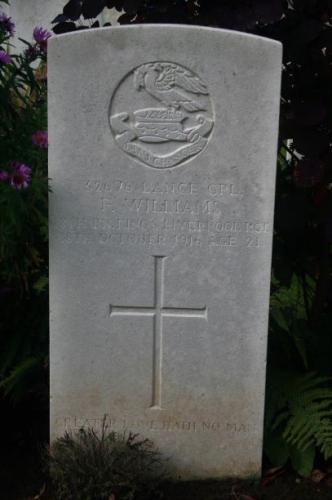
From: Birkenhead, Cheshire
K.I.A (110 Years this day)
Wednesday 18th October 1916.
21 years old
Francis Williams was born in 1895 in Birkenhead and was baptised on the 17th February, 1895 at St Peter’s Church, Birkenhead. He was the son of Joseph and Jane Rebecca Williams, of 243 Brook St, Birkenhead.
The 1911 Census shows the family living at 243 Brook St, Birkenhead. His father Joseph is aged 51, born in Wallasey in 1860 and is a dock labourer. His wife Jane is aged 48, born in 1863 in Ireland. They have eight children who were all born in Birkenhead. Charles aged 22, born 1889 and occupation labourer in fitters shop, Joseph aged 20, born 1891 a trimmer in a power house, Thomas aged 18, born 1893 an apprentice engineer in a shipyard, Francis aged 16 born 1895 is a messenger on the railway. The other four children Martha aged 16, born 1895, Hugh aged 12, born 1899, Francis Maud aged 10, born 1901 and Helen Scarlett aged 6, born 1905 are at school.
Francis enlisted in Liverpool and was serving in the 18th Battalion, The King’s Liverpool Regiment as Lance-Corporal No 32676 when he was killed in action on the 18th October 1916 aged 21 during the Battle of the Transloy Ridges which was part of the ongoing Somme Offensive.
18th Bn Diary
18th October 1916
Attacked German trenches commencing 3.40 am. Relieved by 19th Manchester Regt. Took up position in support Bn trenches W. of Goose Alley.
Graham Maddocks in his book Liverpool Pals gives an overview of the events of the day:
“At 3.40 am the whistles blew, and the Battalion left its assembly trenches, in three waves, approximately fifty yards apart, and began to cross No Man’s Land. Almost immediately, the German Barrage fell on the first wave and halted its advance, so that the second wave soon caught up with it. This was not a great problem at first, and the two combined waves were able to advance together for about 300 yards, whereupon they encountered the German Grid Trench system. On the right of the advance, it was found that the wire was largely intact, apart from a few gaps, and the Germans bombed and machine gunned these gaps, which prevented any further progress. Elsewhere along the trench, however, the wire was cut and there did not seem to be any serious opposition. Nevertheless, the men hesitated to jump down into the German trenches, and instead, began to filter back across to the safety of their own lines.
By this time the third wave had caught up, as had a fourth wave, which had been detailed to mop up any opposition once the trenches had fallen, and all four waves became intermingled which added to the confusion. No less than three attempts were made to try to get the men to go forward again, but each attempt became markedly less successful than its predecessor, and eventually the attack came to a standstill. Although the British assembly trenches had received the attention of the German guns, the attackers in No Mans Land had not come under any great intensity of fire up until this point.
However, once it became obvious to the Germans that the attack was disorganised and faltering, they began to fire into the massed men from the flanks. It was probably this that finally settled the issue and convinced the Pals that they could no longer gain the enemy trenches, and all four waves, now merged into one, began to retreat to their own lines. The whole attack had been an abysmal failure, and no ground had been gained at all”.
He now lies in Warlencourt British Cemetery, France. The inscription on his headstone reads:
“GREATER LOVE HATH NO MAN”
Warlencourt Cemetery is entirely a concentration cemetery, begun late in 1919 when graves were brought in from small cemeteries and the battlefields of Warlencourt and Le Sars. The Graves Registration form shows graves from “Le Sars 6/1, 6/2, Hexham Road, Seven Elms”.
Graves were brought in from the original cemeteries at Hexham Road (Le Sars), and Seven Elms (Flers), as well as over 3,000 British graves due to the fighting which took place around the Butte de Warlencourt from the autumn of 1916 to the spring of 1917, and again in the German advance and retreat of 1918. The cemetery now contains 3,505 Commonwealth burials and commemorations of the First World War, 1,823 of which are unidentified.
He is also commemorated on the Birkenhead War Memorial and London and North Western Railwaymen Roll of Honour.
We currently have no further information on Francis Williams, If you have or know someone who may be able to add to the history of this soldier, please contact us.
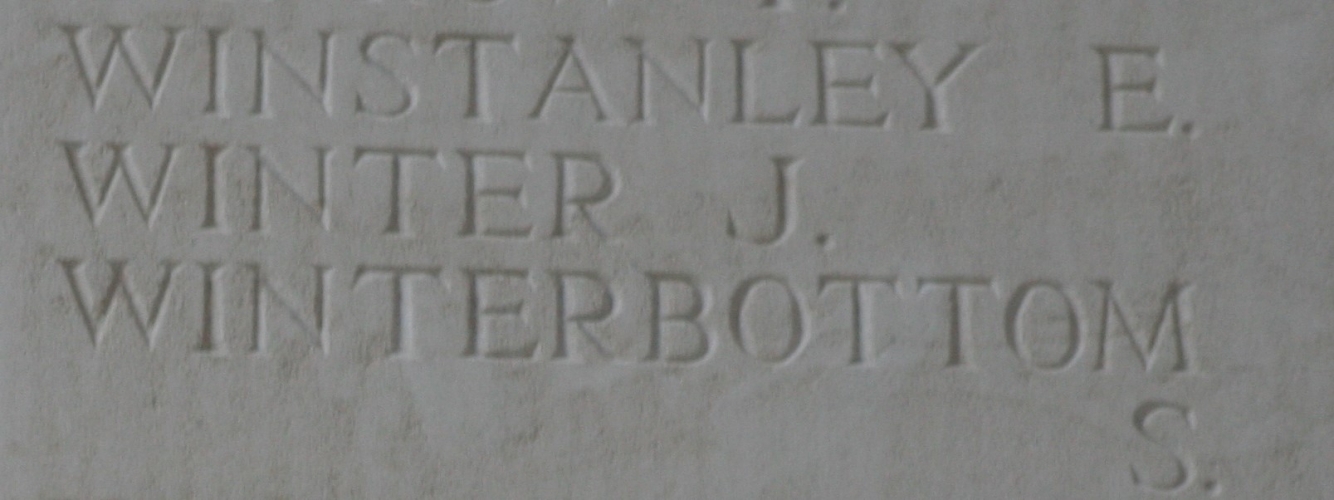
From: Wallasey, Cheshire
K.I.A (110 Years this day)
Wednesday 18th October 1916.
19 years old
Edward Winstanley was born in the second quarter of 1897 in Wallasey and resided in Liscard, Cheshire and was the son of David Watts and Sarah Winstanley, of 50 Strathcona Rd, Wallasey, Cheshire.
The 1901 Census shows the family living at 7, St Brides Road, Liscard.The Father David is aged 45, born 1856 and is a Foreman Scavengers and was born in Liverpool. His wife Sarah is aged 44, born 1857 in Liverpool. They have four children, Mabel aged 18, born 1883 in Liverpool, Harold aged 15, born 1886 in Egremont, Cheshire, Ida aged 13, born 1888 in Liverpool and Edward aged 3, born 1898 was born in Egremont.
He enlisted in Liverpool and was serving in the 18th Battalion, The King’s Liverpool Regiment as Private No 16790.
From the 23rd September 1914 he was billeted at Hooton Park Race Course and remained there until 03rd December 1914 when they moved into the hutted accommodation at Lord Derby’s estate at Knowsley Hall. On 30th April 1915 the 18th Battalion alongside the other three Pals battalions left Liverpool via Prescot Station for further training at Belton Park, Grantham. They remained here until September 1915 when they reached Larkhill Camp on Salisbury Plain. He arrived in France on 7th November 1915.
Edward was killed in action on the 18th October 1916, aged 19, during the Battle of the Transloy Ridges which was part of the ongoing Somme Offensive.
18th Bn Diary
18th October 1916
Attacked German trenches commencing 3.40 am. Relieved by 19th Manchester Regt. Took up position in support Bn trenches W. of Goose Alley.
Graham Maddocks in his book Liverpool Pals gives an overview of the events of the day:
“At 3.40 am the whistles blew, and the Battalion left its assembly trenches, in three waves, approximately fifty yards apart, and began to cross No Man’s Land. Almost immediately, the German Barrage fell on the first wave and halted its advance, so that the second wave soon caught up with it. This was not a great problem at first, and the two combined waves were able to advance together for about 300 yards, whereupon they encountered the German Grid Trench system. On the right of the advance, it was found that the wire was largely intact, apart from a few gaps, and the Germans bombed and machine gunned these gaps, which prevented any further progress. Elsewhere along the trench, however, the wire was cut and there did not seem to be any serious opposition. Nevertheless, the men hesitated to jump down into the German trenches, and instead, began to filter back across to the safety of their own lines.
By this time the third wave had caught up, as had a fourth wave, which had been detailed to mop up any opposition once the trenches had fallen, and all four waves became intermingled which added to the confusion. No less than three attempts were made to try to get the men to go forward again, but each attempt became markedly less successful than its predecessor, and eventually the attack came to a standstill. Although the British assembly trenches had received the attention of the German guns, the attackers in No Mans Land had not come under any great intensity of fire up until this point.
However, once it became obvious to the Germans that the attack was disorganised and faltering, they began to fire into the massed men from the flanks. It was probably this that finally settled the issue and convinced the Pals that they could no longer gain the enemy trenches, and all four waves, now merged into one, began to retreat to their own lines. The whole attack had been an abysmal failure, and no ground had been gained at all”.
Edward has no known grave and is commemorated on the Thiepval Memorial to the Missing of the Somme, France.
The Thiepval Memorial, the Memorial to the Missing of the Somme, bears the names of more than 72,000 officers and men of the United Kingdom and South African forces who died in the Somme sector before 20 March 1918 and have no known grave. Over 90% of those commemorated died between July and November 1916.
On 01st August 1932 the Prince of Wales and the President of France inaugurated the Thiepval Memorial in Picardy. The inscription reads: “Here are recorded the names of officers and men of the British Armies who fell on the Somme battlefields between July 1915 and March 1918 but to whom the fortune of war denied the known and honoured burial given to their comrades in death.”
He is also commemorated on the Wallasey War Memorial and Wallasey Roll of Honour.
We currently have no further information on Edward Winstanley, If you have or know someone who may be able to add to the history of this soldier, please contact us.
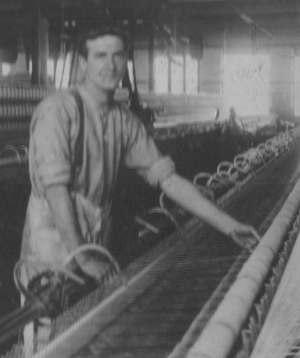
From: Daisy Nook, Lancs
K.I.A (110 Years this day)
Wednesday 18th October 1916.
27 years old
Sydney Winterbottom was born in 1889 in Daisy Nook, Lancashire, the son of Samuel Winterbottom and his wife Mary (nee Higgin). His parents married in 1884 at All Saints Church, Newton Heath.
The 1911 Census shows the family living at 70 Ashton Road, Woodhouse, Ashton Under Lyne. His father, Samuel, is aged 53, born in Daisy Nook, Lancashire in 1858 and is a general labourer, his mother, Mary, is aged 46, born 1865 in Manchester. At the time of the 1911 Census they had been married for 26 years. They have ten children including one stepson. Those listed in the household are; Florence aged 24, born 1887 and occupation Cotton Cop Reeler, Fred aged 23, born 1888 and Sydney aged 21, born 1890 are both Cotton Piecers. Lewis aged 20, born 1891 is a Dryer at a Bleach works, Stanley aged 18, born 1893 is a Bleachers Croft Boy, Harry aged 17, born 1894 is an Apprentice at an Iron Foundry, Alice aged 11, born 1900 is at school, all were born in Daisy Nook. Walter aged 9, born 1902, and Annie aged 7, born 1904 were born in Woodhouse. They also have a stepson Ernest Higgin aged 29, born 1882 and his occupation is a Labourer in an Iron foundry and was born in Manchester.
Sydney married Sarah Emma Rowbottom in 1916 in Oldham. It is highly unlikely that Sydney saw his daughter, Charlotte, who was born on 06th October 1916.
He was serving in the 18th Battalion, The King’s Liverpool Regiment as Private No 35808 when he was killed in action on the 18th October 1916 aged 27 during the Battle of the Transloy Ridges which was part of the ongoing Somme Offensive.
18th Bn Diary
18th October 1916
Attacked German trenches commencing 3.40 am. Relieved by 19th Manchester Regt. Took up position in support Bn trenches W. of Goose Alley.
Graham Maddocks in his book Liverpool Pals gives an overview of the events of the day:
“At 3.40 am the whistles blew, and the Battalion left its assembly trenches, in three waves, approximately fifty yards apart, and began to cross No Man’s Land. Almost immediately, the German Barrage fell on the first wave and halted its advance, so that the second wave soon caught up with it. This was not a great problem at first, and the two combined waves were able to advance together for about 300 yards, whereupon they encountered the German Grid Trench system. On the right of the advance, it was found that the wire was largely intact, apart from a few gaps, and the Germans bombed and machine gunned these gaps, which prevented any further progress. Elsewhere along the trench, however, the wire was cut and there did not seem to be any serious opposition. Nevertheless, the men hesitated to jump down into the German trenches, and instead, began to filter back across to the safety of their own lines.
By this time the third wave had caught up, as had a fourth wave, which had been detailed to mop up any opposition once the trenches had fallen, and all four waves became intermingled which added to the confusion. No less than three attempts were made to try to get the men to go forward again, but each attempt became markedly less successful than its predecessor, and eventually the attack came to a standstill. Although the British assembly trenches had received the attention of the German guns, the attackers in No Mans Land had not come under any great intensity of fire up until this point.
However, once it became obvious to the Germans that the attack was disorganised and faltering, they began to fire into the massed men from the flanks. It was probably this that finally settled the issue and convinced the Pals that they could no longer gain the enemy trenches, and all four waves, now merged into one, began to retreat to their own lines. The whole attack had been an abysmal failure, and no ground had been gained at all”.
Sydney was initially reported as Missing.
His body was not recovered from the battlefield or was subsequently lost as he has no known grave and is commemorated on the Thiepval Memorial to the Missing of the Somme, France.
The Thiepval Memorial, the Memorial to the Missing of the Somme, bears the names of more than 72,000 officers and men of the United Kingdom and South African forces who died in the Somme sector before 20 March 1918 and have no known grave. Over 90% of those commemorated died between July and November 1916.
On 01st August 1932 the Prince of Wales and the President of France inaugurated the Thiepval Memorial in Picardy. The inscription reads: “Here are recorded the names of officers and men of the British Armies who fell on the Somme battlefields between July 1915 and March 1918 but to whom the fortune of war denied the known and honoured burial given to their comrades in death.”
Soldiers Effects and Pension to widow Sarah Emma and child Charlotte.
His mother died in the March quarter of 1925, aged 60.
His father died in the December quarter of 1927, aged 69.
His daughter Charlotte died at the young age of 17 in the December quarter of 1933.
Grateful thanks are extended to Ancestry user sbruntnell110 whose image of Sydney is now on this site.
We currently have no further information on Sydney Winterbottom, If you have or know someone who may be able to add to the history of this soldier, please contact us.
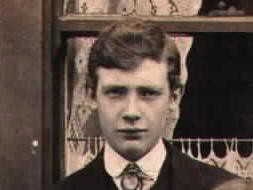
From: Horwich
K.I.A (110 Years this day)
Wednesday 18th October 1916.
20 years old
Abraham Yates was born in 1896 in Horwich, Bolton the eldest son of William James and Betsy Yates (nee Mosscrop) who were married in 1895.
The 1901 census shows William and Betsy, both aged 27 and both born in Bolton, living at 6 Grundy Hill Horwich. As well as the 5 year old Abraham, the couple have two more children 2 year old Thomas and 6 month old William James. William senior is working as a stationery engine driver. Horwich was the site of the Lancashire and Yorkshire Railway’s works for construction and repairs of locomotives. The works was built in 1886 and the 1911 census shows both William senior, Abraham and a lodger doing jobs which almost certainly meant they were working there.
The 1911 Census shows the family living now at 3 Grundy Hill, Horwich. Abraham’s father William James is a Labourer on the railway. His wife Betsy Emma is at home looking after five children. Abraham who was aged 15 is now an apprentice in the railway forge, Thomas aged 12 is at school part-time and William James 10, Esther Hannah 8, and Charles, aged 7, are all at school. They also have a boarder called William Wiggins aged 45 whose occupation is a Plate Layer on the Lancs and Yorkshire Railway.
Abraham married Eleanor Longworth in early 1916 and a daughter also called Eleanor was born in June 1916.
He enlisted in Preston and was serving in the 18th Battalion, The King’s Liverpool Regiment as Private No 34935 when he was killed in action on the 18th October 1916, aged 20, during the Battle of the Transloy Ridges which was part of the ongoing Somme Offensive. Whether he ever saw his baby daughter we do not know.
18th Bn Diary
18th October 1916
Attacked German trenches commencing 3.40 am. Relieved by 19th Manchester Regt. Took up position in support Bn trenches W. of Goose Alley.
Graham Maddocks in his book Liverpool Pals gives an overview of the events of the day:
“At 3.40 am the whistles blew, and the Battalion left its assembly trenches, in three waves, approximately fifty yards apart, and began to cross No Man’s Land. Almost immediately, the German Barrage fell on the first wave and halted its advance, so that the second wave soon caught up with it. This was not a great problem at first, and the two combined waves were able to advance together for about 300 yards, whereupon they encountered the German Grid Trench system. On the right of the advance, it was found that the wire was largely intact, apart from a few gaps, and the Germans bombed and machine gunned these gaps, which prevented any further progress. Elsewhere along the trench, however, the wire was cut and there did not seem to be any serious opposition. Nevertheless, the men hesitated to jump down into the German trenches, and instead, began to filter back across to the safety of their own lines.
By this time the third wave had caught up, as had a fourth wave, which had been detailed to mop up any opposition once the trenches had fallen, and all four waves became intermingled which added to the confusion. No less than three attempts were made to try to get the men to go forward again, but each attempt became markedly less successful than its predecessor, and eventually the attack came to a standstill. Although the British assembly trenches had received the attention of the German guns, the attackers in No Mans Land had not come under any great intensity of fire up until this point.
However, once it became obvious to the Germans that the attack was disorganised and faltering, they began to fire into the massed men from the flanks. It was probably this that finally settled the issue and convinced the Pals that they could no longer gain the enemy trenches, and all four waves, now merged into one, began to retreat to their own lines. The whole attack had been an abysmal failure, and no ground had been gained at all”.
Abraham was reported Missing and the family had an agonising wait before any confirmation of his death was received. The Bolton Journal of 17th August 1917 carried details of the confirmation of Abraham's loss:
"Private Abraham Yates, who has been missing for 10 months, is now presumed to have died on October 10th, 1916, in the King's Liverpool Regiment, prior to which he worked for the Musgrave Spinning Co Ltd., as a maker-up in the cop packing department. Aged 21, he leaves a widow and one child at 21,Dougill-st.,Bolton,and is on the Roll of Honour at Chorley Old Road Wesleyan Church".
Abraham has no known grave and is commemorated on the Thiepval Memorial to the Missing of the Somme, France.
The Thiepval Memorial, the Memorial to the Missing of the Somme, bears the names of more than 72,000 officers and men of the United Kingdom and South African forces who died in the Somme sector before 20 March 1918 and have no known grave. Over 90% of those commemorated died between July and November 1916.
On 01st August 1932 the Prince of Wales and the President of France inaugurated the Thiepval Memorial in Picardy. The inscription reads: “Here are recorded the names of officers and men of the British Armies who fell on the Somme battlefields between July 1915 and March 1918 but to whom the fortune of war denied the known and honoured burial given to their comrades in death.”
He is also commemorated on the following Memorials:
Horwich Roll of Honour
Bolton Roll of Honour (printed Book)
Bolton War Memorial
The 1939 Register shows Abraham’s parents living in Blackpool, and his wife and daughter living together in Valletts Lane in Bolton. His daughter would marry the following year.
We currently have no further information on Abraham Yates, If you have or know someone who may be able to add to the history of this soldier, please contact us.
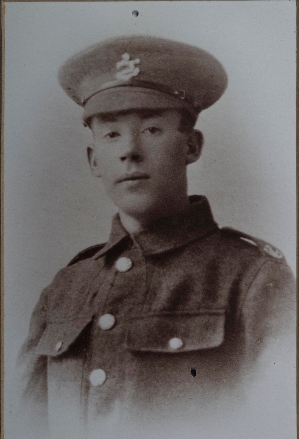
From: Douglas, IOM
K.I.A (109 Years this day)
Thursday 18th October 1917.
26 years old
The 1901 Census shows the family living at Douglas Road, Malew, Isle of Man.
The father Thomas is aged 54, born in 1847 and is a farm labourer who was born in Rushen, Isle of Man, his wife Ann Jane who is aged 45, born 1856 with no occupation listed was born in Malew, Isle of Man as were their two children. Their two children are both living with them at the time of the Census, Ann aged 12, born 1889 and Algie aged 10, born 1891.The 1911 Census shows the family living at 32 Mill Street, Castletown, Isle of Man.
The mother Ann Jane is shown as a widow aged 54, with no occupation listed and her son Elgie (Algie in 1901) is aged 20 and employed as a coal carter.Those United Kingdom and New Zealand servicemen who died after August 16th 1917 are named on the Tyne Cot Memorial, a site which marks the furthest point reached by Commonwealth forces in Belgium until nearly the end of the war.
The Tyne Cot Memorial now bears the names of almost 35,000 officers and men whose graves are not known. The memorial, designed by Sir Herbert Baker with sculpture by Joseph Armitage and F.V. Blundstone, was unveiled by Sir Gilbert Dyett on 20 June 1927.
The memorial forms the north-eastern boundary of Tyne Cot Cemetery, which was established around a captured German blockhouse or pill-box used as an advanced dressing station.
We currently have no further information on Elgie Cregeen, If you have or know someone who may be able to add to the history of this soldier, please contact us.
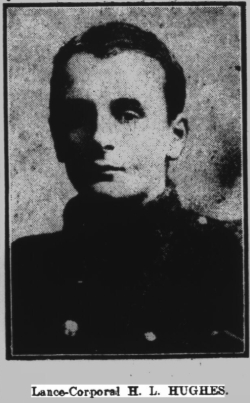
From: Rock Ferry, Cheshire
K.I.A (109 Years this day)
Thursday 18th October 1917.
24 years old
Henry Ledsome Hughes (known as Harry) was born in Rock Ferry on 21st July 1893, the eldest son of Thomas Hughes and his wife Winifred Elizabeth (née Ledsome) who were married on the 24th September 1889 at St Paul’s Church, Tranmere. Thomas was a 30 year old printer of 36 Rockville Street, his father, James, was a deceased warehouseman, whilst Winifred was aged 21 of 418 New Chester Road, her father, Henry, was a milk dealer. Thomas was born in Liverpool and Winifred in Bebington, Cheshire, and they had 12 children, 3 of whom died young. The surviving children were: Winifred and Harry born in Rock Ferry, Jane/Jenny, Lucy, and Charles born in Seacombe, John, Arnold, Gabriella Joy, and Albert born in Wigan.
Formed on 07th September 1914 the 19th Battalion trained locally at Sefton Park and remained living at home or in rented accommodation until November 1914. They then moved to the hutted accommodation at Lord Derby’s estate at Knowsley Hall. On 30th April 1915 the 19th Battalion alongside the other three Pals battalions left Liverpool via Prescot Station for further training at Belton Park, Grantham. They remained here until September 1915 when they reached Larkhill Camp on Salisbury Plain. He arrived in France on 07th November 1915 disembarking at Boulogne.
His father aired his views about the council in the Birkenhead News on Saturday 07th October 1916:
Sir,-I shall be obliged if you will allow me space to air the following grievances.
We have on our Borough Council a number of men put there to watch the interests of the borough, and to try to promote the welfare of the whole people, but one only needs to look at their actions to see that they do not understand their business. If we think of almost any one of the committees into which the councillors are divided we find a general disinclination to do their work in a sensible manner. The Ferries and Gas Committee's performances have been the laughing-stock-of the town for years, but I wish to direct special attention now to the brilliant strategy of the Libraries Committee. Their giant intellects have ordered the Reference Library to be closed at the time when most people require it, viz., the evenings. For rank stupidity this surely cannot be beaten. The Library contains the best magazines published in the country, and the object of any Library Committee worth the name would be to induce the common people to read them, very especially at a time like the present, with the streets in darkness,
very large numbers of men living in lodgings, soldiers away from home and needing all the refining help they can get; in fact, all the conditions of the times point one way, namely, make it as easy as possible for our men to live a refined life.
The action of our Libraries Committee is without a vestige of excuse. We have the books, we have the buildings, we have the people needing the education and anxious to get it. I trust that this outrage on public policy will be at once put among the things of which we are ashamed.
- Yours truly, 60, Westbourne-road, Birkenhead.
T. HUGHES.
Those United Kingdom and New Zealand servicemen who died after August 16th 1917 are named on the Tyne Cot Memorial, a site which marks the furthest point reached by Commonwealth forces in Belgium until nearly the end of the war.
The Tyne Cot Memorial now bears the names of almost 35,000 officers and men whose graves are not known. The memorial, designed by Sir Herbert Baker with sculpture by Joseph Armitage and F.V. Blundstone, was unveiled by Sir Gilbert Dyett on 20 June 1927.
The memorial forms the north-eastern boundary of Tyne Cot Cemetery, which was established around a captured German blockhouse or pill-box used as an advanced dressing station.
De Ruvigny's Roll of Honour (volume four, page 89) contains the following biography.
HUGHES, HENRY LEDSOME, L.-Corpl., No. 17371, 19th (Service) Battn. The King's (Liverpool Regt.), s. of Thomas Hughes, of 60, Westbourne Road, Birkenhead, Furniture Salesman, by his wife, Winifred, dau. of Henry Ledsome; b. Rock Ferry, Birkenhead, co. Chester, 21 July, 1893; educ. Wigan Grammar School; was a Clerk in the employ of Messrs. Joseph Bibby & Sons, Liverpool; enlisted in the Liverpool Regt. 30 Aug. 1914; served with the Expeditionary Force in France from 1 Nov. 1915, being employed first as a sniper, and then as a signaller, and was killed in action near Ypres 16 Oct. 1917. Buried behind the line there; unm.
His death was reported in the Birkenhead News on Wednesday 31st October 1917;
Killed by a Shell.
Mr. and Mrs. Hughes, of 60, Westbourne-road, have received official news of the death in action of their son, Lance-Corpl. Harry L. Hughes. It appears that he was in a working party, and was hit by a shell, dying instantly. He joined the Liverpool "Pals" at the outbreak of war, and went to France in November, 1915, and had been there ever since. Prior to joining the Army he was employed on the office staff of Bibby's, Liverpool, and resided with his parents at 60, Westbourne-road, Birkenhead. Lance-Corporal Hughes was an old Wigan Grammar School boy. He was well known in the town, and his death will be deeply regretted by his many friends.
A memorial to Harry was reported in the Wigan Examiner on Saturday 19th July 1919;
OLD BOYS' MEMORIAL.
Wigan Grammar School's Tribute.
Four marble memorial tablets, recording the names of masters and old boys of the Wigan Grammar School, who have fallen in the war, were unveiled on Thursday afternoon by the Rev. E. F. Forrest, M.A., Vicar of Pemberton, who delivered an address in connection with the occasion. Alderman A. S. Hilton, J.P., a member of the Grammar School Governing Body, presided over a large attendance of parents, friends, and boys in the School Hall.
The following are the names of Old Boys engraved on the three tablets affixed to the wall on the lower staircase, the dates indicating the years during which the boys were respectively at the school:-
To our Schoolmates Fallen in the War.
Harry Ledsome Hughes, 1907-09, Lance-Corpl., King's Liverpool (Pals.)
On the 1921 Census at Jupiter Terrace, his father Thomas is aged 62, a shop manager, mother is Winifred aged 52, a commercial teacher, Winifred is 29, Jane 26, Lucy 25, Arnold 18, Gabrielle 15 and Albert 14.
We currently have no further information on Henry Ledsome Hughes. If you have or know someone who may be able to add to the history of this soldier, please contact us.
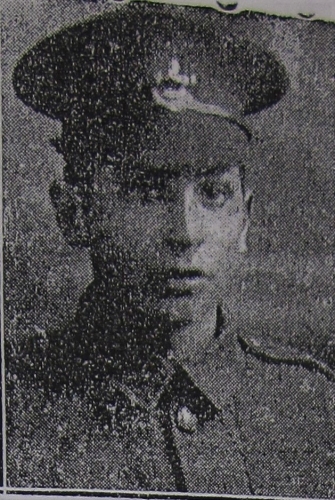
From: Southport, Lancs
K.I.A (109 Years this day)
Thursday 18th October 1917.
20 years old
News of Frederick's death was conveyed in a letter from the Army Chaplain with his unit at the time of the occurrence who wrote:-
"As chaplain to your son's regiment it falls to my sad duty to inform you of his death on the night of 17-18October, 1917. Private F. Leevers (No 25941), 19th K.L.R.'s. He was killedby a shell whilst on a working party , and was buried by me in the Military Cemetery behind our lines. He died asa true soldier, doing his duty bravely and faithfully to the last, and we his comrades and friends wish to express to you our sincere sympathy in your sad bereavement. He was killed instantly. But we do not sorrow as men without hope but look forward to that great day of reunion when sorrow and partings shall be no more, and it is my earnest prayer that the Great God and Father of us all maybe your true Comforter and Consoler in your sad loss.-- Believe me, yours very truly, R. B. Parslow, C. of E. Chaplain"
Due to continued heavy fighting and sustained shelling following the burial of Fred his grave was subsequently lost and his body was not recovered from the battlefield, he is now remembered on the Tyne Cot Memorial to the Missing, Flanders, Belgium.
Those United Kingdom and New Zealand servicemen who died after August 16th 1917 are named on the Tyne Cot Memorial, a site which marks the furthest point reached by Commonwealth forces in Belgium until nearly the end of the war.
The Tyne Cot Memorial now bears the names of almost 35,000 officers and men whose graves are not known. The memorial, designed by Sir Herbert Baker with sculpture by Joseph Armitage and F.V. Blundstone, was unveiled by Sir Gilbert Dyett on 20 June 1927.
The memorial forms the north-eastern boundary of Tyne Cot Cemetery, which was established around a captured German blockhouse or pill-box used as an advanced dressing station.
“Private Fred Leevers (21), K.L.R., third son of Mr. Wm Leevers, Union Street, Southport, has been killed in action.”
A report from the Southport Visiter dated 30th October 1917:
"Private Leevers was the youngest son of Mr William Leevers of Union St, Southport. He was killed on the night of 17th/18th October, by a shell while engaged with a working party. He enlisted in March 1915, and was later gassed at Loos, and twice wounded by machine gun fire within five minutes at Guilllemont. Prior to the war he assisted his father in his business. The deceased soldier was 20 years of age. His brother, Sergt Alfred Leevers, was awarded the Croix de Guerre for gallantry in the field and devotion to duty".
We currently have no further information on Frederick Leevers. If you have or know someone who may be able to add to the history of this soldier, please contact us.
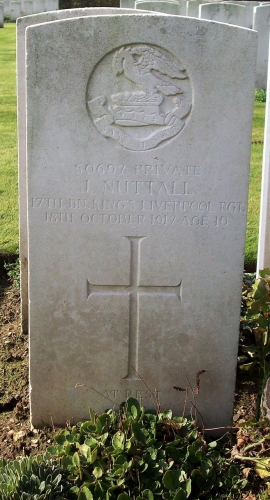
From: Middleton, Lancs
D.O.W (109 Years this day)
Thursday 18th October 1917.
19 years old
John Nuttall was born 1898 at Middleton and was the son of George and Emma Nuttall, of 74, Brassey Street, Middleton, Manchester.
The 1911 Census shows the family living at 74 Brassey Street, Midleton. His father George aged 38, born in Middleton in 1873 is a farm labourer, his mother, Emma is aged 34, born 1877 also in Middleton as were all their children. They have been married for thirteen years and had seven children of which one died. There are six children in the household at the time of the Census; Jonathan aged 12, born 1899, Elsie aged 10, born 1901, Lena aged 8, born 1903, George aged 7, born 1904, Albert aged 3, born 1908 and Hilda aged 2, born 1909.
He enlisted in Middleton and was serving in the 17th Battalion, The King’s Liverpool Regiment as Private No 50697 when he died of wounds on the 18th October 1917, aged 19 during the Third Battle of Ypres.
He now lies in Outtersteene Communal Cemetery Extension, Bailleul, Belgium. The Inscription on his headstone reads:
“AT REST”
Outtersteene was captured by the III Corps on 13 October 1914 but no Commonwealth burials took place there for nearly three years. In August 1917, during the Third Battle of Ypres, the 2nd, 53rd and 1st Australian Casualty Clearing Stations came to Outtersteene, and the first and last of these remained until March 1918. The hamlet was captured by the Germans on 12 April 1918, and retaken by the 9th, 29th and 31st Divisions, with the ridge beyond it, on 18 and 19 August, but the cemetery was not used again during hostilities. After the Armistice, over 900 graves of 1914 and 1918 were brought into Plots I, II and IV from the battlefields surrounding Outtersteene and from certain small cemeteries. In the Extension, on the East side of the Communal Cemetery, were buried 17 soldiers from the United Kingdom and one from Australia, who fell in August and September 1918. 1,147 German graves were initially concentrated into Plot III. These were later removed to Steenwerck German Cemetery. The extension was used again in 1940, for the burial of those killed in the fighting which covered the withdrawal of the British Expeditionary Force to Dunkirk. Outtersteene Communal Cemetery Extension now contains 1,393 Commonwealth burials and commemorations of the First World War. 499 of the burials are unidentified but there are special memorials to 14 casualties known or believed to be buried among them. Second World War burials number 72, of which 23 are unidentified. The extension was designed by Sir Herbert Baker.
He is also commemorated on the Middleton War Memorial.
We currently have no further information on John Nuttall, If you have or know someone who may be able to add to the history of this soldier, please contact us.
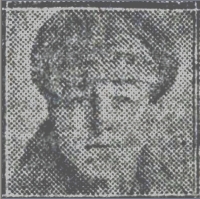
From: Everton, Liverpool
K.I.A (108 Years this day)
Friday 18th October 1918.
30 years old
Liverpool R. - M’Farlane, 300063, W. J.;
He now rests at Maurois Communal Cemetery Extension, France where his headstone bears the epitaph:
“ON WHOSE SOUL SWEET JESUS HAVE MERCY”
Maurois village was the scene of fighting in the Battle of Le Gateau, 1914, and it remained in German hands until it was occupied by the South African Brigade on the 9th October, 1918. There are now over 80, 1914-18 war casualties commemorated in this site. Three were buried by the enemy in August, 1914, three by their comrades in October, 1918, and one in October, 1918 in a single grave. The remainder were buried in October and November, with one of February, 1919. The plot covers an area of 286 square metres.
“Private James McFarlane killed in action, after four years’ service, was an old scholar of Our Lady Immaculate. Sadly missed by parents, sisters, and brothers (in France). He lived at 11, Lune Street, Everton.”
We currently have no further information on William James McFarlane. If you have or know someone who may be able to add to the history of this soldier, please contact us.
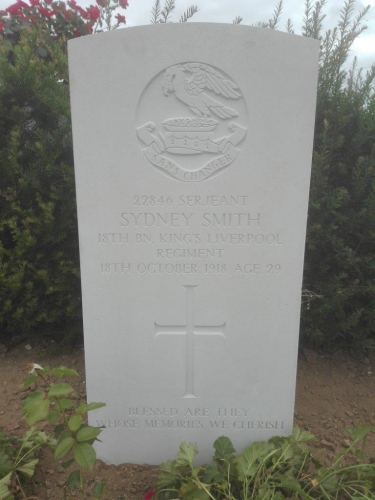
From: Liverpool
K.I.A (108 Years this day)
Friday 18th October 1918.
29 years old
Sydney Smith was born in Liverpool in 1889 the son of Edward Hoyle Smith and his wife Alice Eliza(née Collins) who married on the 26th October 1886 at St Jude's Church, Liverpool. Edward, was a brewer of 290 Kensington, his father, Thomas May, also a brewer, whilst Alice was of 298 Kensington, her father, Henry, on H.M. retired list (Forces).
His birth was registered under the name Sidney Douglas Smith, and he was baptised Sidney Douglas Smith in St. Augustine's Church, Everton, on 07th April 1889, his parents’ residence 42 Needham Road and his father’s occupation given as brewer. However, most of his military records show his first name as Sydney, and his mother wrote his name on the 1911 census form with a “y”. His father was born in Liverpool, and his mother in the Isle of White and they had five children. Sydney had an older brother Edward Henry, born in 1887, and younger siblings Sybil 1891, Alice May 1893, and Charles Lionel 1896.
His father was born in Liverpool, and his mother in the Isle of White. They married in 1886 and had five children. Sydney had an older brother Edward Henry, born in 1887, and younger siblings Sybil 1891, Alice May 1893, and Charles Lionel 1896.
At the time of the 1891 Census, the family is living at 298 Kensington with two children and a domestic servant. His father, 26, is a brewer, his mother is 28, born Southsea, Isle of Wight, Edward is 3, and Sydney 2 years old.
The 1901 Census finds them at 242 Picton Road, Wavertree (the premises of the Rose Brewery). His father is a brewery manager working at home, his mother, Alice, is aged 37. They have five children declared in the household; Edward H. is 13, Sydney is 12, Sybil is 9, Alice M. is 8, and Charles L. is 5. They also have a servant Amy Savage, aged 15.
His father died at the end of 1901, at the age of 37.
In 1911 his mother, 47, is a licensed victualler at 1 Larkhill Lane (The Farmers Arms) in Clubmoor. She employs a barmaid who lives on the premises. Four children are at home: Sydney, 22, is a newspaper clerk, Sybil, 19, has no occupation, Alice, 17, is a dyer’s assistant, and Charles, 15, is an engineer’s apprentice.
He was initiated into Apollo Lodge of the Freemasons in 1913, his occupation noted as bookkeeper.
His brother Charles enlisted at age 18 in March 1914 in the 4th West Lancs Territorial R.F.A. and was embodied on 05th August, the day after war was declared. He was discharged permanently as medically unfit in February 1915 due to perforation of both ear drums (which he had suffered from since childhood).
Sydney enlisted in Liverpool on the 07th November 1914 as Private 22846 joining the 20th Battalion of The King’s Liverpool Regiment. He gave his age as 25 years and 235 days and his occupation as clerk. He is described as being 5’ 8” tall, weighing 126 lbs, with a fresh complexion, grey eyes and light brown hair. He has appendicitis scars. He states previous service in the 5th Battalion Liverpool Regiment (Territorials). He gives as next of kin his mother Alice at 1 Larkhill Lane.
Formed in November 1914 the 20th Battalion were originally billeted at Tournament Hall, Knotty Ash before on 29th January 1915 they moved to the hutted accommodation purposely built at Lord Derby’s estate at Knowsley Hall. On 30th April 1915 the 20th Battalion alongside the other three Pals battalions left Liverpool via Prescot Station for further training at Belton Park, Grantham. They remained here until September 1915 when they reached Larkhill Camp on Salisbury Plain.
No doubt because of his previous Territorial experience, Sydney was rapidly promoted: appointed paid Lance Corporal on 08th December 1914, promoted to Corporal on probation on 09th February 1915 and to Sergeant on probation on 12th March 1915.
Sydney, aged 26, married Alice Hulme on 13th March 1915 in St. James’ Church, Liverpool, giving his occupation as advertising clerk, and his address as 1 Larkhill Lane. Alice was aged 24, of 633 West Derby Road, her father, John, was a gardener. No records of children born to the marriage have been found.
He shipped to France with his battalion, disembarking at Boulogne on 07th November 1915.
A few months later, in March 1916, his mother died, aged 54.
He was granted leave to the U.K. from 16th to 25th May 1916.
On 12th October 1916 during the battle of the Transloy Ridges, he was wounded in action and the next day admitted to 140 Field Ambulance with shell shock (“buried”). He rejoined his unit in the field on 24th October.
He was admitted to 98 F.A. on 02nd March 1917 then to 12 Stationary Hospital with German measles, and discharged to duty on the 16th.
On 30th June 1917 he arrived at 30 Infantry Base Depot (Etaples) and joined No.2 Training Camp at Etaples on 02nd July.
He was severely reprimanded for not informing his platoon of his whereabouts and for sleeping in an unauthorised place on 17th-18th December 1917.
On 27th December 1917 to Brigade School.
When the 20th Battalion K.L.R. was disbanded on the 07th February 1918, Sydney was posted to “A” Company, 18th Bn K.L.R. (Lancashire Hussars Yeomanry), but still attached to Brigade School. He joined the 18th Battalion in the field on the 04th June 1918.
He was killed in action on the 18th October 1918, aged 29, during the hundred days offensive which ended the First World War (8th August-11th November 1918).
He now lies in Maurois Cemetery, France. The Inscription on his headstone reads:
“BLESSED ARE THEY WHOSE MEMORIES WE CHERISH”
Maurois village was the scene of fighting in the Battle of Le Gateau, 1914, and it remained in German hands until it was occupied by the South African Brigade on the 9th October, 1918. There are now over 80, 1914-18 war casualties commemorated in this site. Three were buried by the enemy in August, 1914, three by their comrades in October, 1918, and one in October, 1918 in a single grave. The remainder were buried in October and November, with one of February, 1919. The plot covers an area of 286 square metres.
Sydney’s death was reported in the local press on 28th October 1918:
“News reached Liverpool today of two employees of the “Liverpool Post” and “Echo” having been killed in action, namely, Sergeant Sidney [sic] Smith, Lewis Guns (L.H.Y., K.L.R) late Pals, and Sergeant Edward M’Inroy, King’s Liverpool Regiment. Sergt. Smith was formerly in the advertisement department of this office and Sergt. M’Inroy in the stereo department. Both men joined the forces in the early stages of the war and rapidly secured promotion. Smith joined on the first Saturday after war was declared and, having had previous training in the Territorials, quickly rose to the rank of sergeant. He joined the “Post” and “Echo” advertisement staff as a boy, and his loss is severely felt by his colleagues, who held him in the highest esteem. He leaves a young widow.”
Alice also placed a notice:
“October 18, instantaneously, Sgt. Sidney [sic] Smith (L.H.Y., K.L.R, late Pals), the dearly loved and devoted husband of Alice Smith (Apollo Lodge No. 2042). - Deeply mourned by his sorrowing Wife and all at 25 Craigburn Road, Tuebrook.”
Sydney earned his three medals, which Alice signed for, as well as his Memorial Plaque and Scroll.
Alice received his Army pay of £28 11s 11d and a War Gratuity of £26. She was awarded a pension of 16/3d a week from May 1919.
In 1919 she provided information on Sydney’s living relatives: She had returned to her parents’ home in Craigburn Road. His siblings Edward, 32, Charles, 23, Sybil, 28, and Alice (now married), 26, were still living in Liverpool.
On the 1921 Census at Craigburn Road, his widow, Alice, is aged 30 and a Dyers manageress, with her parents John and Ann Hulme, and brother Thomas 25.
His widow Alice remarried in 1929 to police constable Duncan Mackenzie Foden who had served in the 1st K.L.R. and had been wounded (GSW abdomen) and discharged with a Silver War Badge and a partial disability pension. They were married on the 10th October 1929 at St. Mary The Virgin Church, in West Derby.
In 1939 Alice, 49, is living with her husband, a police constable (clerical work) at 12 Alcester Road. With them are her parents, John and Ann Hulme.
Alice died in 1975, at the age of 85.
Sydney is commemorated on the following memorials -
Liverpool Daily Post and Echo, Old Hall Street, Liverpool
Masonic Roll of Honour 1914-1918
Liverpool Masonic Hall War Memorial, Hope Street, Liverpool
Liverpool’s Hall of Remembrance within Liverpool Town Hall, Panel 39.
Sydney was remembered by the Hulme’s nine years later in the Liverpool Daily Post on Tuesday 18 October 1927;
IN MEMORIAM.
SMITH - In loving and cherished memory of Sergt. SYDNEY SMITH, 20th K.L.R., killed at Le Cateau, October 18, 1918. - 25, Craigburn-road, Tuebrook.
CWGC: Shows that Sydney was the son of Edward Hoyle Smith and Alice Eliza Smith; husband of Alice Smith, of 25, Craigburn Road., Tuebrook, Liverpool.
We currently have no further information on Sydney Smith, If you have or know someone who may be able to add to the history of this soldier, please contact us.
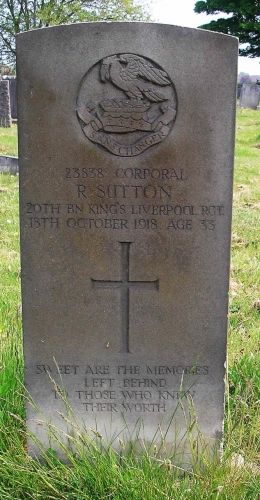
From: Kirkdale, Liverpool
Died (108 Years this day)
Friday 18th October 1918.
32 years old
Richard Sutton was born in Liverpool on 28th March 1886, the son of Richard and Alice Jane Sutton (née Locke) who were married on the 12th November 1882 at St Mary’s Church, Kirkdale. They were both born in Liverpool and had nine children, three of whom sadly died young. Richard had an older sister Alice Helena, and younger siblings John Alfred, Charles (died at age 1), Frances (died in infancy), Maud, Albert Ernest, Ada (died in infancy), and Elizabeth.
In 1891 the family is living at 37 Barlow Street, Kirkdale, with four children. His father is aged 30, a dock labourer, his mother, Alice, is aged 25, with childred Alice aged 6, Richard aged 5, John aged 2, and Charles aged 7 months, he sadly died soon after.
Richard attended St. Chad’s and Westminster Road Council School, the family’s address in 1893 is 220 Westminster Road.
The 1901 Census finds them at 67 Barry Street, Kirkdale with six children. His father, is aged 40, a general labourer, his mother, Alice, is aged 35, with children Alice H. aged 17, and a shop assistant, Richard aged 15 is a railway porter, John aged 12, Albert aged 6, Maud aged 4, and Elizabeth aged 3 months.
At the time of the 1911 census Richard and four siblings are living at home with their parents at 27 Priam Street, Kirkdale. His father, is aged 50, and Richard, 25, are both porters/dock labourers, his mother is 46. Thye advised that they had been married for 27 years, and have had 9 children, 6 of whom have survived. There are four children declared in the household; John, aged 22, is a railway carter, Albert, aged 16, is a railway guard/caller, Maud, aged 14, does dressmaking, and Elizabeth is 10, at school.
Richard enlisted in Liverpool and was serving in the 20th Battalion, The King’s Liverpool Regiment as Corporal No 23838 when he died on the 18th October 1918, aged 32.
Richard died of pneumonia in an Auxiliary Hospital in Liverpool on 18th October 1918.
Corporal Richard Sutton was laid to rest in Kirkdale Cemetery, Liverpool, on 25th October, his age on the burial record given as 32 (CWGC gives his age as 33).
He now rests at Kirkdale Cemetery, Liverpool where the inscription on his headstone reads:
“SWEET ARE THE MEMORIES LEFT BEHIND TO THOSE WHO KNEW THEIR WORTH”
There are 519 First and Second World War burials in the Cemetery.
Although his regimental number suggests that he enlisted in about November 1914, a 1914-1915 Star medal roll has not been found for Richard. He served overseas and earned the British War Medal and Victory Medal.
It is not known when Richard returned to England though he was posted to the 3rd (Garrison) Bn K.L.R. whilst home.
His mother, Alice, received his Army effects, Army Pay of £1 4s 7d and a War Gratuity of £23-10. The pension card does state any amount given.
On the 1921 Census at Priam Street, his parents are living with their married daughter Elizabeth Burns, aged 20.
His father died in 1940, aged 80, and his mother in 1943, aged 78. His parents were buried with their son.
Richard is commemorated on the following memorials -
Westminster Road Council School (now in St. Lawrence C of E School)
St. Mary with St. Athanasius Parishioners.
We currently have no further information on Richard Sutton, If you have or know someone who may be able to add to the history of this soldier, please contact us.
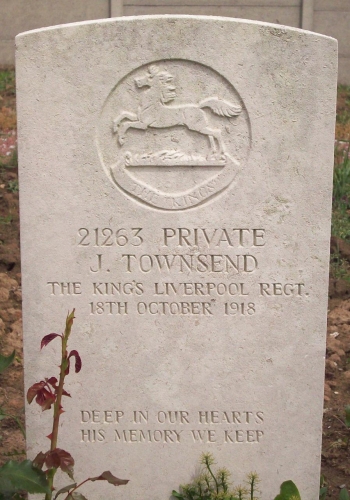
From: Darwen, Lancs
D.O.W (108 Years this day)
Friday 18th October 1918.
23 years old
John attested in Darwen on 9th November 1914, joining The King’s Liverpool Regiment (Depot), as Private 21263, giving his age as 19 years and 9 months, and his occupation as spinner. He is described as being 5’ 5 and a half inches tall, weighing 125lbs, 34” chest, with a sallow complexion, green eyes, and brown hair. He gives his next of kin as his mother Mrs. Mary Townsend, 11 Primrose Hill, this is most likely his stepmother, although no remarriage found though.
He was posted to the 14th Bn K.L.R. and joined his unit on 21st November.
John’s service record shows -
His death was reported in the Blackburn Weekly Telegraph on Saturday 16 November 1918;
Died from Wounds.
Private John Townsend, King's Own(sic) Liverpool Regt., Primrose Hill, Darwen, died on October 22 from wounds received in action. Twenty-three years of age, he enlisted in 1914, and has been at the front over three years.
He now rests at Maurois CC, France. The Inscription on his headstone reads:
“DEEP IN OUR HEARTS HIS MEMORY WE KEEP”
Maurois village was the scene of fighting in the Battle of Le Cateau, 1914, and it remained in German hands until it was occupied by the South African Brigade on the 9th October, 1918. There are now over 80, 1914-18 war casualties commemorated in this site. Three were buried by the enemy in August, 1914, three by their comrades in October, 1918, and one in October, 1918 in a single grave. The remainder were buried in October and November, with one of February, 1919. The plot covers an area of 286 square metres.
We currently have no further information on John Townsend, If you have or know someone who may be able to add to the history of this soldier, please contact us.
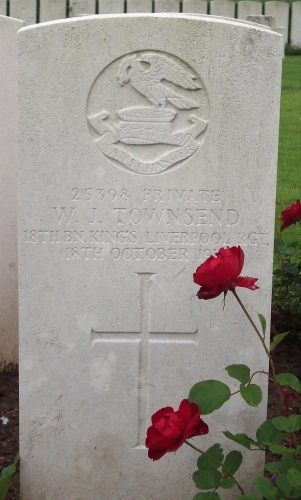
From: Sheldon, Warwickshire
K.I.A (108 Years this day)
Friday 18th October 1918.
23 years old
He now rests at Le Cateau Military Cemetery, France.
Le Cateau-Cambrésis and the country to the west of it was the scene of a battle fought by the British II Corps on 26 August 1914 against a greatly superior German force. The town remained in German hands from that date until the evening of 10 October 1918, when it was rushed by the 5th Connaught Rangers and finally cleared a week later. During the war Le Cateau had been a German railhead and the site of an important hospital centre. The military cemetery was laid out by the Germans in February 1916 with separate plots for the Commonwealth and German dead. It contains the graves of over 5,000 German soldiers, many of whom were buried during the occupation, the rest being brought in from other German cemeteries after the Armistice. A separate plot contains the graves of 34 Russian prisoners of war who died in captivity. The Commonwealth plot is the site of almost 700 graves and commemorations of the First World War. The majority of the graves in Plots I, III, IV and V are those of British dead buried by the Germans, mainly from the battleground of 1914; Plot II contains entirely graves of October and November 1918, eight of which were brought in after the Armistice.
13th December 1918;
Private William John Townsend, King's Liverpool Regiment, second son of Mr and Mrs Townsend of Lyndon End, who is missing since October 18, had been in the army since January 1915. For 2 years and 8 months he was in Salonika and in July was redrafted to France. His elder brother, Lance Corporal George Townsend of the same regiment was killed in action a few weeks ago.
William was listed as Missing in the Birmingham Post on 14th December 1918:
"Private William John Townsend, King’s Liverpool Regiment, second son of Mr. and Mrs. Townsend, of Lyndon End.”
TOLL OF THE BRAVE.
News has been received by Mr. and Mrs. Townsend, of Lyndon End, that their second son, William John, has been missing, following an engagement in France, since the 18th November, 1918.
He joined the King's Liverpool Regiment in 1915, and saw service with his regiment for two years and eight months in Salonica. Coming home in July, 1918, he was re-drafted directly to France. Writing to his parents his Commanding Officer speaks most highly of his qualities, both as a soldier and a man.
Any news of the above would be gratefully received by Mr. and Mrs. Townsend. It is only a very few weeks ago that their elder son George was killed in action in France, and the above news coming through only a few days before the armistice was signed comes as a very hard blow.
His death was once again reported in the Coleshill Chronicle - Saturday 17th December 1918;
COLESHILL AND THE WAR.
A SHELDON YOUNG MAN KILLED.
The sad news has reached Mr. and Mrs. J. Townsend, of Lyndon End, Sheldon, that their eldest son, Lance-corporal George Townsend, was killed on July 26th, 1918. Lance-corporal Townsend joined the army in January, 1915. He had been wounded twice, and had been in France three winters. He was 25 years of age, and previous to joining up worked for the Birmingham Corporation Water Department. He was much respected by all who knew him.
His brother George's death was remembered on the first anniversary of his death in the Coleshill Chronicle on Saturday 26 July 1919;
DEATHS.
IN MEMORIAM.
TOWNSEND. - In ever-loving memory of Lance-corporal George Townsend, of Lyndon End, Sheldon, killed in France after nearly four years' service, on the 26th of July, 1918. Always remembered by Mother, Father, Sisters, Brother-in-law, and all relations. He served his country nobly and well.
TOWNSEND. - In affectionate remembrance of our dear nephew, Corporal George Townsend, of Lyndon End, Sheldon, who was killed in France, July 26th, 1918. Although in a far-off grave, lovingly remembered by Aunt and Uncle.
William was remembered by his family on the first anniversary of his death in the Coleshill Chronicle on Saturday 18 October 1919;
DEATHS.
IN MEMORIAM.
TOWNSEND. - In loving memory of our dear son, Private William John Townsend, of Lyndon End, Sheldon, presumed killed October 18th, 1918. "Gone from our home, but not our hearts." Sadly missed by all at home and relations.
His death was included in a further press report:
KILLED
Corporal George Townsend (25), eldest son of Mr and Mrs J. Townsend, Lyndon End, Sheldon. He joined the army in January 1915, had been twice wounded, and had seen three winter's in France. Previously employed in the Birmingham Corporation Water Department.
His death was once again reported in the Coleshill Chronicle - Saturday 17 August 1918
COLESHILL AND THE WAR.
A SHELDON YOUNG MAN KILLED.
The sad news has reached Mr. and Mrs. J. Townsend, of Lyndon End, Sheldon, that their eldest son, Lance-corporal George Townsend, was killed on July 26th, 1918. Lance-corporal Townsend joined the army in January, 1915. He had been wounded twice, and had been in France three winters. He was 25 years of age, and previous to joining up worked for the Birmingham Corporation Water Department. He was much respected by all who knew him.
On the 1921 Census at Oak Cottage, Lyndon End, his father, John, is aged 56, now born Preston Bagot, is a navvy for Birmingham Drainage Board, his mother, Harriett, is 54, now born Marston Green, married daughter Ada Jackman is aged 32. Another grandson is present, Wilfred aged 11, his father dead.
On the 1939 Register they are living at 581 Barrows Lane, Lyndon Green, his father John, date of birth the 04th October 1863, is a retired farm labourer, his mother Harriett was born on the 28th February 1867. Grandson Wilfred is still with them.
His father died, aged 78, in 1942, and his mother, aged 77, in 1944.
From: Macclesfield, Cheshire
K.I.A (108 Years this day)
Friday 18th October 1918.
30 years old
After the Battle of Le Cateau (26 August 1914), the town remained in German hands until the middle of October 1918. The original cemetery (Plot III) was made by the 50th (Northumbrian) Division after the fighting of 17 October; the name of Highland Cemetery is suggestive at once of the comparatively high ground on which it stands and of the 32 graves of the 13th (Scottish Horse) Battalion, Black Watch, found in this plot. The cemetery was greatly enlarged after the Armistice when graves of October and November 1918 were brought in from isolated positions on all sides of Le Cateau. Highland Cemetery now contains 624 First World War burials. The cemetery was designed by Charles Holden.
FALLEN FIGHTERS.
Corpl. Ernest Yates, King's Liverpools, 17, Robert-street, Ardwick, killed October 18, worked for the Lancashire and Yorkshire Railway Co.
His family paid tribute to Ernest on the first anniversary of his death in the Manchester Evening News on Saturday 18 October 1919;
IN MEMORIAM
YATES - In loving memory of my dear husband, Corpl. ERNEST YATES, King's Liverpool Regt., killed in action, October 18, 1918, aged 31.
- From his sorrowing WIFE and 3 little CHILDREN, 17 Robert-street, Ardwick.
We have lost him -we who loved him-
And, like others, must be brave;
For we know that he is sleeping in a British soldier's grave.
YATES - In loving memory of our dear son and brother, Corpl. ERNEST YATES, King's Liverpool Regiment, who was killed in action October 18, 1918, aged 31.
From his FATHER, MOTHER, brother ROBERT, and sister-in-law ANNIE. - 34, St. Andrew's-street, Ancoats.
A loving son, true and kind,
A beautiful memory left behind.
YATES - In loving memory of our dear nephew, Corpl. ERNEST YATES, King's Liverpool Regt., who was killed in action Oct. 18, 1918, aged 31. Also FRED YATES, brother of above, who died Feb. 15, 1918, aged 32, after much suffering.
From their loving UNCLE, AUNT, and cousins (Mr. and Mrs. Woodbury). 10, Wesley-st, Ancoats.
Some time we hope to meet them,
Sometime - we know not when;
To clasp their hand in the Better Land,
Never to part again.
His widow, Ann, born on the 06th May 1889 remarried to John Lee, but no marriage record has been found.
On the 1921 Census at 17 Robert Street, Ardwick, John Lee is aged 34, a labourer born in Salford, wife Ann Lee is aged 31, with her brothers John T. Simpson, 25 and Arthur Simpson 22. Ann’s three children are yet to be found.
Ann died, aged 75, in 1964, however she cannot be found on the 1939 Register.
We currently have no further information on Ernest Yates, If you have or know someone who may be able to add to the history of this soldier, please contact us.