
1885 - 1916

CPL David Wallace Crawford
1887 - 1916

Lce-Corpl John Joseph Nickle
1894 - 1916

Pte 17911 Morton Neill
1897 - 1916

Lieut Edward Stanley Ashcroft
1883 - 1918

Pte 17191 Roy William Aubrey Grundy
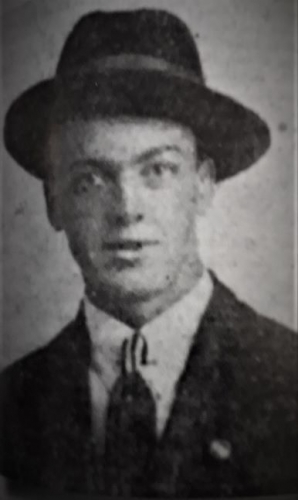
- Age: 29
- From: Blundellsands, Liverpool
- Regiment: The King's (Liverpool Regiment) 18th Btn
- D.O.W Tuesday 4th July 1916
- Commemorated at: Daours Cc Ext
Panel Ref: II.B.29
Roy William Aubrey Grundy was born in Blundellsands on the 02nd July 1887 and baptised in Holy Trinity Church, Wavertree, Liverpool on the 07th December 1890 together with his sister Gladys Maud. He was the son of Harry Edward Lomax Grundy and his wife Emily Margaret (nee Coward). His father, from Manchester, and his mother, born in Birkenhead, married in Barbados in 1883, and had eight children, all born in the Liverpool area. Roy had older siblings Ethel and Harry, and younger siblings Gladys, Frederick, Lucy, Herbert, and Gertrude. His father who was a Councillor, was the Managing Director of Liverpool Shipowners Supply Company Ltd, patentees, manufacturers and general merchants (they specialised in cork insulation) with offices in 19 Hanover Street, Liverpool.
Roy enlisted at St George's Hall in Liverpool on 31st August 1914 joining the 18th Battalion of The King's Liverpool Regiment as Private 1719. He gave his age as 27 years and 60 days and listed his occupation as salesman. He is described as being 5' 6" tall, weight 117lbs with a fair complexion, blue eyes and sandy hair. His religion is stated as Church of England.
From the 23rd September 1914 he was billeted at Hooton Park Race Course and remained there until 03rd December 1914 when they moved into the hutted accommodation at Lord Derby’s estate at Knowsley Hall. On 30th April 1915 the 18th Battalion alongside the other three Pals battalions left Liverpool via Prescot Station for further training at Belton Park, Grantham. They remained here until September 1915 when they reached Larkhill Camp on Salisbury Plain.
He crossed to France with his Battalion on board the SS Invicta on 07th November 1915.
In November 1915 and January 1916, he was treated for bronchitis and influenza respectively.
In the attack at Montauban on the 01st July 1916, he received a wound to the chest which penetrated his lung. He was admitted to 96 Field ambulance and transferred to 45 Casualty Clearing Station on the 03rd July where he died the following day, he was 29 years of age.
The 18th Battalion Diary gives an insight into the events of the day when Roy was wounded:
At 6.30am the artillery commenced an intensive bombardment of the enemy’s trenches. Zero Hour – 7.30 am – the battalion commenced to leave their trenches and the attack commenced. The attack was pressed with great spirit and determination in spite of heavy shelling and machine gun enfilade fire which caused casualties amounting to 2/3rds of the strength of the Battalion in action. The whole system of German trenches including the Glatz Redoubt was captured without any deviation from the scheduled programme. Consolidated positions and made strong points for defence against possible counter attacks.
Graham Maddocks provides more detail concerning the events of the day:
As the first three waves began to move forward towards the German reserve line, known as Alt Trench and then on to the Glatz Redoubt itself, they suddenly came under enfilading fire from the left. This was from a machine gun which the Germans had sited at a strong point in Alt Trench. The gun itself was protected by a party of snipers and bombers, who, hidden in a rough hedge, were dug into a position in Alt Trench, at its junction with a communication trench known as Alt Alley. These bombers and snipers were themselves protected by rifle fire from another communication trench, Train Alley which snaked back up the high ground and into Montauban itself. The machine gun fire was devastating and it is certain that nearly of the Battalion’s casualties that day were caused by that one gun.
Lieutenant Colonel Edward Henry Trotter wrote in the conclusion of his account of the days action:
I cannot speak to highly of the gallantry of the Officers and men. The men amply repaid the care and kindness of their Company Officers, who have always tried to lead and not to drive. As laid down in my first lecture to the Battalion when formed, in the words of Prince Kraft:
“Men follow their Officers not from fear, but from love of the Regiment where everything had always and at all times gone well with them”.
Joe Devereux in his book A Singular Day on the Somme gives the Casualty Breakdown for the 18th Battalion as Killed in Action 7 Officers and 165 men and of those who died in consequence of the wounds 3 Officers and 19 men a total of 194 out of a total loss for the four Liverpool Pals Battalions of 257.
He now rests at Daours Communal Cemetery Extension, France, where his headstone bears the epitaph:
“HE DID HIS DUTY”.
The preparations for the Somme offensive of July 1916 brought a group of casualty clearing stations (the 1st/1st South Midland, 21st, 34th, 45th and Lucknow, section "B") to Daours. The extension to the communal cemetery was opened and the first burials made in Plots I, II, Row A of Plot III and the Indian plot, between June and November 1916. The Allied advance in the spring of 1917 took the hospitals with it, and no further burials were made in the cemetery until April 1918, when the Germans recovered the ground they had lost. From April to the middle of August 1918, the extension was almost a front line cemetery. In August and September 1918, the casualty clearing stations came forward again (the 5th, 37th, 41st, 53rd, 55th and 61st) but in September, the cemetery was closed. There are now 1,231 Commonwealth servicemen of the First World War buried or commemorated in Daours Communal Cemetery Extension. The total includes special memorials to four men of the Chinese labour corps whose graves in White Chateau Cemetery, Cachy, could not be located. The adjoining communal cemetery contains two First World War burials made before the extension was opened. The extension was designed by Sir Edwin Lutyens.
Councillor’s Son Killed
A War Office message received yesterday (Friday) announces that Private Roy Grundy, of the Liverpool Pals, died on July 4th while serving in France. No further information is given, but some days ago a letter from his brother, Corpl. Fred Grundy, stated that he was wounded. Private Grundy was the son of Councillor and Mrs. H.E.L. Grundy, of 42, Serpentine Road, Liscard.
After being notified of Roy’s death, his parents received the letter, referred to in the article in the Wallasey News, from his brother Fred (17190) serving in the same battalion, written on 6th July, informing them that Roy was “only wounded in the shoulder and was being sent to one of the hospitals in England”. This naturally caused the family much anxiety and his father wrote, “anxious to know the full facts”.
In a declaration in April 1919 Roy's surviving siblings were declared as baing: Harry Edward Lomax aged 34, Frederick Cecil Clement aged 26, Reginald Herbert Stanley aged 20, Ethel aged 36, Gladys aged 28, Daisy aged 24 and Muriel aged 18.
Roy is remembered on the following memorials:
Bedford Road Council School war memorial which is now located in Bedford County Primary School, Quarry Road, Bootle
Wallasey War Memorial (Roll of Honour which is in Wallasey Library Earlston Road), and on the Wallasey War Memorial which is located in the Hospital in Mill Lane, Wallasey.
Liverpool’s Hall of Remembrance, Panel 47 Left
When Roy enlisted in the 18th Battalion as Private 17191 he was obviously alongside his brother Fred who served as Private 17190 and was subsequently commissioned into the Royal Air Force as a Lieutenant. He survived the war.
His brothers Harry Edward Lomax served with the "Transport Service" (he was awarded the Meritorious Service Medal in 1918 for recognition of his service as a Staff Sergeant with the Military Works Service) and Reginald Herbert Stanley served with Royal Air Force as a Lieutenant and both survived the war.
We currently have no further information on Roy William Aubrey Grundy. If you have or know someone who may be able to add to the history of this soldier, please contact us.
Killed On This Day.
(110 Years this day)Tuesday 4th July 1916.
Pte 17191 Roy William Aubrey Grundy
29 years old
(110 Years this day)
Tuesday 4th July 1916.
Pte 22123 John Hughes
20 years old
(110 Years this day)
Tuesday 4th July 1916.
Cpl 16976 Frank Lindon
26 years old
(109 Years this day)
Wednesday 4th July 1917.
Lieut Aidan Chavasse
26 years old
(109 Years this day)
Wednesday 4th July 1917.
2nd Lieut Cyril Aubrey Peters
22 years old
(109 Years this day)
Wednesday 4th July 1917.
Pte 31399 William Edward Sinnott
27 years old
(108 Years this day)
Thursday 4th July 1918.
Pte 31707 Joseph Edward Barker
38 years old