
1885 - 1916

CPL David Wallace Crawford
1887 - 1916

Lce-Corpl John Joseph Nickle
1894 - 1916

Pte 17911 Morton Neill
1897 - 1916

Lieut Edward Stanley Ashcroft
1883 - 1918

2nd Lieut Douglas Morley Griffin
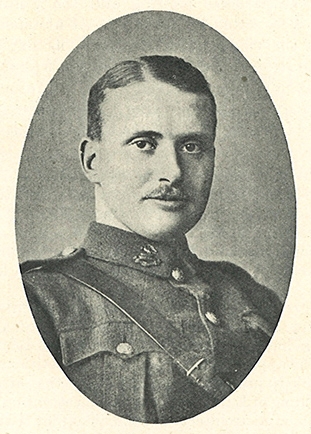
- Age: 26
- From: Hampstead, London
- Regiment: The King's (Liverpool Regiment) 18th Btn
- D.O.W Sunday 16th July 1916
- Commemorated at: Abbeville Cc
Panel Ref: IV.E.1
Douglas Morley Griffin was born in 1889 and was the son of William Hall Griffin and his wife Emily (nee Criffs).
1891 Census - Netherhall Gardens, Hampstead - James T and Elizabeth Griffin (Grandparents) and Parents William H and Emily with children Douglas Morley and Una Doris. Father, William Hall Griffin was born in New York and was a Professor of English Literature at Queens College.
1901 Census - 31 Greencroft Gardens, Hampstead - Parents William Hall Griffin and Emily with Douglas Morley, Una Doris and Winifred H.
His father William Hall Griffin died on 16/12/1907.
1911 Census - 45 Buckland Crescent, N.W. Hampstead - Mother Emily Griffin (Widow) with Una Doris and Winifed Hilda and Mother in law Elizabeth Douglas Griffin, 2 servants and 2 boarders. Emily is living on Private means. Emily died 20/9/1937
Douglas Morley Griffin’s home at the time of his enlistment was 7, The Esplanade Waterloo, he was an Architect and Surveyor.
He enlisted in Liverpool joining the 18th Battalion of the King's Liverpool Regiment on 03rd September 1914, as a Private. He was promoted to Serjeant on 07th September 1914. Then in April 1915, he was made a temporary 2nd Lieutenant.
From the 23rd September 1914 he was billeted at Hooton Park Race Course and remained there until 03rd December 1914 when they moved into the hutted accommodation at Lord Derby’s estate at Knowsley Hall. On 30th April 1915 the 18th Battalion alongside the other three Pals battalions left Liverpool via Prescot Station for further training at Belton Park, Grantham. They remained here until September 1915 when they reached Larkhill Camp on Salisbury Plain.
He crossed to France in November 1915, as part of No2 Company and it is assumed that he served with it throughout 1915 and 1916 when it was on the Somme Front.
He is first mentioned in the 18th Battalion War Diary on 27th May 1916 when he was in charge of a party of eight men, to act as cover to the 202nd Field Company, Royal Engineers, who were marking out the position of new trenches to be dug at Maricourt. He is not mentioned again until the attack on the Glatz Redoubt South of Montauban, on 1st July 1916, when the Battalion achieved its objectives, but with heavy loss, Second-Lieutenant Griffin was wounded during this attack, but nevertheless remained on duty. He was mentioned amongst six surviving officers by Lieutenant Colonel E H Trotter, the Battalion Commanding Officer, as having distinguished himself with Gallantry and devotion to duty on that day.
On the 8th July, the Battalion was moved up to Train Alley, to provide carrying parties for the rest of the 21st Brigade. This was probably because there were insufficient numbers left, after the losses of 1st July to man the line. At about 17.30 pm, Lieutenant Colonel Trotter was visiting the Headquarters of the 21st Brigade in Train Alley, accompanied by officers and orderlies from the Battalion, when the Germans shelled the trench. He and Second-Lieutenant N A S Barnard were killed, and the Commanding Officer of the 18th Battalion The Manchester Regiment, Lieutenant Colonel W A Smith, formerly, Second in Command of the 20th Battalion The King’s Liverpool Regiment was mortally wounded. At 21.30pm, the Commander of No2. Company, Major R K Cornish Bowden, was given temporary command of the Battalion. At the same time, Second-Lieutenant Griffin was ordered to take over No2. Company and lead them up to garrison Chimney Trench, south of Bernafay Wood. At some stage after this, he must have been wounded, as the War Diary lists him as such on a return for that day.
He was evacuated from the front to the Base hospital at Abbeville, but died of his wounds at No.2 Stationary Hospital, France on 16th July 1916, he was aged twenty six.
He now rests at Abbeville Communal Cemetery France, in Plot 4, Row E, Grave 1.
For much of the First World War, Abbeville was headquarters of the Commonwealth lines of communication and No.3 BRCS, No.5 and No.2 Stationary Hospitals were stationed there variously from October 1914 to January 1920. The communal cemetery was used for burials from November 1914 to September 1916, the earliest being made among the French military graves. The extension was begun in September 1916. During the early part of the Second World War, Abbeville was a major operational aerodrome, but the town fell to the Germans at the end of May 1940. On 4 June, an attempt was made by the 51st Division, in conjunction with the French, to break the German bridgehead, but without success. Towards the end of 1943, eight large ski shaped buildings appeared near Abbeville. These proved to be storage units for flying bomb components an they were heavily bombed by Commonwealth air forces. Abbeville was retaken on 4 September 1944 by Canadian and Polish units. Abbeville Communal Cemetery contains 774 Commonwealth burials of First World War and 30 from the Second.
Douglas was reported to have died of wounds in the Army and Navy Gazette on 30th September 1916
The following article taken from Westminster School magazine gives us an insight into Douglas' early life and his charcater:
The Elizabethan records that Douglas Morley Griffin was ‘the only son of the late William Hall Griffin, the biographer of Browning, was admitted a King’s Scholar in 1903, and left on his father’s death in 1907. He was a boy of character, and faced misfortune with the courage which he afterwards showed in war.’
Griffin had proved a successful athlete whilst at Westminster, representing the school in gymnastics, although his performance on the parallel bars was once described as ‘disappointing’. He was also in the Officer Training Corps and took part in shooting competitions, exceeding the school’s ‘highest hopes’ with an excellent performance at a training camp at Bisley in 1907 leading to promotion to the rank of Lance-Corporal. Upon his father’s death it clearly became impossible for his mother to pay the fees necessary for him to continue in his education. In order to support his family he joined an architect’s office, Harris and Hobson, in Liverpool, his mother’s home town. He attended Liverpool University School of Architecture and became a member of the Royal Institute of British Architects in 1910.
He was elected Associate of the Royal Institute of British Architects in 1914.
On the outbreak of war Griffin enlisted, becoming a Lieutenant in the King’s Liverpool Regiment in November of 1914 and going out to the Western Front in 1915. His sister also joined the war effort and worked as a nurse in Rosslyn Lodge in Hampstead from 1916 and we know that Griffin gave her a photograph album to record her experiences.
Soldiers Effects to his mother.
Liverpool Echo 2nd July 1917
Lost At The Somme Battle:
To the Glorious Memory of Lieut.-Colonel E. H. Trotter, D.S.O., Captain A. de Bels Adam, Captain C. N. Brockbank, Lieut. G. M. Dawson, Lieut. B. Withy, Sec.-Lieut. N. A. Barnard, Sec.-Lieut. L. R. Davies, Sec.-Lieut. E. Fitzbrown, Sec.-Lieut. D. M. Griffin, Sec.-Lieut. G. B. Golds, Sec.-Lieut. G. A. Herdman, Sec.-Lieut. R. V. Merry, Sec.-Lieut. R. H. Tomlinson, Sec.-Lieut. T. R. Walker, and the non-commissioned officers and men the 18th (Serv.) Battalion “The King's” (Liverpool Regiment), who fell in the battle of the Somme, July, 1916.
His mother Emily Griffin (widow) was left £243.16.5d. by Douglas in Probate.
She died on 20th September 1937 and was living at 2 The Wilderness, Holly Hill, Hampstead, London at the time of her death.
Douglas Morley Griffin is commemorated on the following local memorials:
Hall of Remembrance, Liverpool Town Hall, Panel 49
Waterloo with Seaforth Civic Memorial
United Free Church, Waterloo (St.Andrew's Presbyterian Church)
St.Andrew's Presbyterian Church, Waterloo
Liverpool Presbytery (St.Andrew's, Waterloo)
Liverpool University
Waterloo Rugby Football Club
Westminster School
We currently have no further information on Douglas Morley Griffin, If you have or know someone who may be able to add to the history of this soldier, please contact us.
Killed On This Day.
(108 Years this day)Sunday 5th May 1918.
Lieut Frederick James Hodgson
30 years old
(108 Years this day)
Sunday 5th May 1918.
Pte 20035 Claude Ballard (MM)
26 years old
(108 Years this day)
Sunday 5th May 1918.
Rifleman 35960 James Parkinson
22 years old
(107 Years this day)
Monday 5th May 1919.
Pte 108666 Joseph Murphy
20 years old