
1885 - 1916

CPL David Wallace Crawford
1887 - 1916

Lce-Corpl John Joseph Nickle
1894 - 1916

Pte 17911 Morton Neill
1897 - 1916

Lieut Edward Stanley Ashcroft
1883 - 1918

Sgt 15915 George Dening
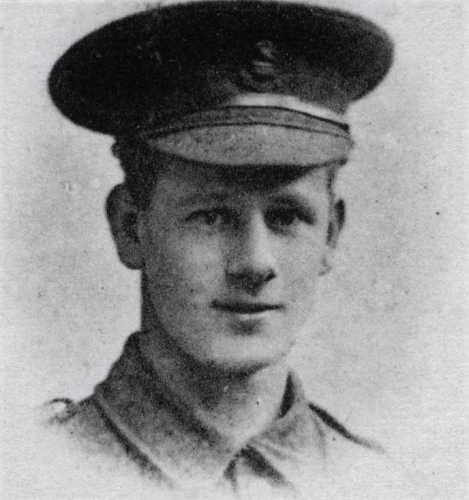
- Age: 25
- From: Liverpool
- Regiment: The King's (Liverpool Regiment) 17th Btn
- K.I.A Sunday 30th July 1916
- Commemorated at: Thiepval Memorial
Panel Ref: P&F1D8B &8 C.
George Dening was born in Aigburth, Liverpool on 09th April 1891, the son of Samuel Dening and his wife Mary (nee Jones). The couple who were married on the 13th February 1888 at St Bede’s Church, Toxteth. Samuel was a widowed 35 year old railway traffic inspector of 26 Argyle Road, Garston, father John, whilst Mary was aged 33 of 51 Van Dyke Street, father John.
George had an elder brother Richard Samuel, and younger sisters Ethel Elizabeth and Margaret Jane.
George was baptised in St. Peter's Church, Liverpool, on 17th June 1891, his parents' residence Belgrave Road and his father's occupation given as traffic manager.
At the time of the 1901 Census the family were living at 18 Sunbourne Road, Aigburth. Samuel had worked as a railway inspector for most of his life, in 1901 he was a station master. Mary was Samuel’s second wife. His first wife Amelia had died in 1886, so living with the family are children from his first marriage – John aged 23, James 21, Edith 19, Beatrice 16 and Annie 14. The children from his marriage with Mary were – Richard aged 12, George 9, Ethel 8 and Margaret aged 4.
By the 1911 Census the family were living at 1 Ampthill Road, Aigburth. His father, 59, is a station master, his mother is 56. Edith, 29, works in a confectionery shop, Annie, 24, is a post office telephonist, 19-year old George is a railway clerk, Ethel, 18, is a millinery apprentice, and Margaret, 14, is at school. Richard had emigrated to Canada. They have a 29-year old visitor, Walter Dudley, a commercial traveller, who will marry Edith a few weeks later, George being one of the witnesses at the ceremony.
George enlisted on the 01st September 1914 at Liverpool at St George's Hall, Liverpool joining the 17th Battalion of The King’s Liverpool Regiment as Private 15915. He gave his age as 23 years and 140 days and his occupation as a clerk. He was described as being five feet ten and three quarter inches tall, weighed 145lbs, 37" chest, with a fresh complexion, grey eyes and brown hair. He stated his religion as Church of England. He advised that he had served four years with the 6th Liverpool Territorials.
He was billeted at Prescot Watch Factory from 14th September 1914, he trained there and also at Knowsley Hall. On 30th April 1915 the 17th Battalion alongside the other three Pals battalions left Liverpool via Prescot Station for further training at Belton Park, Grantham. They remained here until September 1915 when they reached Larkhill Camp on Salisbury Plain. His service records show:
05.12.14: Appointed unpaid Lance Corporal.
19.12.14: Appointed paid Lance Corporal.
03.4.15: Promoted to Corporal.
30.4.15-4.9.15: Belton Camp, Grantham.
05.9.15-6.11.15: Larkhill Camp, Salisbury
01.9.15: Appointed paid Lance Sergeant.
07.11.15: Embarked for France with his battalion.
27.5.16- 05.6.16: Granted leave
08.6.16: Promoted to Sergeant.
George was killed in action on the 30th July 1916, aged 25, at the village of Guillemont, France, during the Somme Offensive.
17th Battalion Diary 30th July 1916
The Battalion was in support to 19 & 20 Battalions K.L.R. 2 Coys. behind 19th & 2 Coys. behind 20th. Very thick mist. The attack was pushed home to the objective in places but in the main was held up by machine gun fire from hidden machine guns.
Fighting continued all day swaying backwards and forwards until by 6pm about 300 yards in depth had been gained & consolidated all along our front.
Casualties in the 17th Battalion were 15 Officers and 281 Other Ranks
Further details are reported in more detailed by Everard Wyrall in his book The History of the King’s Regiment (Liverpool) 1914-1919 Volume II 1916-1917
The 17th King’s had advanced (two companies each behind the 19th and 20th Battalions) in small columns. They too suffered heavily from machine-gun fire and were quickly absorbed into the waves that preceded them. They also shared the gains and losses of that terrible day.
When darkness fell on the battlefield the 30th Division held a line from the railway on the eastern side of Trones Wood , southwards and including Arrow Head Copse, to east of Maltz Horn Farm. On this line the division was relieved by the 55th Division during the early hours of the 31st July.
The events of 30th July 1916 were regarded at the time as Liverpool’s blackest day. There follows an extract from The History of the 89th Brigade written by Brigadier General Ferdinand Stanley which gives an indication of the events of the day.
Guillemont
Well the hour to advance came, and of all bad luck in the world it was a thick fog; so thick that you couldn’t see more than about ten yards. It was next to impossible to delay the attack – it was much too big an operation- so forward they had to go. It will give some idea when I say that on one flank we had to go 1,750 yards over big rolling country. Everyone knows what it is like to cross enclosed country which you know really well in a fog and how easy it is to lose your way. Therefore, imagine these rolling hills, with no landmarks and absolutely unknown to anyone. Is it surprising that people lost their way and lost touch with those next to them? As a matter of fact, it was wonderful the way in which many men found their way right to the place we wanted to get to. But as a connected attack it was impossible.
The fog was intense it was practically impossible to keep direction and parties got split up. Owing to the heavy shelling all the Bosches had left their main trenches and were lying out in the open with snipers and machine guns in shell holes, so of course our fellows were the most easy prey.
It is so awfully sad now going about and finding so many splendid fellows gone.
George was initially declared Missing; his parents appealed for information in the Liverpool Daily Post on 30th August 1916.George’s fiancee Dorothy Greenwood of "Oakleigh" 32 Horringford Road, Aigburth wrote to the Record Office asking for names of any boys that served alongside him.
"Dear Sir,
I am writing you with reference to my fiance 15915 Sergeant George Dening, C. Company, 17th King's Liverpool Regiment who has been Missing since July 30th 1916. I wonder if you would give me the names and addresses of any boys out of the same Battn who were taken prisoners about that day. Their address in Germany I mean of course. They perhaps will be able to give me some information about him. I have written to an address in Switzerland and they want the names so that they can question the boys. Hoping you will do this for me as the suspense is just dreadful.
Thanking you in anticipation,
Yours truly,
(Miss) Dorothy Greenwood"
A reply was sent on 17th April 1917, the content of which is not included in his service record.
Dorothy also contacted the International Red Cross in hopes that George ('C' Company) had been taken prisoner, but she learned that they held no information on him, in a reply dated 25th September 1916. A subsequent enquiry by her received the same response in March 1917. A negative reply was also sent to a Mrs. McNally, 16a Walton Lane, Stanley Park, Liverpool, on 12th October 1916.
His father Samuel, by now stationmaster at Central Station in Liverpool, wrote anxiously for news of his son as late as April 1917 asking for any news as he had no reliable information concerning George. He writes:
“the suspense is telling very heavily on his mother”.
George was officially declared killed in action over ten months later, his loved ones posting notices in the local paper on 11th June 1917:
"Previously reported missing, now presumed killed July 30, 1916, aged 26 years, Sergeant George Dening (K.L.R.), youngest son of Mr. and Mrs. S. Dening, 8 Brabant Road, Aigburth. (His duty nobly done.) - Father, Mother, and Family."
"Previously reported missing, now presumed killed July 30, 1916, aged 26 years, Sergeant George Dening (K.L.R.), youngest son of Mr. and Mrs. S. Dening, 8 Brabant Road, Aigburth. (Sadly missed by his Fiancee Dorothy.)"
His body was not recovered from the battlefield or was subsequently lost as he has no known grave and is commemorated on the Thiepval Memorial to the Missing of the Somme.
The Thiepval Memorial, the Memorial to the Missing of the Somme, bears the names of more than 72,000 officers and men of the United Kingdom and South African forces who died in the Somme sector before 20 March 1918 and have no known grave. Over 90% of those commemorated died between July and November 1916.
On 01st August 1932 the Prince of Wales and the President of France inaugurated the Thiepval Memorial in Picardy. The inscription reads: “Here are recorded the names of officers and men of the British Armies who fell on the Somme battlefields between July 1915 and March 1918 but to whom the fortune of war denied the known and honoured burial given to their comrades in death.”
He earned his three medals. His Victory Medal and British War Medal were returned for adjustment.His father received George's outstanding Army pay and a War Gratuity of £11-10s.
In the Liverpool Echo, on 30th July 1917 under the heading Lost At The Battle of Guillemont his fiancee paid tribute to George:
“Reported missing, now officially presumed killed, July 30, 1916, aged 26 years, Sergeant George Dening, K.L.R. (Pals) the dearly-loved fiancé of Dorothy Greenwood, 32 Horringford Road, Aigburth, Liverpool.
A year has passed,
my heart’s still sore,
As time rolls on I miss him more;
Only those who have lost one are able to tell
How great is the loss of him I loved so well.”
George was remembered on the second anniversary of his death in 1918:
"In loving memory of Sergeant George Dening (K.L.R.) (Pals), missing presumed killed, July 30, 1916. - Never forgotten by Father, Mother, Brothers, and Sisters."
DENING In loving memory of Sergeant GEORGE DENNING (1st Pals), missing since July 30, 1916. Never forgotten and sadly missed by his fiancee Dorothy.
George’s brother Richard who emigrated to Canada served in the Canadian Army in WWI and WWII. He won the Military Medal in 1917 for a daylight raid on Vimy Ridge. The award of the medal was reported in the Liverpool Echo on 4th May 1917:"The Military Medal for bravery in the field has been awarded to Sergeant R. S. Dening, of the Canadian Highlanders, who is the third son of Mr. S. Dening, stationmaster, of Central Station, Liverpool. He is 29 years of age, and was a bombing sergeant of his regiment. At present he is lying wounded in hospital in this country, progressing favourably from the wounds he received during the exploit at Vimy Ridge, which has won for him this medal. After a successful trench raid Dening discovered that his officer was missing and returned to the trench in order to search for him. He found him lying mortally wounded, and after doing all he could to relieve the officer, Sergeant Dening began his return journey across "No Man's Land" to his own trench; but on the way he was hit several times with shrapnel, and it was only with the greatest risk and by great endurance that he got back to his own line.
Before the war he was engaged with the Canadian Explosives Company, Montreal. Another of his brothers, who was a member of the King's Liverpool Regiment, has been missing since July last."
In 1919 his parents lived at 8 Brabant Road with married daughter Ethel Horton, 27, and Margaret, 22. Richard, 30, was in Ottawa, Canada.
His father retired in 1919 having worked for Cheshire Lines for over 50 years. He was featured in the Liverpool Echo on 25th March 1919:
HALF A CENTURY.
OLD STATIONMASTER TAKES
BACKWARD GLANCE.
After half a century of service with the Cheshire Lines, Mr Samuel Dening, the station master at Liverpool Central, is to retire at the end of next June. Mr Dening is one of the best known and most respected figures in the railway life of Lancashire and Cheshire. He joined the Cheshire Lines in 1869 as a young man of 19, “just come up come up from Devonshire.” The main station of the company then was the old Brunswick, Liverpool Central did not come into being until four or five years later. After working through the various departments at Brunswick he was appointed guard by the time he was 21 years of age, and the first train of which he was put in charge was the one which opened the new line between Glazebrook and Manchester. Five years later he was brought to Liverpool Central and given the rank of inspector. In 1884 he was taken from the platform into the manager' office and appointed chief district traffic inspector, from which position in May of 1900 he was advanced to the post which he now holds.
“When I began with the Cheshire lines,” said Mr Denning “the carriages where of the old four-wheeled kind - very small and inconvenient. There were no cushions in the third class compartments; there was no heating in any class and all the lighting was supplied by oil lamps. On the long distance journeys the practice was to run third class coaches on only two trains each day. I can remember quite well when I was ticket examiner of Brunswick putting up the bills which announced for the first time that third class coaches will be attached to all mainline trains. That was an innovation over which there had been a big struggle. In those days, too, we very often used the roofs of carriages for carrying luggage. That was particularly so in the case of the continental traffic to Grimsby. We had to get the luggage up a ladder at the side of the coach, pack it all very neatly and securely - a job which required an expert - and then sheet it over. I wonder what the present-day porters would think of that sort of job.”
During his term as chief traffic inspector Mr Dening was in charge of the loading and unloading at Aintree of the horses for the Grand National and other races.
His mother applied for a pension in 1920, her address at the time 9 Bromley Avenue, Greenbank Road, Liverpool. She travelled to Ottawa in 1920 with daughter Margaret, and returned in 1925. She appears to have died soon afterwards, aged 70.
Richard served in the Second World War as a Corporal with the Canadian Army Corps of Military Staff Clerks attached to Toronto Headquarters Staff. He died on 23rd February 1941 aged 52, from brain injuries sustained in an altercation with a younger soldier, and rests in Toronto Mount Pleasant Cemetery with a CWGC headstone.
Dorothy never married.
In 1939 she was 45, still living at 32 Horringford Road, a civil servant in the Post Office Engineering Department. She died in 1988, aged 93.
George is commemorated on the following Memorials:
Hall of Remembrance in Liverpool Town Hall Panel 4
Elders and Fyffes Shipping Line Roll of Honour
Victoria Schools, Grassendale, Liverpool
St. Anne's Parish Church, Aigburth
St. Michael County Primary School, St. Michael in the Hamlet, Liverpool
89th Brigade On This Day.
109 Years Ago.Battle of Arras begins, this is one of the costliest battles of the war in terms of days fought and lives lost. The Pals are heavily involved.
Killed On This Day.
(109 Years this day)Sunday 15th April 1917.
L/Cpl 22358 George Henry Davies
27 years old
(109 Years this day)
Sunday 15th April 1917.
Pte 47317 Charles Frederick Lumb
36 years old
(109 Years this day)
Sunday 15th April 1917.
A/Cpl 57597 James Picken
23 years old
(109 Years this day)
Sunday 15th April 1917.
L/Cpl 16994 Edgar Roberts
23 years old
(109 Years this day)
Sunday 15th April 1917.
Pte 303024 Sidney Francis Norris
22 years old
(108 Years this day)
Monday 15th April 1918.
Cpl 24348 Arthur Keenan
23 years old
(108 Years this day)
Monday 15th April 1918.
Pte 41818 William Coleman
20 years old
(108 Years this day)
Monday 15th April 1918.
Pte 51557 Charles Frederick Phillips
22 years old