
1885 - 1916

CPL David Wallace Crawford
1887 - 1916

Lce-Corpl John Joseph Nickle
1894 - 1916

Pte 17911 Morton Neill
1897 - 1916

Lieut Edward Stanley Ashcroft
1883 - 1918

2nd Lieut Arthur Charles Slaughter
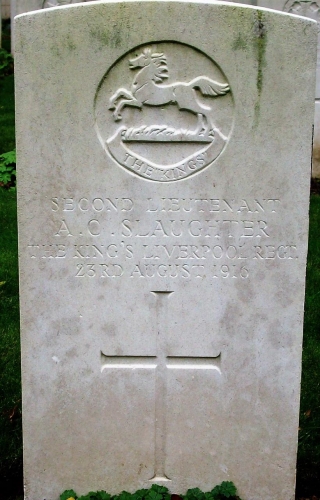
- Age: 32
- From: Chesterfield
- Regiment: The King's (Liverpool Regiment) 18th Btn
- D.O.W Wednesday 23rd August 1916
- Commemorated at: Gorre Brit Cem, Beuvry
Panel Ref: II.D.14
Arthur Charles Slaughter was born on the 16th August, 1884 in Chesterfield and was the son of John Edward Slaughter, a Surgeon and his wife Edith (nee Jarvis) of the High Street, Bolsover. His parents married in 1876 in Camberwell, London. They had nine children. Arthur had older siblings Emily, born in 1878 in Kent (a twin, Mary Caroline, died in infancy), after which the family moved to Derbyshire where the other children were born: Dorothy Margaret in 1879, Thomas George 1880, Herbert John 1882, Geoffrey Nelson 1883, and younger siblings Monlas (a family name) Ferguson 1886, and Amy Beatrice in 1887.
The 1891 Census shows the family living at Lower Addiscombe Road, Croydon. His mother Edith is married aged 41, born 1850 is living on her own means and was born in London. His father is not in the household. She is living with her seven children, Emily aged 12, born 1879, Thomas aged 10, born 1881, Herbert 8, Geoffrey aged 7, born 1884, Arthur aged 6, Nicholas (Monlas) aged 5, born 1886 are all at school, Amy aged 3, born 1888 and Herbert. They have two servants living at the address Clara Edmonds aged 26 born 1865 is a cook and Georgina Edmonds aged 20, born 1871 is a nursemaid. His sister Dorothy, 11, is living with her aunts Emily and Cecilia Slaughter in Kent.
Bankruptcy proceedings were brought against his father, a Member of the Royal College of Surgeons, in 1882. He was fined for assault in 1886. His father was born on 03rd December, 1850 and baptised 13th December, 1852 at SS Peter & Paul Church, Farningham in 1852. In 1892 his father, of no fixed abode, living in Islington, London, was convicted of theft and illegal pawning of a gold watch and chain and a George III spade guinea, and sentenced to one month in gaol. He died in the third quarter of 1897 aged 46 and was buried in the church he was baptised on the 03rd September, 1897.
Arthur was educated at Bedford Modern School.
In 1901 Arthur is found in Gateshead, Durham, with Thomas Bowden, a chartered accountant and his wife Ada. Arthur is 16, employed as a chartered accountant’s clerk, and is listed as a cousin.
His widowed mother, 51, is living on her own means in Rickinghall, Suffolk with daughters Emily and Amy and her sister Caroline Jarvis. His brother Monlas is a pupil at Clare House School in Margate, Kent. Brother Herbert is a farm pupil in Cornwall. Geoffrey has joined the Bedfordshire Regiment; he later emigrated to Canada, settling in Vancouver.
An Immigration record from Vermont, USA in 1908, shows Arthur Charles Slaughter aged 23 and a labourer. He crossed from Alberta arriving at the port of Sweet Grass, Montana on the Canada/U.S. border on 05th February 1908. He states he arrived in Quebec on 09th July 1907 on the S.S. Lake Manitoba. He gave his last permanent residence as Lethbridge (Alberta), Canada, and his destination as Great Falls, Manitoba (northeast of Winnipeg). He declares funds of $10. He is described as being 6’ tall, with a dark complexion, black hair, and blue eyes, and gives as next of kin his mother Edith in Sandhurst, Kent.
The 1911 Census in Edmonton, Canada shows Arthur aged 26 and occupation farmer, he is single and gives his religion as Anglican. His brother Maulas aged 25 is also in Canada.
The UK Census for 1911 shows his mother, 61, is living on private means at “Rotherview”, Sandhurst, Kent with her daughter Emily and her sister Caroline, and a domestic servant.
He was made a temporary 2nd Lieutenant on the 03rd June, 1915 (London Gazette).
He was named in the Chester Chronicle on 13th May 1916:
The Licencee of the Swan Hotel, Whitchurch was heavily fined for supplying alcohol after hours to serving Officers, including Lt Arthur Charles Slaughter.
He does not appear in the 18th Battalion War Diary until the day of his fatal wounding, in August 1916. This is probably because he was nominally on the strength of the 16th Battalion The King’s Liverpool Regiment and only attached to the 18th Battalion. This attachment was probably to help make up the heavy losses in junior officers sustained by the 18th Battalion in the early Somme fighting.
On the day of his death, the Battalion was in the line at Givenchy on the northern edge of the Somme sector, north east of Bethune. It appears that it was an active part of the line, with both sides trying hard to keep up the offensive spirit with constant duels of small arms fire, Trench mortars, artillery and mines. Both sides seemed to have exploded mines under each other and then fought fierce actions to capture and hold the resulting craters.
At some time on Wednesday August 23rd 1916, Second-Lieutenant Slaughter was hit by a rifle bullet in the head, probably hit by a sniper and although he was evacuated to a Field Ambulance, he died of his wounds the same day. He was 32 years of age.
He now rests at Gorre British and Indian Cemetery, Beuvry, France in Plot 2, Row D, Grave 14. His headstone does not bear the Eagle and Child of the Pals Battalions, but the White Horse of Hanover of the 16th Battalion, from which he was attached. He is buried next to two soldiers of the 18th Battalion, 16799 Lance Corporal J Currie and 23385 Private G Hyland, both of whom were killed on 20th August 1916. Currie from a rifle bullet wound and Hyland as a result of the mine explosion.
The chateau at Gorre was occupied early in the war by troops serving with the British Expeditionary Force and the Indian Corps, and the cemeteries, located in the south-east corner of original the chateau grounds, were begun in the autumn of 1914. The Indian section of the cemetery was closed in October 1915, shortly before the Indian infantry divisions left France for redeployment to the Middle East.
Many of those who now lie in plots V and VI of the British section of the cemetery were killed during the Battle of Estaires in April 1918. There are now over 930 Commonwealth servicemen of the First World War buried or commemorated here. The cemetery, which was designed by Charles Holden, also contains nine war graves of other nationalities, most of them German.
Gorre Chateau during the First World War
For much of the war, the chateau stood approximately four kilometres behind a section of the British front-line that ran northward along the Aubers Ridge from Givenchy-lès-la-Bassée to Festubert. From the end of the Battle of Festubert in May 1915 until the spring of 1918, this was considered a relatively ‘quiet’ sector. The village of Gorre was occasionally bombarded by German artillery during this period, but the chateau remained intact and its rooms were used as an officer’s mess and headquarters for British units stationed in the area. The grounds of the chateau were also the site of several artillery emplacements, a rifle range and an improvised parade ground and football pitch. Throughout 1916 and ’17 British troops could be seen drilling in the fields next to the chateau or unloading supplies from barges on the La Bassée Canal, which runs just south of the village.
The British section of the cemetery was used by infantry and artillery units stationed in the area until April 1918, when the relative quiet of the sector was shattered by the German Spring Offensive and Gorre became a support post close behind the front line during the Battle of Estaire. This battle was one of two massive German assaults on the Commonwealth positions from Ypres to Festubert that became known as the Battle of the Lys. When the battle erupted on 9 April, the 55th (West Lancashire) Division occupied the front-line trenches running north from Givenchy to Richebourg L’Avoué. The Allied positions to their left, around the village of Le Touret, were held by Portuguese units.
After a preliminary artillery bombardment that began on the evening of 7 April the German Sixth Army, spearheaded by storm troops, attacked in force early on the morning of the 9th. Heavy mist enabled the attackers to get very close to the Allied lines before they were observed and Portuguese units suffered heavy casualties and began to retire. Further south, the various formations of the 55th Division were hard pressed from the outset and the front line trenches around Givenchy were the scene of fierce fighting between British and German troops. The divisional brigade holding the northern section of the British line was forced to pull back, but well-organised counter-attacks and determined defence elsewhere enabled the 55th Division to hold its ground for the rest of the battle and prevent a major German breakthrough. Fighting continued in the trenches east of Gorre until 17 April when the German forces finally broke off the attack. In just over a week of fighting almost 3,000 officers and men of the Division had been killed, wounded, or taken prisoner, but the territory over which they had fought remained in Allied hands.
The Cemetery Register entry only lists his belonging to the 16th Battalion The King’s Liverpool Regiment and makes no mention of his 18th Battalion attachment. It also only records only his name, unit and date of birth and gives no family or personal details.
He was reported as died of wounds in Army and Navy Gazette 09th September 1916.
Arthur received a mention in the book "A Subaltern on the Somme" by Max Plowman.
Probate of £23.19s 8d was administered to his mother Edith Slaughter.
Arthur's loss was not the only one to be suffered by the family. His brother Maulus Ferguson Slaughter born 27th December 1885 arrived back into Liverpool on 26th December 1914 and was also to fall. (Kent baptism records have his name as Monlas Ferguson). He was serving with the Royal Fusiliers (23rd (Service) Battalion (1st Sportsman's) when he was killed in action on the 27th July 1916.
His body was not recovered or was subsequently lost as he has no known grave and is commemorated on the Thiepval Memorial to the Missing of the Somme.
Two sons killed in four weeks must have been an unbearable loss for their mother and the family.
His brother Geoffrey enlisted in Canada on 09th November 1914 and served as a Sergeant with the 29th Canadian Infantry. He was captured unwounded at St. Eloi, south of Ypres, on 19th April 1916 and spent over two and a half years as a POW. He was repatriated after the war.
His mother died in 1922.
Arthur and Monlas are commemorated on the following memorials -
St. Nicholas’ Church, Sandhurst, Kent
Sandhurst Memorial Cross (designed by Lutyens)
We currently have no further information on Arthur Charles Slaughter, If you have or know someone who may be able to add to the history of this soldier, please contact us.
Killed On This Day.
(109 Years this day)Friday 8th June 1917.
Pte 49099 Herbert Allan Brown
30 years old
(109 Years this day)
Friday 8th June 1917.
Pte 49180 John Edwin Walley
25 years old
(108 Years this day)
Saturday 8th June 1918.
Rifleman 16849 Alan Wensley
22 years old