
1885 - 1916

CPL David Wallace Crawford
1887 - 1916

Lce-Corpl John Joseph Nickle
1894 - 1916

Pte 17911 Morton Neill
1897 - 1916

Lieut Edward Stanley Ashcroft
1883 - 1918

Pte 21998 Fredrick Ivor Pulford
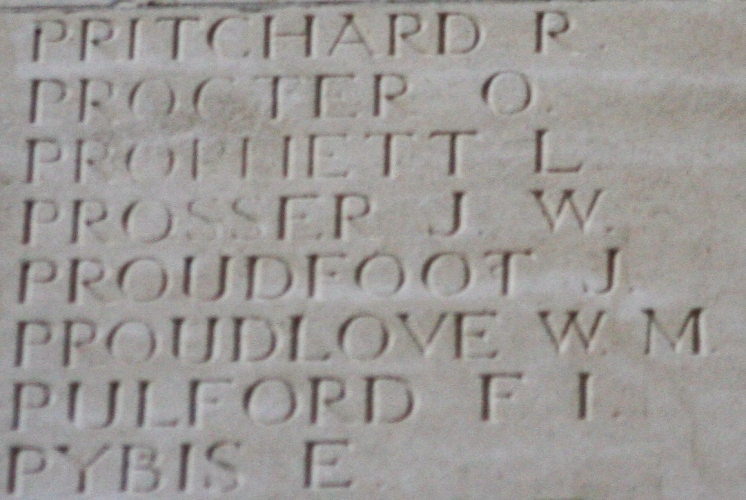
- Age: 30
- From: Middlesex, London
- Regiment: The King's (Liverpool Regiment) 17th Btn
- K.I.A Thursday 12th October 1916
- Commemorated at: Thiepval Memorial
Panel Ref: P&F1D8B &8 C.
Frederick Ivor Pulford was born in Tottenham on 11th August 1886 , the son of Thomas Pulford and his wife Rhoda Louisa (nee Law). His parents married in Battersea in 1883 and had three children. Fred had an older sister Mary Gwendoline, born in 1885, and a younger sister Winifred May, born in 1888 in Wandsworth.
At the time of the 1891 census Frederick, 4, is living with his parents and two sisters at 40 Broomwood Road, Battersea, London. His father is a commercial clerk. They have a boarder and a domestic servant.
He attended Bowes Park School in North London until the family moved to Liverpool in 1898 when he enrolled in Clint Road Council School in Edge Hill. He was admitted to the Liverpool Institute School in May 1899 when he was 12.
The 1901 census finds the family at 40 Rufford Road, Fairfield, Liverpool. His father, 51, is a fruit merchant’s clerk, his mother is 44, Mary is 16, Frederick 14, and Winifred 12.
He left the Liverpool Institute school a month before his sixteenth birthday.
He began his banking career in June 1903.
The 1911 census shows the family living at 26 Rufford Road, Fairfield, Liverpool. His father Thomas is aged 61, born 1850 and occupation Commercial Clerk, born in Liverpool, his wife Rhoda aged 54, born 1857 in Holloway, London. They have two children both born in Edmonton, London. Mary Gwendoline aged 26, born 1885 and Frederick Ivor aged 24, born 1887 occupation Bank Clerk. His sister Winifred, 22, is a certified elementary school teacher boarding in Neville’s Cross, Durham.
Fred was a keen walker and enjoyed outdoor holidays in Wales and the Lake District. On 20th July 1912 a group of six young backpackers from Merseyside took the train to London and the overnight Southampton-Le Havre ferry for a fortnight’s holiday in northern France. Their memories are preserved in an album with photographs, “Six Nomads in Normandy”. Fred had booked all the tickets for “Mr. Pulford’s party”, and the album records him “keeping his friends awake at night reciting comic monologues and falling in love with every pretty French girl”. Their story ends with the toast, “To friendship, long life and happy days”.
As a junior clerk, working for the London, City and Midland Bank, he would for many years be paid considerably less than manual workers of the same age. Fred's important career move came in the summer of 1914 when he was promoted from the Bootle branch to the Midland's new banking hall in Threadneedle Street in the City of London.
His service records have survived and show he enlisted on the 09th November 1914 in Prescot, joining the 17th Battalion of The King's Liverpool Regiment as Private 21998. He advised that he was aged 28 years and 88 days and gave his occupation as a clerk. He had previously served in the Territorial Force with the Liverpool Scottish. He was five foot five and a quarter inch tall, weighed 138lbs, of fresh complexion, had blue eyes, dark brown hair and gave his religion as Congregational. He gave as next of kin his parents at 26 Rufford Road, Liverpool.
He was billeted at Prescot Watch Factory, he trained there and also at Knowsley Hall. On 30th April 1915 the 17th Battalion alongside the other three Pals battalions left Liverpool via Prescot Station for further training at Belton Park, Grantham. They remained here until September 1915 when they reached Larkhill Camp on Salisbury Plain. He arrived in France on 7th November 1915.
08/12/15: he was confined to barracks for 5 days as of 09/12/15.(hesitating to attend to an order given by an NCO)
01/2/07/16: Wounded to Field Ambulance.
03/07/16: 96 Field Ambulance (Shrapnel to wrist).
03/07/16: 45 C.C.S. Gunshot wound to left wrist
05/07/16: To Le Havre?
08/07/16: Etaples.
11/07/16: Rejoined 17th Battalion.
13/08/16: Sick to Field Ambulance.
14/08/16: Rejoined unit.
He was killed in action on the 12th October 1916 aged 30 during the Battle of the Transloy Ridges which was part of the ongoing Somme Offensive.
17th Bn War Diary: Battle of Transloy Ridge –
11-10-16 - Gird Trench/Gird Support – Battalion in front line and support trenches. British bombardment of enemy front line system commenced about midday. Hostile shelling was intermittent throughout the day.
12-10-16 - Our bombardment continued. Enemy reply weak. 2.5 p.m. Zero hour. Attack on German front line system commenced. Enemy wire was found to be uncut and attack was unsuccessful. Hostile machine gun fire was very heavy and caused many casualties. Battalion H.Q. and Support Trench were heavily shelled throughout afternoon and evening. […] During this action all communication had to be carried out by runners and carrier pigeons as all wires were being continually cut by enemy shelling.
Casualties: 5 officers killed, 5 officers wounded, 38 OR killed, about 225 OR wounded/missing etc.
Graham Maddocks, in “Liverpool Pals” p.140, adds:
“As the whistle blew, the 17th Battalion left its trenches to move forward. […] As soon as the attacking waves left their trenches the enemy artillery began to register on them, and at the same time, the defending infantry commenced a murderous rain of fire. […] Although their numbers had been depleted by the British bombardment, they were trained and experienced soldiers, well dug in on high ground, and for the most part, looking out on uncut wire. As such, it was virtually impossible for them to miss the City Battalion men struggling to advance in the mud towards them. The 17th Battalion, on the left, was particularly badly hit, as its portion of No Man’s Land contained a slight rise in the ground, and as the troops emerged onto it they were silhouetted against the sky and became easy targets. Those on the left of the attack, who managed to avoid the hail of bullets and make it to the German wire, then found that it was totally uncut, and thus trapped, they too became easy targets, to be picked off almost at the enemy’s will. It was hardly surprising that, seeing the first waves being wiped out, some of the following waves turned back and made for their start lines. These lines were now packed with other waves of troops, however, and the fleeing men added to the congestion already there, and became easy prey for the German gunners. There is some evidence also, to suggest that at this stage, the British trenches were also being hit by their own heavy artillery shells which were falling short.”
His father sent a telegram on 19th October: “Received news from a comrade that my son 21998 Private F. I. Pulford Lewis Gun section 17th Battn King’s Liverpool killed 12th. Is it true. Pulford 26 Rufford Road Liverpool”
And he wrote to the Army Record Office in Preston: “At noon today I wired you that I had received from a Comrade of my son No.21998 Private F. I. Pulford, Lewis Gun Section, 17th Service Battalion, King’s Liverpool Regiment in France, news of my son having been killed on the 12th inst., and asking if it is true, to which up to the time of writing I have no reply. I may state that the Comrade in question is not only a very old personal friend of my son’s but also the Quarter Master Sergeant of his Company but as so many mistakes have been made in this sad War about men being reported killed and afterwards being found to be alive, that I and my family are lothe to give up hope while there is any possibility of a mistake. My young friend’s letter is very short giving no particulars beyond stating that my son was killed on the 12th or 13th. The absence of particulars and doubt about the date leads us to cling to the hope that after all it may not be true. I shall be glad if it is possible for you to remove our suspense. Yours faithfully, T. Pulford.”
Just over a week later, his family received confirmation of his death. His family placed a notice in the Liverpool Echo on 28th October 1916:
“October 12, killed in action, aged 30 years, Private F. J. (sic) Pulford, dearly-loved only son of Mr. and Mrs. T Pulford, 26, Rufford Road, Fairfield.”
Frederick Ivor has no known grave and is commemorated on the Thiepval Memorial, France.
The Thiepval Memorial, the Memorial to the Missing of the Somme, bears the names of more than 72,000 officers and men of the United Kingdom and South African forces who died in the Somme sector before 20 March 1918 and have no known grave. Over 90% of those commemorated died between July and November 1916.
On 01st August 1932 the Prince of Wales and the President of France inaugurated the Thiepval Memorial in Picardy. The inscription reads: “Here are recorded the names of officers and men of the British Armies who fell on the Somme battlefields between July 1915 and March 1918 but to whom the fortune of war denied the known and honoured burial given to their comrades in death.”
Probate was granted on 06th January 1917 to Thomas Pulford Company Secretary and John Evans, Builders Merchant. Effects of £509 2s 5d.
On the first anniversary of his death a notice was placed by a friend or sweetheart:
“In loving memory of Frederick I. Pulford (K.L.R.), who was killed in action October 12, 1916. Lilian.”
Fred earned his three medals.
His father Thomas and uncle John Evans received his Army pay and a War Gratuity of £9. No pension card has been found.
By 1919 his parents had moved back to the London area, and were living at 20 Airedale Road, Wandsworth Common with daughter Winifred, aged 31. His sister Mary Gwendoline, 34, had married and remained in Liverpool, and was living in Ampthill Road, Aigburth.
Fred is commemorated on the following Memorials:
Liverpool Institute School
Institute of Bankers Roll of Honour
Midland Bank, Birmingham
London Joint City and Midland Bank, Canary Wharf
And on the family headstone in Anfield Cemetery -
In Loving Memory of
ALSO FREDERICK IVOR PULFORD
BELOVED ONLY SON OF THE ABOVE
KILLED IN ACTION IN FRANCE
12TH OCTR. 1916, AGED 30 YEARS.
His father died in 1923 aged 73.
In 1939 his mother Rhoda, 83, is in Liverpool, living with married daughter Mary and her husband at 33 Booker Avenue. She died in the March quarter of 1942 at the age of 85.
We currently have no further information on Frederick Ivor Pulford, If you have or know someone who may be able to add to the history of this soldier, please contact us.
Killed On This Day.
(109 Years this day)Wednesday 22nd August 1917.
Pte 16260 George Hillier Parr
24 years old
(109 Years this day)
Wednesday 22nd August 1917.
Gunner 75902 Edwin McConnochie
21 years old
(108 Years this day)
Thursday 22nd August 1918.
Pte 24326 Joseph Lyon
31 years old
(108 Years this day)
Thursday 22nd August 1918.
Pte 29177 Thomas Crook
28 years old