
1885 - 1916

CPL David Wallace Crawford
1887 - 1916

Lce-Corpl John Joseph Nickle
1894 - 1916

Pte 17911 Morton Neill
1897 - 1916

Lieut Edward Stanley Ashcroft
1883 - 1918

Pte 33196 Arthur Pulford
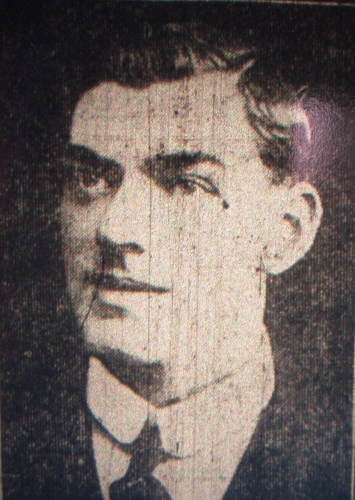
- Age: 25
- From: Seacombe, Cheshire
- Regiment: The King's (Liverpool Regiment) 17th Btn
- K.I.A Sunday 30th July 1916
- Commemorated at: Guillemont Rd Cem
Panel Ref: VI.A.9
Arthur Pulford was born in 1891 at Seacombe, Cheshire and was baptised 16th September 1891 at St Mary's Church, Liscard. He was the son of William Pulford and his wife Mary (nee Cutler). His parents married in 1888 at St Mary, Liscard and had three children. Arthur had an elder sister Ada, and a younger brother George. Arthur was baptised on the 16th Sept 1891 also at St Mary’s.
The 1901 Census shows the family living at 21 Waverley Street, Poulton cum Seacombe. His father, William, is aged 36, born in Wallasey in 1865, his occupation is shown as a butcher, his mother, Mary, is aged 40, born 1861 in Langley Green, Worcestershire. At the time of the Census they have three children, Ada aged 11, born 1890, Arthur aged 9, born 1892 and George aged 7, born 1894.
Sadly, his sister, Ada, died in 1907 aged 18.
In 1911 Census the family are living at 9 Luke Street, Seacombe. His father, 47, is an offal butcher, Arthur is 19, a butcher’s assistant, his mother is 50, and George, 17, is a grocer’s assistant. Arthur and his father both work at the Lairages.
Birkenhead once had a thriving cattle trade. In 1886 the Birkenhead abattoir was opened, followed three years later by the Birkenhead Lairage buildings. Lairages monitored the unloading of cattle into the Lairage to ensure none of the cattle were injured or showed signs of sickness. In 1897 40%-50% of Britain’s imported sheep and cattle from America passed through Birkenhead.
The family suffered further tragedy when George died on 06th July 1911, at the age of 17, leaving Arthur as the only surviving child.
Arthur was educated at Paul's School. He attended Seacombe Presbyterian Church and Bible class.
Prior to the outbreak of the war he had been employed by Simpson's Ltd, Wholesale butchers, St Johns Market, Liverpool.
Arthur enlisted in Liverpool and was serving in the 17th Battalion, The King’s Liverpool Regiment as Private No 33196. Based on the amount of the War Gratuity, Arthur had served for no more than one year when he was killed. He joined up some time after July 1915 and went to France in 1916. There may have been some understandable reluctance to Arthur's enlisting on the part of his parents, having lost two of their three children.
He was killed in action on the 30th July 1916, aged 25, at the village of Guillemont, France, during the Somme Offensive.
17th Battalion Diary 30th July 1916
The Battalion was in support to 19 & 20 Battalions K.L.R. 2 Coys. behind 19th & 2 Coys. behind 20th. Very thick mist. The attack was pushed home to the objective in places but in the main was held up by machine gun fire from hidden machine guns.
Fighting continued all day swaying backwards and forwards until by 6pm about 300 yards in depth had been gained & consolidated all along our front.
Casualties in the 17th Battalion were 15 Officers and 281 Other Ranks
Further details are reported in more detailed by Everard Wyrall in his book The History of the King’s Regiment (Liverpool) 1914-1919 Volume II 1916-1917
The 17th King’s had advanced (two companies each behind the 19th and 20th Battalions) in small columns. They too suffered heavily from machine-gun fire and were quickly absorbed into the waves that preceded them. They also shared the gains and losses of that terrible day.
When darkness fell on the battlefield the 30th Division held a line from the railway on the eastern side of Trones Wood , southwards and including Arrow Head Copse, to east of Maltz Horn Farm. On this line the division was relieved by the 55th Division during the early hours of the 31st July.
The events of 30th July 1916 were regarded at the time as Liverpool’s blackest day. There follows an extract from The History of the 89th Brigade written by Brigadier General Ferdinand Stanley which gives an indication of the events of the day.
Guillemont
Well the hour to advance came, and of all bad luck in the world it was a thick fog; so thick that you couldn’t see more than about ten yards. It was next to impossible to delay the attack – it was much too big an operation- so forward they had to go. It will give some idea when I say that on one flank we had to go 1,750 yards over big rolling country. Everyone knows what it is like to cross enclosed country which you know really well in a fog and how easy it is to lose your way. Therefore, imagine these rolling hills, with no landmarks and absolutely unknown to anyone. Is it surprising that people lost their way and lost touch with those next to them? As a matter of fact, it was wonderful the way in which many men found their way right to the place we wanted to get to. But as a connected attack it was impossible.
The fog was intense it was practically impossible to keep direction and parties got split up. Owing to the heavy shelling all the Bosches had left their main trenches and were lying out in the open with snipers and machine guns in shell holes, so of course our fellows were the most easy prey.
It is so awfully sad now going about and finding so many splendid fellows gone.
Arthur was initially declared Missing. His parents appealed for information on 11th September in the Liverpool Echo. By 2nd October 1916 they had heard official news:
“July 30, reported missing, now officially reported killed in action, aged 25, Private A. Pulford, K.L.R., only son of Mr. and Mrs. W. Pulford, 3, Vivian Avenue, Seacombe. (His loss deeply felt by all.)”
Arthur was buried close to where he fell and after the war, when graves were concentrated, his body was removed and reinterred at Guillemont Road Cemetery, where he now rests.
Guillemont was an important point in the German defences at the beginning of the Battle of the Somme in July 1916. It was taken by the 2nd Royal Scots Fusiliers on 30 July but the battalion was obliged to fall back, and it was again entered for a short time by the 55th (West Lancashire) Division on 8 August. On 18 August, the village was reached by the 2nd Division, and on 3 September (in the Battle of Guillemont) it was captured and cleared by the 20th (Light) and part of the 16th (Irish) Divisions. It was lost in March 1918 during the German advance, but retaken on 29 August by the 18th and 38th (Welsh) Divisions.
The cemetery was begun by fighting units (mainly of the Guards Division) and field ambulances after the Battle of Guillemont, and was closed in March 1917, when it contained 121 burials. It was greatly increased after the Armistice when graves (almost all of July-September 1916) were brought in from the battlefields immediately surrounding the village and certain smaller cemeteries, including:-
HARDECOURT FRENCH MILITARY CEMETERY. The village of Hardecourt-au-Bois was captured by French troops on the 8th July 1916, and again by the 58th (London) and 12th (Eastern) Divisions on 28 August 1918. Five British Artillerymen were buried by their unit in the French Military Cemetery, in the middle of the village, in September 1916; and in 1918 the 12th Division buried in the same cemetery 14 men of the 9th Royal Fusiliers and two of the 7th Royal Sussex.
Guillemont Road Cemetery now contains 2,263 Commonwealth burials and commemorations of the First World War. 1,523 of the burials are unidentified but there are special memorials to eight casualties known or believed to be buried among them.
The cemetery was designed by Sir Herbert Baker.
His Army pay and a War Gratuity of £3 went to his father.
From the pension card in the name of his mother, the amount of pension awarded is unknown, the duplicate card states, “original card missing”.
His family paid tribute to Arthur in the Liverpool Echo, on the first anniversary of his death, 30th July 1917, under the heading ‘Lost At The Battle of Guillemont’
“In loving memory of Private Arthur Pulford, K.L.R., eldest son of William and Mary Pulford, who was killed in action July 30, 1916.
He nobly rose to his country’s call,
He gave his best, his life, his all.
(Deeply mourned by his loving Father and Mother and all who knew him) – 3 Vivian Avenue, Seacombe.”
Arthur was also remembered on the second anniversary of his death in 1918:
"In loving memory of Private Arthur Pulford, K.L.R. (Pals), eldest son of William and Mary Pulford, who was killed in action July 30, 1916.
He nobly rose to his country's call;
He gave his best, his life, his all.
Also George, youngest son, died July 6, 1911. Deeply mourned by their Father and Mother, and all who knew them. - 3, Vivian Avenue, Seacombe."
His mother died in 1932 aged 72.
Liverpool Daily Post - Friday 02 December 1932
PULFORD— Mr PULFORD wishes to thank relatives for their great kindness and sympathy, also the beautiful floral tributes during his sad bereavement— 3 Vivian-avenue, Wallasey.
In 1939 his father, now 75 and retired, is still at 3 Vivian Avenue, with relatives James H. and Elizabeth Pulford.
His father died on the 26th April 1940 aged 76.
His death was reported in the Liverpool Echo on Monday 29 April 1940:
PULFORD—ApriI 26. In hospital. WILLIAM, beloved husband of the late Mary Pulford, 3 Vivian Avenue. Wallasey. Service at St. Paul's Church, Wallasey, on Wednesday next, at 2 p.m., interment at Rake Lane Cemetery, at 2.30 p.m. (Friends please accept this—the only—intimation.)
Arthur is also commemorated on the following Memorials
United Reform Church, Seacombe
Victoria Central Community Hospital, Wallasey
We currently have no further information on Arthur Pulford, If you have or know someone who may be able to add to the history of this soldier, please contact us.
Killed On This Day.
(109 Years this day)Friday 1st June 1917.
Pte 29979 Claude Thomas Bicker
22 years old
(108 Years this day)
Saturday 1st June 1918.
Pte 50652 Alfred Barnes
21 years old
(108 Years this day)
Saturday 1st June 1918.
Captain Peter Carroll Dudley Stuart (CDG)
24 years old