
1885 - 1916

CPL David Wallace Crawford
1887 - 1916

Lce-Corpl John Joseph Nickle
1894 - 1916

Pte 17911 Morton Neill
1897 - 1916

Lieut Edward Stanley Ashcroft
1883 - 1918

A/Cpl 57609 Clifford Petthrick
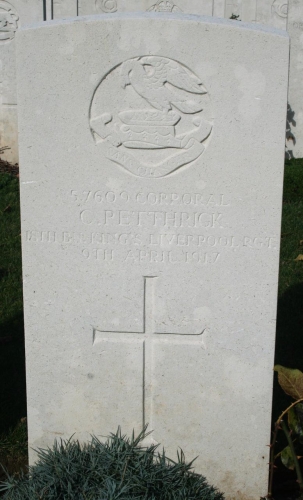
- Age: 22
- From: Sheffield, Yorks
- Regiment: The King's (Liverpool Regiment) 18th Btn
- K.I.A Monday 9th April 1917
- Commemorated at: Wancourt Brit Cem
Panel Ref: V.E.29
Clifford was born on 30th April 1894, the son of Robinson Petthrick and Ethel Elizabeth (née Holmes). His father was born in about 1863 in Clitheroe (or some records say Accrington), and his mother in Sheffield in about 1867. They married on 8th August 1885, and had three children. Clifford had an older brother Herbert, born in 1886, and an older sister Edith, born in 1891.
The family lived at 6 Bigod Street, Sheffield, then moved to Rotherham, before moving to Leeds.
In 1896 his father was sentenced to one month’s hard labour for embezzlement, using a false name. He is described on records as a paper hanger, painter, or picture canvasser, and seems to have sold paintings door to door for some years.
In 1898 he deserted the family, leaving his wife and children destitute, when Clifford would have been about four years old. He accumulated a criminal record, including: in 1898, 42 days for bastardy, (but entry crossed off); 1898 three months’ hard labour for stealing gold watches; and two “minor” convictions for deserting his family and drunkenness.
His wife was compelled to apply to the Poor Law authorities, his father was sentenced to ten days’ imprisonment for wife desertion. He was ordered to pay 12/6d a week for maintenance but paid only 5/- before disappearing.
He turned up in Doncaster, where he married Amy Thackrah in 1900 under a false name, Alfred Bramhall (the name of his wife’s brother-in-law), claiming to be a widower whose wife and two children had died. They soon moved to Sunderland where the 1901 census finds “Alfred Bramhall”, a grocer, and wife Amy. They later moved to Swinton in Yorkshire. No children were born to the marriage.
In November 1901 his father was prosecuted for bigamy, as well as a variety of bad behaviours including violence, drunkenness, and threats to his second wife. He admitted to all the charges, and in December was sentenced to 12 months’ imprisonment with hard labour. That same month his legal wife, Clifford’s mother, filed for divorce, which was granted a few months later. She remarried to William Henry Taylor in 1904 when Clifford was 10.
After being released from prison his father was again in trouble, in 1904 spending one month in gaol for assaulting a police constable while under the influence. In 1905 he was locked up for seven days for drunkenness. In 1909 he was sentenced to six months for “oblg. money”. He was a regular at Wakefield Prison and appears on the list of “Habitual Criminals”. In 1911 he is found as a house painter, boarder, in Hessle, Yorkshire, under his own name, with wife Florence Anne, but no record of a marriage has been found. He died in Sheffield in 1930 aged 62.
The 1901 Census shows Clifford living with his mother Ethel as head of the household. She states she is married but there is no record of her husband at the property at the time the Census was taken (see above). Clifford has a brother Herbert and a sister Edith. They are living at 1 Court 1, Napier Street, Eccleshall.
In 1911 Clifford, by now 16 and shown as a Shovel Finisher is living at 8 Napier Street, Eccleshall with his mother now Ethel Taylor and her husband William H. Clifford's brother Herbert had joined the Navy. His sister Edith is living in Sheffield with her mother’s sister Clara, and her husband Alfred Bramhall.
He enlisted in Sheffield about November 1914 joining the Army Cyclist Corps as Private 2433 before he was subsequently transferred to the 18th Battalion of The King's Liverpool Regiment as Private 57069. He was serving as Acting Lance Corporal when he was killed in action on 09th April 1917 aged 22. This was the opening day of the Battle of Arras.
Arras 09th April 1917
Details of the circumstances the18th Battalion had to contend with are illustrated below:
The battalion formed the left assaulting battalion of the brigade, the 2nd Wiltshire Regiment being on the right, the 19th Manchester Regiment being in support and 2nd Battalion Yorkshire Regiment furnishing “moppers -up” for the two assaulting battalions. The brigade advance was timed to begin at ---- hour after “Zero”, suited to conform with the movements of 56th Division and other divisions on our left further north (near Arras). This battalion’s objective was the front-line system Lion Lane on the left (exclusive) to Panther Lane on right (exclusive). This sector included the strongpoint known as “The Egg”.
The brigade advanced at prearranged time, i.e., 11.38 a.m, from position of assembly trenches south of Neuville Vitasse to German front line. This necessitated an advance across the open of at least 2,000 yards. This area up to Neuville Vitasse- Henin road was crossed in artillery formation; after this, owing to machine-gun fire and considerable resistance from German posts forward in the sunken roads, it was found necessary to deploy. During the whole movement across the open the advancing columns had been under considerable artillery fire from guns of all calibres. On gaining the position immediately in front of German line it was found that the wire was practically uncut; this wire formed two strong belts in front of German trenches. Two small gaps were eventually discovered and Second-Lieut H.F.Merry gallantly led a bombing party through them, but his three remaining men were killed as they reached the German trenches.
From the moment the battalion was “held up” in front of German wire Capt. R. W. Jones, the senior company commander on the spot, at once began the work of consolidating in front of German wire. The battalion held on in this position for the remainder of the day, until relieved by the 16th Manchester Regiment about 3 a.m. on the 10th of April, all the time under intense machine-gun and rifle fire.
Between 9th-10th April, 1917, the 18th King's lost 2 officers 2nd Lt. F. Ashcroft and 2nd Lt. H.G. Ewing and 59 other ranks killed. 8 other officers were wounded.
Clifford now rests at Wancourt British Cemetery in France.
Wancourt was captured on 12 April 1917 after very heavy fighting and the advance was continued on the following days. The cemetery, called at first Cojeul Valley Cemetery, or River Road Cemetery, was opened about ten days later; it was used until October 1918, but was in German hands from March 1918 until 26 August, when the Canadian Corps recaptured Wancourt. At the Armistice, the cemetery contained 410 graves, but was very greatly increased in the following years when graves were brought in from other small cemeteries and isolated positions on the battlefields south-east of Arras including HENIN-SUR-COJEUL, about 800 metres North of the village, contained the graves of 29 British soldiers who fell on 9 April 1917, almost all of whom belonged to the 2nd Wilts or the 18th King's Liverpools. The cemetery now contains 1,936 burials and commemorations of the First World War. 829 of the burials are unidentified but there are special memorials to 76 casualties known or believed to be buried among them, and to 20 who were buried in Signal Trench Cemetery whose graves were destroyed in later battles. The cemetery was designed by Sir Edwin Lutyens.
His medal roll shows he went overseas with the 1st West Riding D.C.C. (Divisional Cyclist Company), as Acting Corporal.
CWGC Graves Registration form shows his surname as Petherwick and date of death 14th April 1917. A number of others from the 18th Bn are initially shown to have died on the 13th, and the date subsequently changed to the 9th.
On the first anniversary of his death a notice appeared in the Sheffield Evening Telegraph:
“In loving memory of Corpl. C. Petthrick, who fell in action April 9th, 1917. To memory ever dear. Annie.”
And on the second anniversary in 1919:
“In loving memory of Corporal. C. Petthrick, who fell in action April 9th, 1917. Though lost to sight, to memory ever dear. - From his loving Mother and Stepfather.”
“In loving memory of my dear brother, Corporal. C. Petthrick, fell in action April 9, 1917. For ever in our thoughts. - From his Brother and Sister-in-law.”
“In loving memory of Corporal. C. Petthrick, who fell in action April 9th, 1917. From loving memory you will never fade. - From his loving Sister and Brother, Edith and Harold.”
His family remembered him again in 1920, his mother posting,
“Time changes many things; mother’s love ever clings.”
His Army effects and a War Gratuity of £12-10s went to his mother.
His brother Herbert had enlisted in the Royal Navy in 1907, served throughout the war, and completed 12 years in 1919.
His sister Edith married in 1915 to Harold Kershaw who served in the Yorks & Lancs. He later served in the Army Pay Corps, received a disability pension, and died in 1926 at the age of 36. They had a son they named Clifford (who in 1939 was an articled clerk, accountant, and living in Sheffield with Alfred Bramhall). Edith remarried in 1949 and died in 1970.
It is not known when his stepfather died.
In 1939 his mother, 72, widowed, was living alone at 8 Napier Street. His mother suffered further loss when Clifford's brother Herbert died in 1943, aged 56. She died in 1948, at the age of 80.
Clifford is commemorated on the Victoria Hall Methodist Church Memorial.
We currently have no further information on Clifford Petthrick, If you have or know someone who may be able to add to the history of this soldier, please contact us.