
1885 - 1916

CPL David Wallace Crawford
1887 - 1916

Lce-Corpl John Joseph Nickle
1894 - 1916

Pte 17911 Morton Neill
1897 - 1916

Lieut Edward Stanley Ashcroft
1883 - 1918

L/Cpl 17932 Ivor Owen
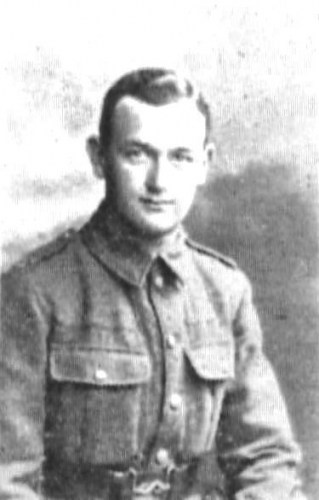
- Age: 25
- From: Bootle
- Regiment: The King's (Liverpool Regiment) 19th Btn
- K.I.A Sunday 30th July 1916
- Commemorated at: Guillemont Rd Cem
Panel Ref: VII.K.8
Ivor Owen was born in 1891 in Bootle, the son of John Jones Owen and his wife Mary (nee Foulkes). His parents were both born in Wales, his father at Festiniog, Merioneth and his mother at Llandyrnog, Denbighshire. They were married at Birkenhead in 1888.
The 1891 Census shows the family living at 5 Crete Street, Bootle.
The father John J. is aged 28, a joiner, and his wife Mary is aged 26, with children John Foulkes aged 2, and Ivor (aged 2 months).
The 1901 Census finds the family still living at 5 Crete Street, Bootle.
The father John J. is aged 38, is now working as a warehouseman, mother Mary is 35, with children John 12, Ivor 10, and Ceridwen 8.
By the time of the 1911 Census the family have moved to 18 Victoria Drive, Orrell Park.
The parents John J. and Mary with children Ivor and Ceridwen. His parents have been married for 23 years and have had three children. His father, 48, is Superintendent of warehouses (cotton), his mother is 45. Ivor, aged 20 is a commercial clerk. His brother John is living in Wales with his uncle Robert Manod Owen, a farmer, and grandmother Mary Owen in the village of Llandderfel, Corwen, Merioneth. John is 22, working as a waggoner on the farm.
Ivor was a member of the Free Church of Wales, Merton Road, Bootle. He had worked in the office of Messrs Edmund Schlutter & Co, merchants of Exchange Buildings Liverpool. Ivor was a prominent member for Bootle Albion Football Club.
John Foulkes Owen married Ellen (nee Thomas) at Bala, Merionethshire in 1914. They had two sons and two daughters, calling their eldest son, who was born in 1915, Ivor.
Ivor enlisted at Liverpool on the 11th September 1914, joining the 19th Battalion of The King's Liverpool Regiment as Private 17932. He gave his age as 23 years and 240 days and occupation as a clerk. He is described as being 5ft 7” inches tall, with a 36 inch chest and weighed 134lbs. He had brown eyes, brown hair and was a Methodist. His parents lived at 18 Victoria Drive, father John being his next of kin.
Formed on 07th September 1914 the 19th Battalion trained locally at Sefton Park and remained living at home or in rented accommodation until November 1914. They then moved to the hutted accommodation at Lord Derby’s estate at Knowsley Hall. On 30th April 1915 the 19th Battalion alongside the other three Pals battalions left Liverpool via Prescot Station for further training at Belton Park, Grantham. They remained here until September 1915 when they reached Larkhill Camp on Salisbury Plain.
While at Grantham, Ivor was admitted to the Military Hospital on 19th July with German measles, and discharged after nine days.
He arrived in France on 07th November 1915.
Ivor was appointed an unpaid Lance-Corporal on the 24th July just before he was killed in action on the 30th July 1916, aged 25, at the village of Guillemont, France, during the Somme Offensive.
19th Battalion Diary 30th July 1916
MALTZ HORN FARM
BATTLE begun. ZERO hour 4:45 am. The Battalion reached its objective, but suffered heavy losses, and had to evacuate its position owing to no reinforcements.
Everard Wyrall gives details of the attack in his book The History of The King’s Regiment;
"The 2nd Attack on Guillemont- 29th July 1916 the 89th Brigade the 20th King's were to attack on the right and the 19th on the left. During the evening of the 29th the night was dark and foggy when the Battalions moved off and the 19th with Lt Col G Rollo commanding, when passing the South east of the Briqueterie they were heavily shelled first with H E and then with a new kind of asphyxiating Gas shell which had curious results, at first it had no nasty effect but about 8 hrs later men began to fall sick with violent headaches and pains in the stomach. All ranks had to wear gas masks which in the darkness and mist made the going terribly difficult. It was indeed wonderful that they were able to reach their Assembly point at all. But they did and by 2.45 a.m. on the 30th July 1916 the Btn was assembled having suffered about 30 Casualties on the way up ready for the Zero hour at 4.45 a.m.
It is known that the two left Companies of the 19th under Capt. Dodd and Capt. Nicholson advanced in touch with the 2nd Royal Scots Fusiliers on their left although they suffered many casualties from Machine gun Fire did not encounter many Germans and reached their final objective about the time allocated, beginning at once to dig in south of the orchard on the South east corner of Guillemont.
On the left of the 19th the Scots Fusiliers most gallantly forced their way through Guillemont to the eastern side of the village but were soon overwhelmed by the enemy and few returned.
At 8 a.m. finding that the village was not held the two left Companies of the 19th received no word from the rear or either flank believed themselves to be totally isolated so were forced to fall back and dig in, their position being untenable.
At midday the effective fighting strength of the 19th Btn was just 7 Officers and 43 other ranks"
When darkness fell on the battlefield the 30th Division held a line from the railway on the eastern side of Trones Wood , southwards and including Arrow Head Copse, to east of Maltz Horn Farm. On this line the division was relieved by the 55th Division during the early hours of the 31st July.
Casualties in the 19th Battalion were 11 Officers and 435 Other Ranks
The events of 30th July 1916 were regarded at the time as Liverpool’s blackest day. There follows an extract from The History of the 89th Brigade written by Brigadier General Ferdinand Stanley which gives an indication of the events of the day.
Guillemont
Well the hour to advance came, and of all bad luck in the world it was a thick fog; so thick that you couldn’t see more than about ten yards. It was next to impossible to delay the attack – it was much too big an operation- so forward they had to go. It will give some idea when I say that on one flank we had to go 1,750 yards over big rolling country. Everyone knows what it is like to cross enclosed country which you know really well in a fog and how easy it is to lose your way. Therefore, imagine these rolling hills, with no landmarks and absolutely unknown to anyone. Is it surprising that people lost their way and lost touch with those next to them? As a matter of fact, it was wonderful the way in which many men found their way right to the place we wanted to get to. But as a connected attack it was impossible.
The fog was intense it was practically impossible to keep direction and parties got split up. Owing to the heavy shelling all the Bosches had left their main trenches and were lying out in the open with snipers and machine guns in shell holes, so of course our fellows were the most easy prey.
It is so awfully sad now going about and finding so many splendid fellows gone.
He was buried close to where he fell and after the war, when graves were concentrated, his body was removed and he now rests in Guillemont Road Cemetery, Somme, where his headstone bears the epitaph:
"FAITHFUL UNTO DEATH"
Guillemont was an important point in the German defences at the beginning of the Battle of the Somme in July 1916. It was taken by the 2nd Royal Scots Fusiliers on 30 July but the battalion was obliged to fall back, and it was again entered for a short time by the 55th (West Lancashire) Division on 8 August. On 18 August, the village was reached by the 2nd Division, and on 3 September (in the Battle of Guillemont) it was captured and cleared by the 20th (Light) and part of the 16th (Irish) Divisions. It was lost in March 1918 during the German advance, but retaken on 29 August by the 18th and 38th (Welsh) Divisions.
The cemetery was begun by fighting units (mainly of the Guards Division) and field ambulances after the Battle of Guillemont, and was closed in March 1917, when it contained 121 burials. It was greatly increased after the Armistice when graves (almost all of July-September 1916) were brought in from the battlefields immediately surrounding the village and certain smaller cemeteries, including:-
HARDECOURT FRENCH MILITARY CEMETERY. The village of Hardecourt-au-Bois was captured by French troops on the 8th July 1916, and again by the 58th (London) and 12th (Eastern) Divisions on 28 August 1918. Five British Artillerymen were buried by their unit in the French Military Cemetery, in the middle of the village, in September 1916; and in 1918 the 12th Division buried in the same cemetery 14 men of the 9th Royal Fusiliers and two of the 7th Royal Sussex.
Guillemont Road Cemetery now contains 2,263 Commonwealth burials and commemorations of the First World War. 1,523 of the burials are unidentified but there are special memorials to eight casualties known or believed to be buried among them.
The cemetery was designed by Sir Herbert Baker.
A death notice was placed in the Liverpool Echo on 11th August 1916 :
L/Cpl Ivor Owen Kings Liverpool 17932 KIA 30/7/1916 son of John & Mary Owen 18 Victoria Drive Aintree.
A further report in the Liverpool Echo of 14th August 1916:
"News has been received of the death in action in France of Lance-Corporal, Ivor Owen. He was a member of the Free Church of Wales, Merton-road, Bootle. From boyhood he has been in the office of Messrs. Edmund, Schluter and Co., merchants, Exchange Building, where he was highly respected. He was also a prominent member of the Bootle Albion Football Club. He went to France last November with the "Pals." His platoon comrades in letters speak well of him as a "fearless" soldier and mourn his loss very much. He was the son of Mr. and Mrs. J. Owen of, 19, Victoria-drive, Aintree".
Another report on Ivor's death appeared in the Bootle Times on the 18th August 1916.
LOCAL SPORTSMEN WHO HAVE FALLEN.
A prominent member of Bootle Albion Football Club, Lance-Corporal Ivor Owen, who was the son of Mr. and Mrs. J. J. Owen, of Victoria-drive, Aintree, has been killed in action in France. He went to the front last November with the "Pals," and his comrades speak of him in the highest terms as a friend and fearless young soldier. He was a member of the Free Church of Wales, Merton-road, Bootle. From boyhood he had been in the office of Messrs. Edmund Schulter and Co., merchants, Exchange Buildings, where he was highly respected.
Lance-Corporal Owen is the third member of Albion F.C. to fall in action. His chum, Peter Walker, also of the Albion, has been wounded in the thigh, but not seriously. Ivor played with the club for a number of years, and was treasurer and captain. He always had the welfare of the club at heart, and was well-known in local, and especially Zingari football. He used to give a dashing performance at either half-back or centre-forward, always "playing the game," and it was woe betide the man whose standard of fair play was not particularly high, for Ivor was up in arms in a moment. This spirit of fighting for right and fair play he had carried out to the full in the game of life, and has paid the supreme sacrifice. All the old supporters of the Club join with officials and players in extending deepest sympathy to his bereaved parents.
His death was reported in the Liverpool Daily Post Wednesday 13 September 1916
KILLED.
King’s (Liverpool Regt) - Owen, 17932, I.;
He earned his three medals, which his father signed for.
Ivor’s personal effects were sent to his father in December 1916: 1 Tin box containing watch (broken), Pkt letters, photos, cards. Other personal belongings were sent in February 1919 when Ivor’s body was exhumed (per D.G.R.&E. form).
Ivor was remembered by his parents on the first anniversary of his death in the Liverpool Echo on 30th July 1917, under the heading, “Lost At The Battle Of Guillemont”:
“In loving memory of Ivor Owen (19th King’s), who fell in action July 30, 1916. (Ever remembered by Father and Mother.)”
His Army pay and a War Gratuity of £8-10s went to his father. No pension card has been found, suggesting that his parents did not apply for a pension.
Ivor is remembered on the following Memorials:
Bootle Civic Memorial,
Salisbury Road School,
Bootle Civic Memorial,
Orrell FC Memorial
Liverpool Exchange Newsroom Memorial.
Both parents died in 1934, his father on the 1st June, aged 71.
Liverpool Daily Post - Monday 04 June 1934
OWEN— June 1, at his son’s residence, JOHN JONES OWEN, the dearly beloved husband of Mary Owen, 18 Victoria Drive, Orrell Park. Service at Walton Welsh C.M. Chapel, tomorrow (Tuesday) at 2 p.m., prior to interment at Longmoor-lane Cemetery. (No flowers by request.)
His mother on the 24th July, aged 69.
Liverpool Daily Post - Friday 27 July 1934
OWEN - July 24, at Tattenhall, MARY, the dearly beloved wife of the late John Jones Owen (Reunited), 18 Victoria-drive, Orrell, Interment at Longmoor-lane Cemetery, today (Friday) 3 p.m.
We currently have no further information on Ivor Owen, If you have or know someone who may be able to add to the history of this soldier, please contact us.
Killed On This Day.
(109 Years this day)Saturday 25th August 1917.
Pte 16289 George Brough
22 years old
(109 Years this day)
Saturday 25th August 1917.
Pte 24765 William Burrows
23 years old
(109 Years this day)
Saturday 25th August 1917.
Cpl 16466 Thomas Clayton Lindsay
22 years old
(109 Years this day)
Saturday 25th August 1917.
Pte 52437 William Ridgway
23 years old
(109 Years this day)
Saturday 25th August 1917.
Sgt 16486 Harry Spencer
30 years old
(108 Years this day)
Sunday 25th August 1918.
Cpl 50180 Arthur Henry Alliott
22 years old
(108 Years this day)
Sunday 25th August 1918.
Pte 26162 Henry Pearson
26 years old