
1885 - 1916

CPL David Wallace Crawford
1887 - 1916

Lce-Corpl John Joseph Nickle
1894 - 1916

Pte 17911 Morton Neill
1897 - 1916

Lieut Edward Stanley Ashcroft
1883 - 1918

Pte 57559 Walter Melville Mitchell
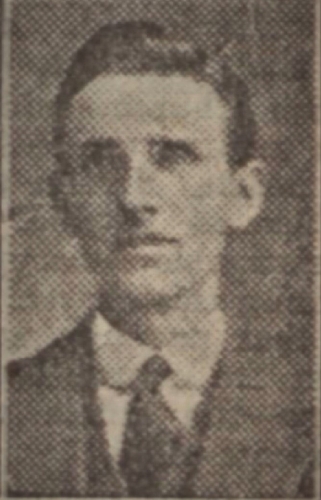
- Age: 22
- From: Dundee
- Regiment: The King's (Liverpool Regiment) 18th Btn
- K.I.A Monday 9th April 1917
- Commemorated at: Wancourt Brit Cem
Panel Ref: V.E.33
Walter Melville Mitchell was born in 1895 in Dundee and was the youngest son of David Nicoll Mitchell and his wife Susan Lyon Hagg (nee Burns). His parents were both born in Dundee and married in 1885. Walter had older brothers James, Edward, and David, and a younger sister Agnes, all born in Dundee.
In 1891, before Walter’s birth, the family lived at 69 N. Wellington Street, Dundee, his father employed as a furnace stoker.
At the time of the 1901 census they are living at 6 Eliza Street, Dundee, with five children. His father 46, is a labourer, mill porter, and his mother is 42. Edward is 10, David 8, Walter 5, and Agnes is 1 year old. The eldest son James, 14, is employed as a low batcher. Batching is a step in the preparation of jute for spinning. Batching and softening allowed the hard dry raw jute to be turned into a pliable workable fibre. Normally men and lads did this dusty job (which quite possibly contributed to James’ later lung problems).
In 1900 Dundee had over 100 working jute mills and almost half the city’s population worked in jute or jute-related industries. Until the late 19th century Dundee produced almost all the jute cloth that was used anywhere in the world.
Unfortunately the 1911 Scotland census is only available by subscription. It is quite possible that Walter worked in a jute mill, like his father and brother, after he left school.
Walter enlisted in Dundee and originally served as Private 851 in the Army Cyclist Corps. The amount of the War Gratuity suggests that he served for eighteen months, enlisting in about November 1915.
Following a transfer he was serving in the 18th Battalion, The King’s Liverpool Regiment as Private No 57559 when he was killed in action on the 9th April 1917, aged 22, during the Battle of Arras.
Arras 09th April 1917
Details of the circumstances the 18th Battalion had to contend with are illustrated below:
The battalion formed the left assaulting battalion of the brigade, the 2nd Wiltshire Regiment being on the right, the 19th Manchester Regiment being in support and 2nd Battalion Yorkshire Regiment furnishing “moppers -up” for the two assaulting battalions. The brigade advance was timed to begin at ---- hour after “Zero”, suited to conform with the movements of 56th Division and other divisions on our left further north (near Arras). This battalion’s objective was the front-line system Lion Lane on the left (exclusive) to Panther Lane on right (exclusive). This sector included the strongpoint known as “The Egg”.
The brigade advanced at prearranged time, i.e., 11.38 a.m, from position of assembly trenches south of Neuville Vitasse to German front line. This necessitated an advance across the open of at least 2,000 yards. This area up to Neuville Vitasse- Henin road was crossed in artillery formation; after this, owing to machine-gun fire and considerable resistance from German posts forward in the sunken roads, it was found necessary to deploy. During the whole movement across the open the advancing columns had been under considerable artillery fire from guns of all calibres. On gaining the position immediately in front of German line it was found that the wire was practically uncut; this wire formed two strong belts in front of German trenches. Two small gaps were eventually discovered and Second-Lieut H.F.Merry gallantly led a bombing party through them, but his three remaining men were killed as they reached the German trenches.
From the moment the battalion was “held up” in front of German wire Capt. R. W. Jones, the senior company commander on the spot, at once began the work of consolidating in front of German wire. The battalion held on in this position for the remainder of the day, until relieved by the 16th Manchester Regiment about 3 a.m. on the 10th of April, all the time under intense machine-gun and rifle fire.
Between 9th-10th April, 1917, the 18th King's lost 2 officers 2nd Lt. F. Ashcroft and 2nd Lt. H.G. Ewing and 59 other ranks killed. 8 other officers were wounded.
Walter was buried close to where he fell and after the war, when graves were concentrated, his body was removed and reinterred and Walter now rests at Wancourt British Cemetery, France where his headstone bears the epitaph:
“ROCK OF AGES CLEFT FOR ME”
Wancourt was captured on 12 April 1917 after very heavy fighting and the advance was continued on the following days. The cemetery, called at first Cojeul Valley Cemetery, or River Road Cemetery, was opened about ten days later; it was used until October 1918, but was in German hands from March 1918 until 26 August, when the Canadian Corps recaptured Wancourt. At the Armistice, the cemetery contained 410 graves, but was very greatly increased in the following years when graves were brought in from the following small cemeteries and isolated positions on the battlefields south-east of Arras : HENIN NORTH CEMETERY, HENIN-SUR-COJEUL, about 800 metres North of the village, contained the graves of 29 British soldiers who fell on 9 April 1917, almost all of whom belonged to the 2nd Wilts or the 18th King's Liverpools.
The cemetery now contains 1,936 burials and commemorations of the First World War. 829 of the burials are unidentified but there are special memorials to 76 casualties known or believed to be buried among them, and to 20 who were buried in Signal Trench Cemetery whose graves were destroyed in later battles. The cemetery was designed by Sir Edwin Lutyens.
His mother placed a notice in the Dundee Courier on 20th April 1917:
“Killed in action on 9th April, Pte. W. M. Mitchell, youngest and beloved son of Mrs. D. Mitchell and of the late David Mitchell, 3, Tannadice Street, Dundee - deeply regretted. Thanking everyone for their kind sympathy.”
An In Memoriam notice on the first anniversary of his death:
“In loving memory of my cousin, Pte. Walter M. Mitchell, who fell in action 9th April, 1917 - Gone but not forgotten. - Inserted by Mrs. A. Peebles.”
His Army effects and a War Gratuity of £6 went to his mother.
Walter is commemorated on the following memorials -
Dundee Roll of Honour
Scottish National War Memorial
His eldest brother James enlisted soon after war was declared and served in the Black Watch (Royal Highlanders), arriving in France on 20th January 1915. He suffered from gassing, and was demobilised in January 1919 with a disability pension. He suffered the rest of his life from lung problems and died in 1928, aged 41.
A notation on the pension card suggests that his mother died in 1931, aged 72.
We currently have no further information on Walter Melville Mitchell, If you have or know someone who may be able to add to the history of this soldier, please contact us.