
1885 - 1916

CPL David Wallace Crawford
1887 - 1916

Lce-Corpl John Joseph Nickle
1894 - 1916

Pte 17911 Morton Neill
1897 - 1916

Lieut Edward Stanley Ashcroft
1883 - 1918

Pte 17847 William Percy Hughes
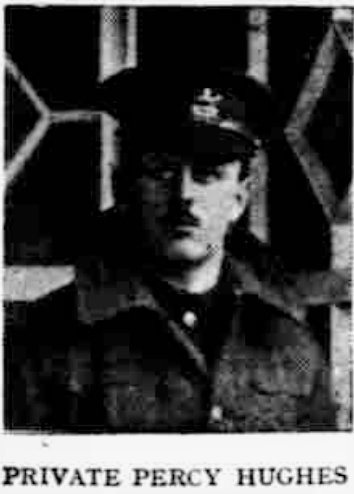
- Age: 26
- From: Colwyn Bay, N. Wales
- Regiment: The King's (Liverpool Regiment) 19th Btn
- K.I.A Sunday 30th July 1916
- Commemorated at: Thiepval Memorial
Panel Ref: P&F1D8B &8 C.
William Percy Hughes was born in Colwyn Bay in the December quarter of 1889, the son of Hugh Hughes and his wife Annie (nee Williams). His parents were both born in Denbighshire, his father in Llandulas, and his mother in Glan Conwy. They married in 1887 and had seven children, two of whom died young. Percy had an elder sister Margaret Anne, and younger siblings Emily Grace, John Alfred, and Thomas Harold. Hugh was a grocer and the couple’s children were baptised at St Cystennin's Church, Llangystenin (Percy on 27th August 1889).
The family were living at Wern Villa, Mochdre, a small village outside Colwyn Bay at the time of the 1891 census. William is just 1, and he has a 3 year old sister called Margaret. Their father Hugh is 34 and a grocer, and his wife Annie is 30 years old. The couple also have a nurse domestic living with them, 16 year old Elizabeth Jones. The census in Wales shows which language is spoken: Hugh and Annie are shown as speaking both Welsh and English, toddler Margaret speaks Welsh and Elizabeth Jones speaks Welsh.
William, who was known by his middle name Percy, was living with his parents at Ivy Street, Colwyn Bay at the time of the 1901 census. He was 11 years old, he now has four siblings – Margaret (called Maggie) , Emily 9, John 5 and Thomas 2. His father runs a grocery, bakery and provisions shop.
The 1911 Census shows his father, 54, now keeps a grocer's shop in Woodland Park, Colwyn Bay. His mother is 51, Margaret, 23, assists at home, Emily, 19, is a cashier in her father's shop, and Thomas, 12, is at school. His brother John, 15, is at boarding school in Wrexham. The parents and children all speak both languages.
On the same Census 21 year old Percy is a grocer’s assistant at 18 Englands Lane, Hampstead in London, he’s a boarder with another young man who is a poulterer. The group of addresses around William’s all show residents doing shop occupations, so more than likely they’re living over the shops they work in.
He enlisted on the 04th September 1914 at St George's Hall in Liverpool, joining the 19th Battalion of The King’s Liverpool Regiment as Private No 17847. He gave his age as 25 years and 28 days and gave his occupation as a provisions merchant. He was described as being five feet nine inches tall, weighed 176 lbs, 40” chest, with a fresh complexion, blue eyes and fair hair. He stated his religion as Church of England and as his father Hugh, Maes Euryn, Whitehall Road, Colwyn Bay as his next of kin.
The North Wales Weekly News reported on 17th September 1914 under the heading:
"Colwyn Bay Men Training - Several in Liverpool Regiment":
A number of Colwyn Bay men are now in training with the King's Own Liverpool Rifles [sic] (Commercial Battalions) in Liverpool. The men who have joined this regiment include Private George Bevan, Private L. G. B. Blackwell, Private W. Percy Hughes, Private J. D. Cartmell, Private G. S. Price and Private R. O. Price. The above left Colwyn Bay by the 7:13 a.m. on Monday of last week for Liverpool, and are now putting all their energy into the work of training."
Of the five other Colwyn lads who enlisted together, one was killed, one was discharged with a disability pension, and the three others were commissioned:
George Herbert Bevan 17791, discharged 20/10/1916 with sickness (soldiers' heart), with a Silver War Badge and a 30% disability pension.
Leslie George Bennett Blackwell 17492, later Lieutenant, South Wales Borderers.
John Douglas Cartmell 17801, who was killed at Guillemont.
George Stanley Price 17927, later 2nd Lt., Hampshire Reg.
Robert Owen Price 17925, later 2nd Lt., Welsh Regiment.
Formed on 07th September 1914 the 19th Battalion trained locally at Sefton Park and remained living at home or in rented accommodation until November 1914. They then moved to the hutted accommodation at Lord Derby’s estate at Knowsley Hall. On 30th April 1915 the 19th Battalion alongside the other three Pals battalions left Liverpool via Prescot Station for further training at Belton Park, Grantham. They remained here until September 1915 when they reached Larkhill Camp on Salisbury Plain.
21.8.15.: At Belton Park, Grantham: attention at firing range. Five days confined to barracks.
7.11.15: Embarked for France with his battalion from Folkestone.
The local paper published extracts, on 6th January 1916, from a letter written home by a local lad, Evan Evans of the 1/9th Royal Welsh Fusiliers, about his Christmas in the trenches. Among other details (the dinner was splendid - roast beef, potatoes, haricot beans and cabbage, and plum pudding) he wrote,
"You will, no doubt, be greatly surprised to know that I met Percy Hughes, George Bevan, Price and his brother in this place last week. They were in with our Brigade for instruction and they left on Friday for some place a good distance behind the firing line. It was strange how I met them, it was Percy Hughes who saw me as I was going down the street with a party for the trenches to do some work there. [...] Mr. Cartmell's son was also with them but I did not speak to him. They were all looking very well and cheerful and expressed their satisfaction at being out at last in France doing their bit. It may possibly be some weeks yet before they take over some part of the line on their own; but no doubt their people will soon get to know from them when they come up to the firing line again. [...] I don't suppose half the present recruits will ever see any fighting. Cofiwch fi at bawb [remember me to everyone]."
Percy was killed in action on the 30th July 1916, aged 27, at the village of Guillemont, France, during the Somme Offensive.
19th Battalion Diary 30th July 1916
MALTZ HORN FARM
BATTLE begun. ZERO hour 4:45 am. The Battalion reached its objective, but suffered heavy losses, and had to evacuate its position owing to no reinforcements.
Everard Wyrall gives details of the attack in his book The History of The King’s Regiment;
"The 2nd Attack on Guillemont- 29th July 1916 the 89th Brigade the 20th King's were to attack on the right and the 19th on the left. During the evening of the 29th the night was dark and foggy when the Battalions moved off and the 19th with Lt Col G Rollo commanding, when passing the South east of the Briqueterie they were heavily shelled first with H E and then with a new kind of asphyxiating Gas shell which had curious results, at first it had no nasty effect but about 8 hrs later men began to fall sick with
violent headaches and pains in the stomach. All ranks had to wear gas masks which in the darkness and mist made the going terribly difficult. It was indeed wonderful that they were able to reach their Assembly point at all. But they did and by 2.45 a.m. on the 30th July 1916 the Btn was assembled having suffered about 30 Casualties on the way up ready for the Zero hour at 4.45 a.m.
It is known that the two left Companies of the 19th under Capt. Dodd and Capt. Nicholson advanced in touch with the 2nd Royal Scots Fusiliers on their left although they suffered many casualties from Machine gun Fire did not encounter many Germans and reached their final objective about the time allocated, beginning at once to dig in south of the orchard on the South east corner of Guillemont.
On the left of the 19th the Scots Fusiliers most gallantly forced their way through Guillemont to the eastern side of the village but were soon overwhelmed by the enemy and few returned.
At 8 a.m. finding that the village was not held the two left Companies of the 19th received no word from the rear or either flank believed themselves to be totally isolated so were forced to fall back and dig in, their position being untenable.
At midday the effective fighting strength of the 19th Btn was just 7 Officers and 43 other ranks"
When darkness fell on the battlefield the 30th Division held a line from the railway on the eastern side of Trones Wood , southwards and including Arrow Head Copse, to east of Maltz Horn Farm. On this line the division was relieved by the 55th Division during the early hours of the 31st July.
Casualties in the 19th Battalion were 11 Officers and 435 Other Ranks
The events of 30th July 1916 were regarded at the time as Liverpool’s blackest day. There follows an extract from The History of the 89th Brigade written by Brigadier General Ferdinand Stanley which gives an indication of the events of the day.
Guillemont
Well the hour to advance came, and of all bad luck in the world it was a thick fog; so thick that you couldn’t see more than about ten yards. It was next to impossible to delay the attack – it was much too big an operation- so forward they had to go. It will give some idea when I say that on one flank we had to go 1,750 yards over big rolling country. Everyone knows what it is like to cross enclosed country which you know really well in a fog and how easy it is to lose your way. Therefore, imagine these rolling hills, with no landmarks and absolutely unknown to anyone. Is it surprising that people lost their way and lost touch with those next to them? As a matter of fact, it was wonderful the way in which many men found their way right to the place we wanted to get to. But as a connected attack it was impossible.
The fog was intense it was practically impossible to keep direction and parties got split up. Owing to the heavy shelling all the Bosches had left their main trenches and were lying out in the open with snipers and machine guns in shell holes, so of course our fellows were the most easy prey.
It is so awfully sad now going about and finding so many splendid fellows gone.
Percy’s father was a local councillor in Colwyn Bay and his death was reported in the Liverpool Daily Post on 28th August 1916, with a long article in the North Wales Weekly News on 31st August 1916:
"The many friends of Councillor and Mrs. Hugh Hughes, Maes Euryn, Whitehall Road, and Ivy Buildings, Abergele Road, Colwyn Bay, will learn with great grief that their eldest son, Percy, has been killed in action.
The deepest sympathy with Mr. and Mrs. Hughes in their bereavement is expressed by everyone and regret is felt that so popular and esteemed a young man has died. Private Percy Hughes was posted missing on July 30th, and on Thursday evening last the parents received an official notification from the War Office that on July 30th he was killed in action while fighting with his regiment, the King's Liverpool's. Having been hoping against hope for nearly a month, the family were crushed by the tidings.
The late Private Hughes was a fine type of young man, genial and sunny of temperament, and possessing qualities which made him a great favourite. He has been cut off at the untimely age of 26 years, when he appeared to be on the threshold of a prosperous business career.
He was educated at the Colwyn Bay Higher Grade School, and the Mold County School, and at the age of 16 entered his father's grocery business at Colwyn Bay. A couple of years later he sought wider experience in London and on the South Coast; then returning to the Colwyn Bay establishment. Three years ago his father transferred the business to him, and under his direction the old traditions were worthily maintained.
On the outbreak of war Percy felt it his duty to respond to the nation's call, and he joined the army with the consent and approval of his father, who readily took over the management of the business during his absence.
On September 3rd, 1914, with five other Colwyn Bay young men, Private Hughes went to Liverpool and joined the King's 3rd City Battalion (Pals), and after the training at Sefton Park, Knowsley, Grantham, and Salisbury Plain, he proceeded to France on November 1st [sic], 1915, and went through several actions, finally laying down his life in the great advance on the banks of the Somme.
Mr. and Mrs. Hughes have for a number of years been closely identified with the Church of England at Colwyn Bay and Percy was a most active worker in connection with St. David's Church. In the Sunday School he was an enthusiastic secretary, and for two years he was selected by the late Canon Roberts as vicar's warden, a position formerly held by his father.
Before joining the army, Pte. Hughes took a keen interest in first aid and ambulance work, and his knowledge enabled him to save the lives of two soldiers who otherwise would have bled to death. The first occasion was in Knowsley Park and the second in France; and both called forth high praise from his superior officers.
Mr. Hugh Hughes is one of the veterans of the public life of Colwyn Bay, as councillor, guardian, and overseer, and in this sphere, as well as in private and business life, is held in the highest esteem. Having regard to their associations with the district and the personal popularity of their late son, it is little wonder that the family have received such a large number of letters of sympathy. Among the writers are [...], and the comrades in the Liverpool Pals Battalion.
[...]
The name of the late Private Hughes is inscribed on the Roll of Honour at the Liberal Club, and of the men in that list he is the second to fall in battle.
Sympathetic reference to the death of Private Hughes was made by the Vicar of Colwyn Bay (the Rev. Lewis Pryce) at the morning service on Sunday. 'Churchpeople in this parish have cause to mourn one such life, Percy Hughes, the news of whose death in action has come during the last few days. He was, so I am told by many, one of the young Churchmen of the parish whose zeal and activity and whose steadfast faith would have been a great help to the Church and the parish in years to come, had he been spared us.'"
"Let our Lord's tears remind those who chiefly mourn his loss, of the perfect compassion and comfort of God; that as he wept by the grave of Lazarus, so He mourns with those who mourn today; that in His love and pity He gathers His loved ones to His paradise, to His safe keeping, where the light of His countenance ever shineth, until that day when He shall gather all to His perfect Home above."
A memorial service for Percy was held on 07th September 1916 in St David's (Welsh Church of England). The eulogy praised Percy, "a favourite amongst all sections of the people of Colwyn Bay". "He loved his church and loved his country." "His memory would be ever green amongst the congregation of St. David's Welsh Church". The service was attended by a large congregation, including his parents and sisters, and his brother Corporal J. A. Hughes.
(Before the war his brother John was living near Liverpool. He enlisted the day after Percy, on 5th September 1914, in the 2/7th K.L.R. and arrived in France in February 1917. He ended the war as Acting C.Q.M.S. with the Labour Corps, and was demobbed in March 1919.)
The North Wales Weekly News reported on the memorial service as packed with a large congregation of family, friends, and the great and good of Colwyn Bay:
....Appropriate hymns were sung and sympathetic reference was made by the Rev. Mr Morgan Jones who took as his text the first and ninth verses of the 119th psalm. Referring to the deceased, he said that he was a favourite amongst all sections of the people of Colwyn Bay, and sympathy with the family was universal in their bereavement. He loved his Church and he loved his country....the last occasion the rev. gentleman saw him was at a morning service immediately before he crossed to France. He died in France, and his memory would be ever green amongst the congregation of St David’s Welsh Church. “May he be counted amongst the saints in the everlasting heavens”
The following week the newspaper published further details of his death:
"News of how Private Percy Hughes, of the King's (Liverpool) Regiment, son of Mr. and Mrs. Hugh Hughes of Colwyn Bay, fell nobly on the field of battle has been received.
As has been stated in our columns, Pte Hughes was killed in action on July 30th, and it was not till three weeks afterwards that the parents received the sad news. Nor have they yet had any official particulars of the circumstances of their son's death, which perhaps is hardly to be expected. But a letter from his cousin, Corporal T. J. Dowell, Army Pay Corps, son of Mr. T. J. Dowell of Ivy Grove, Colwyn Bay, enclosing a letter from a lieutenant in Hughes' company, shows he fell like a true and brave soldier. The officer's letter is as follows:-
"As regards Private W. P. Hughes, I regret to say that the information that he was killed in action on July 30th is correct. I was at the time a scout officer. Private Hughes was one of my scouts during an attack on the enemy.
The party I was with were swept with a machine gun and all wiped out but three. Hughes and myself were among the three and I am sorry to say that a few minutes later he was killed by a bullet.
I had got a bit ahead and did not see him fall, but it was reported to me. I understand that his body was recovered and buried near M--- but you will be able to get the exact location from the Graves Registration Committee.
I should like to add that Hughes had been with me for several months, and I always found him a keen and reliable soldier. I am sorry to say that Hughes was one of a number of good fellows who lost their lives on that day. Please accept my sympathy."
His body was evidently later lost, as he has no known grave and is commemorated on the Thiepval Memorial to the Missing of the Somme.
The Thiepval Memorial, the Memorial to the Missing of the Somme, bears the names of more than 72,000 officers and men of the United Kingdom and South African forces who died in the Somme sector before 20 March 1918 and have no known grave. Over 90% of those commemorated died between July and November 1916.
On 01st August 1932 the Prince of Wales and the President of France inaugurated the Thiepval Memorial in Picardy. The inscription reads: “Here are recorded the names of officers and men of the British Armies who fell on the Somme battlefields between July 1915 and March 1918 but to whom the fortune of war denied the known and honoured burial given to their comrades in death.”
It was also reported that at the next Council meeting:
The Chairman in moving a vote on sympathy with Mr. Hugh Hughes on the loss of his son on the battlefield in France said the deceased had joined the forces at the outset and was a promising youth. He added that he felt it was the duty of the Board to pass a vote of sympathy with the family of every hero in the union who fell in defence of his native land. The motion was carried in silence, all of the members standing.
A letter sent to the family by the local MP was also reported in the press:
SIR J. HERBERT ROBERTS' LETTER
WHY THIS WAR?
"Sir J. Herbert Roberts, Bart., M.P., in a letter from Bryngwenallt, on August 27th, wrote as follows to the parents of Private Hughes:-
"I have heard with very deep regret of the overwhelming loss which you have sustained through the death, on the battlefield, of your eldest and gallant son. I feel that under the shadow of death words are of no avail, and when I place myself in your position I am unable to say anything which can be of comfort.My wife and I, however wish you to know that we deeply sympathise with you in this dark hour. The mystery of the ways of God is to us at the present time, impenetrable. Why should this terrible war scourge Europe? Why should it be allowed to destroy the best and most precious young manhood of our country and bring unspeakable agony into in innumerable homes? We cannot now see the reason or answer, but some day He will make it plain. All we see today is the cruel ending of the very bright and promising life bringing pleasure and confidence and rest to you and yours. But in God's sight the life of your dear son had run its full course on earth, and He has taken him home to complete it in a ampler, nobler sphere."How can we measure our debt to the spirit and sacrifice of your son? I think it may be an abiding inspiration, and that in this way a ray of comfort may come to your heart."
Percy earned his three medals.
Probate in the amount of £55-12s-10d was granted to his father, who also received Percy's Army pay and a War Gratuity of £8-10s. The pension card in the name of his mother, at Maes Euryn, Colwyn Bay, shows that she was awarded a pension of 5/- a week.
In September 1919 a stained-glass memorial window was unveiled in St. George's Church, Colwyn Bay. Col. R. Williams-Wynn, D.S.O., unveiled the east window over the altar, "In memory of the officers, non-commissioned officers, and men of this parish who fell in the war". He proceeded to read aloud the names of the fallen, including those of John Douglas Cartmell, Robert Rowland Evans (21404) and William Percy Hughes, all 19th Bn. King's Liverpool Regiment, and all killed at Guillemont.
William Percy Hughes is also remembered on the Colwyn Bay War Memorial.
His father died on the 06th April 1927, aged 70.
His death was reported in the North Wales Weekly News on Thursday 07 April 1927:
DEATH OF MR HUGH HUGHES J.P.
A Much-Respected Resident Of Colwyn Bay.
End Of A Long Public Career.
It is with very great regret that we announce this week the death of Mr Hugh Hughes J.P C.C., of Maes Euryn, Whitehall Road, Rhos-on-Sea, early yesterday afternoon. Mr Hughes, on Sunday morning, attended the service at St George's Church, and feeling unwell, he went home and was immediately afterwards removed to a local nursing home where he was operated upon for appendicitis. As far as the operation itself was concerned it was altogether successful, but pneumonia set in and the patients condition became serious. Indeed yesterday morning he became worse and despite every medical attention and the best of nursing, he passed away about two o'clock. The sad news was soon in circulation and practically everybody who had heard it was greatly shocked.
Mr Hughes was to have been presented with a testimonial today, Thursday, in recognition of his distinguished services on the Urban Council and other public bodies during the past 40 years.
A native of Betws, Abegele and born in Cefn Castell, Mr Hughes was the son of Mr Thomas Hughes, late of Ivy House, and whose shop premises were, we think, the first of any note in Colwyn Bay. Mr Hughes carried on a grocery business at the same place for a considerable number of years, filling in his time serving the town in a variety of directions. He was a member of the local authority when only 12 members constituted same and was chairman of the Council in 1903-05 and again 1922-23. He was also a member of the Board of Guardians and the Denbighshire County Council for a large number of years. He was appointed a magistrate in 1918.
He leaves a widow, two daughters, and two sons, with whom deep sympathy is felt. In the Great War he lost his son Percy in France, and this naturally caused him and the other members of the family very great grief. The funeral will take place on Saturday. There will be a public service as St George's Church at two o'clock, but the interment at Llangystenin will be of a private character. It was at Mr Hughes request that there be no flowers at the funeral.
His mother died, aged 72, on the 19th January 1933
We currently have no further information on William Percy Hughes. If you have or know someone who may be able to add to the history of this soldier, please contact us.
Killed On This Day.
(109 Years this day)Tuesday 5th June 1917.
Pte 23113 James Mellor
25 years old
(108 Years this day)
Wednesday 5th June 1918.
Pte James Douglas Quilliam
23 years old
(108 Years this day)
Wednesday 5th June 1918.
Pte 31175 Richard Bretherton
31 years old